
Kéré Architecture plans healthcare campus in burundi
In Bubanza, around 30 kilometers north of Bujumbura, Burundi, Francis Kéré and Kéré Architecture design the Ineza Clinic, a decentralized healthcare campus embedded into a steep, north-facing hillside. Conceived to support the region’s rural population, the project complements an existing general hospital while introducing dedicated maternity and surgical care. A primary spine road organizes the site, ascending from the national route below to a visitor zone above, stitching together ten pavilions distributed along the terrain.
The buildings follow existing contour lines, reducing excavation and preserving the hill’s natural profile, allowing the clinic to maintain clear and legible movement for staff, patients, and visitors, while optimizing adjacencies between departments. The pavilion system breaks down the scale of the hospital into approachable units, improving orientation and creating a more humane healthcare environment.
outpatient unit | all images © Kéré Architecture, unless stated otherwise
Climate-responsive design and passive comfort
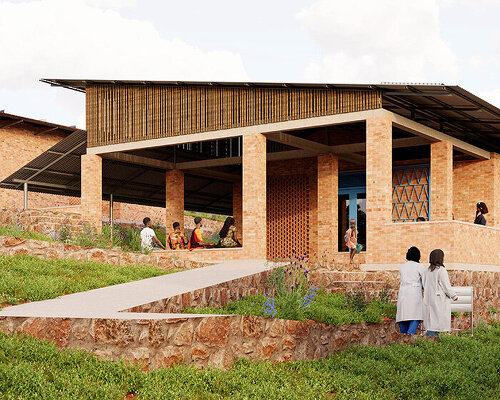
All structures of the Ineza Clinic are oriented according to prevailing winds to maximize cross-ventilation and minimize reliance on mechanical systems. The birthing and outpatient units share a typology with irregular perimeters that generate shaded waiting zones, integrating built-in seating along their edges. Above, a ventilated roof system, refined through earlier projects by the studio, protects against heavy seasonal rainfall while promoting airflow. In contrast, the surgical ward introduces vertical chimneys for stack ventilation, paired with individual windows for each patient bay, ensuring daylight, views, and a sense of dignity during recovery.
Kéré Architecture’s Ineza Clinic is constructed using locally sourced materials and adapted building techniques developed by the practice. Perforated walls and screens are made from locally fabricated clay bricks, while ramps and retaining structures use stone from nearby quarries. Alongside construction, the team actively trains local workers, sharing expertise and strengthening regional capacity. This approach reduces the project’s carbon footprint while supporting the local economy and embedding knowledge within the community.
outpatient unit
outpatient unit and pharmacy
birthing unit
surgical ward
foundations of one of the Ineza Clinic buildings built with local stone © Epitace Niyubahwe
development of facade mockup, January 2026 © Kéré Architecture
facade mockup, January 2026
aerial view of the Ineza Clinic site, March 2026 © Epitace Niyubahwe
project info:
name: Ineza Clinic
architect: Francis Kéré, Kéré Architecture | @kerearchitecture
location: Bubanza, Burundi
area: 3,000 sqm
design team: Giovanni Bortolotti, Maria Paula Rodriguez Sarmiento
contributors: Pierre Jules Gagniére, Ben Nepomuk Klages, Sophie Schräder, Pablo Sanchez Sanus, Jonathan Wiedemann, Valeria Torrens Zapata, LeonneZoe Vögelin
engineering: EVAN Company, Bujumbura, Burundi
general contractor: Robuco Group, Bujumbura, Burundi
client: Ineza Clinic Burundi
The post kéré architecture shapes clinic across hillside in burundi to expand rural healthcare access appeared first on designboom | architecture & design magazine.