
testing space through presence
The work of South Korean artist Kimsooja alters our perception of the world as it exists, bringing light and even optimism to existing spaces rather than imagining new ones.
Over the past three decades, the artist has developed a body of work that moves between performance and site-specific installation art. Across these formats, she returns to a consistent approach. She works with existing environments to adjust how they are perceived through stillness and light.
While her site-specific works have occupied contexts from the Venice Biennale to the Bourse de Commerce, they have extended even to subterranean galleries and vast deserts. Her work has shaped a distinct way of thinking about space as something that can be recalibrated rather than redesigned.
Kimsooja, image by Malthe Ivarsson © Cisternerne | header: Forest Festival of the Arts Okayama, Japan, 2025
a body that shifts the city
A clear starting point is A Needle Woman, a long-running series which Kimsooja initiated in the late 1990s. In cities including Tokyo, Mexico City, Delhi, and Shanghai, the artist stands motionless with her back to the camera as pedestrians move around her. Even though the gesture is minimal, it changes how the space reads. The density of the street becomes more apparent, and patterns of movement come into focus against a fixed body.
She describes herself as a needle threading through fabric, with the city understood as a field of movement. The metaphor stays grounded in physical experience. Standing still in a crowded street is a tangible act that alters perception for both the viewer and those passing by. This work tests how public space can be re-experienced without redesign. It proposes that a shift in behavior, even a small one, can recalibrate how a city is understood.
Kimsooja, A Needle Woman, Delhi, Tokyo, Mexico City, Shanghai, 1999-2001
bringing optimism through light
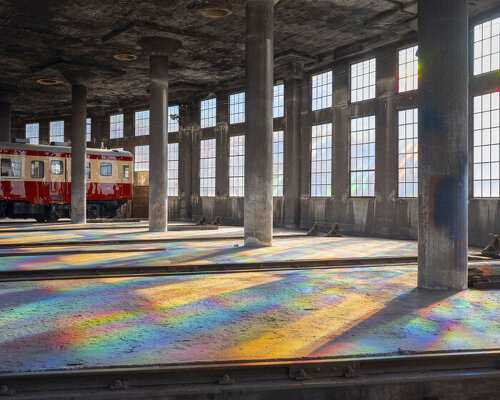
Kimsooja extends this approach into architectural space with projects such as her series, To Breathe, where she uses diffraction film and natural light to transform interiors. Windows and surfaces are covered with translucent material that refracts light into shifting color. As visitors move through the space, the environment changes subtly, with variations in intensity and hue throughout the day.
The intervention is precise and restrained, as the atmosphere of the unchanged building comes alive. There is no central object to focus on, only a field of light that responds to movement and time. The subtle work reframes architecture as something that can be adjusted through perception rather than construction. Within a discussion of utopia, it suggests that environments can be recalibrated to support awareness and shared experience through minimal means.
Kimsooja, ‘To Breathe,’ Galeries Lafayette Paris Haussmann, 2022, courtesy Kimsooja Studio (see here)
working within existing structures
This method becomes more pronounced in Weaving the Light at Cisternerne in Copenhagen, a former underground reservoir defined by darkness, water, and a grid of concrete columns. Kimsooja introduces transparent panels coated with diffraction film, allowing light to enter and disperse across the surfaces. Reflections shift across the water and walls, and visitors moving through the space become part of the changing field of light.
The structure of the reservoir remains untouched. What changes is how it is perceived and inhabited. The work heightens awareness of sound, humidity, and movement, drawing attention to the conditions already present. It operates as a clear spatial test. It demonstrates again how a fixed environment can be transformed through a minimal system that engages light and time.
Kimsooja, Weaving the Light at Cisternerne, Copenhagen, image © Torben Eskerod
extending into the landscape
In To Breathe — Coachella Valley, created for Desert X 2025, Kimsooja applies the same approach at the scale of the landscape. A spiraling glass structure wrapped in diffraction film sits within the open desert, exposed to sunlight and shifting atmospheric conditions. As light passes through the surface, it refracts into color, tinting the surrounding terrain and altering how the horizon is perceived.
Here, there is no attempt to reshape the desert, nor introduce an invasive construction. Instead, the work shapes a lightweight system that responds to the movement of the sun and the position of the viewer. The experience of the landscape shifts throughout the day, with color and reflection appearing and dissolving in real time. This extends her method beyond the room, to show that the same principles can operate at the scale of territory.
Desert X 2025 installation view of Kimsooja, To Breathe – Coachella Valley, image © Lance Gerber
a method that moves across contexts
Across these projects, Kimsooja maintains a consistent approach while working in very different conditions. Urban streets, interior rooms, underground reservoirs, and open desert landscapes are all treated as sites for adjustment rather than replacement. The method remains stable, while each context introduces new variables.
This continuity is central to how her work aligns with utopia as a method. Instead of proposing a singular ideal environment, she develops a way of working that can be applied across locations. Each project builds on the previous one, extending the range of what can be tested. Change emerges through repetition, variation, and attention to existing conditions.
Kimsooja, To Breathe — Constellation, 2024, image courtesy Pinault Collection
The post kimsooja brings optimism through light, shifting our perception of spaces we already inhabit appeared first on designboom | architecture & design magazine.