
A historic pharmacy reactivated in romania
Laboratorium is a café by EktraArhitectura and Fain Design located in Cluj-Napoca, Romania, set within the ground floor of the Széki Palace, a Gothic Revival landmark dating to the late nineteenth century. Occupying the former Matia Corvin Pharmacy, the project is an example of adaptive reuse where contemporary café culture is accommodated in an interior shaped by centuries of craft.
Cluj-Napoca, Romania’s second-largest city, provides a fitting context for the project, and the building has a prominent presence in the historic center. Laboratorium operates within this continuity, treating the site as an evolving interior rather than a preserved artifact, and allowing daily use to reactivate architectural memory.
images © Stefi Hopirtean
laboratorium: celebrating the history of Cluj-Napoca
Long before it was repurposed for Laboratorium, the Széki Palace was built in Cluj-Napoca, Romania as a pharmacy in 1893 by Hungarian architect Pecz Samu. The pharmacy occupied the ground floor, with production spaces and laboratories located below, while residential apartments filled the upper levels. Over time, the space retained an impressive portion of its original interior details, even as functions and ownership evolved across the twentieth century.
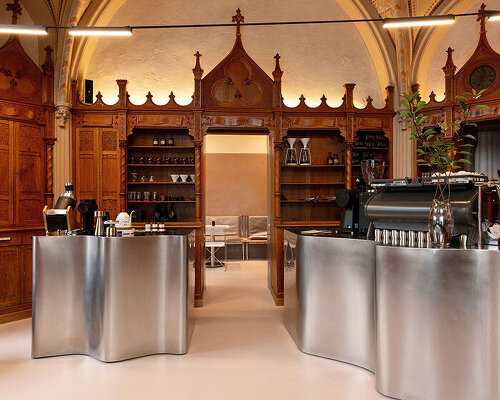
Vaulted ceilings, pointed arches, and richly carved Neo-Gothic wooden cabinets define the character of the former apothecary. These cabinets, produced by cabinetmaker B. Bak Lajos, line the walls with a rhythmic density that gives the room both weight and order. EktraArhitectura and Fain Design approached these elements as the primary spatial framework, restoring them in collaboration with heritage specialists and allowing their presence to guide every subsequent design decision.
Laboratorium occupies a restored Neo-Gothic pharmacy inside Cluj-Napoca’s Széki Palace
contemporary interventions for layered interiors
New interventions are restrained and precisely positioned. Lighting is integrated with discretion, emphasizing depth and surface without drawing attention away from the historic envelope. The design avoids pastiche, relying instead on a contemporary language that acknowledges the building’s original function as a place of preparation, measurement, and experimentation.
Two sculptural, stainless steel coffee counters are the main contemporary gestures within the main room. Their softly undulating profiles reflect light across the space and register the movement of patrons and staff. These counters bring a calibrated contrast against the carved timber cabinetry and the disciplined geometry of the vaults.
A window bench finished in red lacquer runs along the facade, paired with small matching tables. This insertion adds warmth and informality, offering a place to pause within the otherwise ordered interior. The choice of color and finish signals a present-day sensibility, while its scale respects the proportions of the historic room.
the café is designed by EktraArhitectura and Fain Design as an adaptive reuse project
the historic interior retains vaulted ceilings, pointed arches, and carved wooden cabinets
a red lacquered window bench occupies an ornamental niche
two stainless steel coffee counters introduce reflective sculptural forms
heritage woodwork by cabinetmaker B Bak Lajos shapes the space
the building was completed as a pharmacy in 1893 by architect Pecz Samu
project info:
name: Laboratorium | @laboratorium.coffee
architect: EktraArhitectura | @ektraarhitectura, Fain Design | @faindsgn @deea.balgaradean
location: Cluj-Napoca, Romania
photography: © Stefi Hopirtean | @stefiligia
The post laboratorium café opens within revived neo-gothic apothecary in romania appeared first on designboom | architecture & design magazine.