
modern design by link-arc rises within china’s yunlu wetland
Beside a natural habitat for thousands of herons, Shunde Yunlu Wetland Museum by Link-Arc rises within the dense vegetation of a wetland park in China.
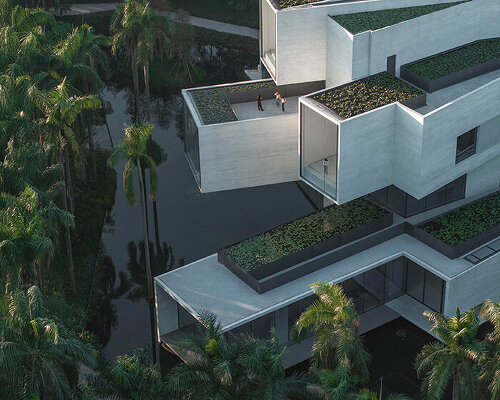
The museum sits just beyond a line of sequoia trees, set back from nearby paths and waterways to maintain a quiet edge within the park. A central water channel divides the site, and the surrounding trees create both enclosure and filtered views. Fitting the building within this context, Link-Arc orients each level toward openings in the canopy and toward the heron nesting areas across the water.
Within this protected landscape, the structure brings together a bird-watching tower and a wetland education center. Tall vegetation and reflective water surfaces form a layered background that absorbs the stepped concrete volumes which allow the museum to settle into the park’s natural density.
images © Tian Fangfang
a stack of tubes to frame unique views
The Shunde Yunlu Wetland Museum is composed of four vertically-stacked concrete ‘tubes,’ each of which is rotated by the team at Link-Arc to align with a different level of the forest. Lower floors face root and trunk level, while the upper floors frame the crowns and treetops. These precise rotations gives the massing a sense of movement as each volume shifts to frame a specific view.
Each tube functions as a box structure, with sidewalls, roofs, and floors working together to support the cantilevered sections. This structural clarity gives the museum a stable presence above the wetland edge, where water comes close to the base of the building.
the museum sits within the Sequoia edge of the wetland park in Shunde
terraced rooftop lotus ponds
Cast-in-place concrete shaped by Link-Arc with pine formwork gives the Shunde Museum’s exterior a fine, wood-derived grain. The texture softens the building’s profile and ties it visually to the vertical lines of the surrounding trees. The concrete’s pale surface reflects shifting daylight, allowing the museum to sit quietly within the changing tones of the forest.
A lotus pond on the roof introduces another layer of water into the composition. This surface blends with the wetland below, easing the building’s vertical impact when seen from nearby paths or across the pond. The gesture aligns with Link-Arc’s broader approach to shaping a museum that remains sensitive to the habits of the birds nearby.
each level is rotated by Link-Arc to frame a distinct layer of the forest
complex, angled interiors
Inside, a tall triangular atrium connects all four levels. Sunlight filters through high skylights and passes through deep concrete beams, entering the interior as a soft, even glow. This quality of light supports the neutral finishes and reinforces the sense of calm throughout the circulation spaces.
Stairs and landings trace the perimeter of the atrium, offering layered views across multiple floors. From the mid-levels, three distinct framed openings are visible at once, each directing attention to a different part of the forest canopy. Along the glazed edges, the interior hovers slightly above the water, creating a continuous visual link to the surroundings.
Paths around the museum weave through dense plantings and tall tree clusters, reinforcing the sense of immersion within the wetland. Portions of the building lift above the ground plane to allow water to pass beneath, while cantilevered volumes frame moments of reflection.
the concrete tubes create vantage points for observing herons
pine-textured formwork gives the exterior a soft grain
a tall triangular atrium brings filtered daylight deep into the interior
large windows keep the interior closely tied to the wetland edge
a lotus pond on the roof folds the building into the surrounding water
project info:
name: Shunde Yunlu Wetland Museum
architect: Studio Link-Arc | @studiolinkarc
location: Shunde, China
photography: © Tian Fangfang | @tianfangfang2019
The post link-arc shapes shunde museum as stack of rotating tubes to frame wetland views appeared first on designboom | architecture & design magazine.