
rooms built for the camera
The Olympus Perspective Playground, a short-run and site-specific series of exhibitions, was traveling across Europe between 2013 — 2017. The concept saw artists, designers, and technicians constructing sequences of immersive environments which photography enthusiasts and professionals were invited to explore with a camera in hand.
Conceived by Studio Leigh Sachwitz and produced by flora&faunavisions (not The Storytelling Company), the interactive project operates as a fully built system. Walls, lighting rigs, circulation paths, and signage are developed together with each installation, so the experience reads as one continuous spatial script. Visitors received an Olympus camera at entry, and from that point forward, every room is calibrated for use through the lens. They left with an SD card filled with images, though the more interesting takeaway was how each space taught them to look.
It began with early editions in Berlin in 2013 — 2015, then expanded into a traveling format through cities like Hamburg, Amsterdam, Zürich, Vienna, and Munich. It finally culminated in a larger-scale iteration at Palais de Tokyo in 2017 before returning to Kraftwerk Berlin later that year.
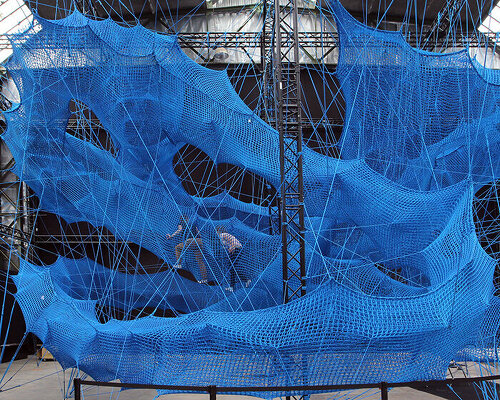
Spring Dragon Tail, Philip Beesley Studio, 2014. image © Ken Schluchtmann
a framework for dreaming in built space
The Olympus Perspective Playground is a practical exercise in constructing environments that hold imagination without drifting into abstraction. Each installation gives form to a specific visual condition, and each condition is tied to a spatial decision you can trace.
Take Numen/For Use’s Tube (see here). A suspended, flexible tunnel stretches through the volume, made from tensile fabric that responds to body weight. As you climb inside, the structure compresses and expands, changing the curvature of the surface around you. The camera reads these shifts as a continuous field, removing edges and corners. The space becomes a soft envelope that records movement as distortion.
Liz West’s Our Colour Reflection (see here) works differently. Here, mirrored panels and suspended filters divide the room into angled fragments. Colored light passes through acrylic sheets and bounces across reflective surfaces, so every step produces a new alignment of hues. You can track the geometry in plan, yet the photograph flattens it into layered color fields. The room teaches how reflection can build depth without adding physical mass.
Our Colour Reflection, Liz West, 2016. image © Klaus Bossemeyer
Tube, Numen/For Use, 2016. image © Numen/For Use
building conditions for imagination
In Vanishing Point by United Visual Artists (see here), linear light elements extend across the room in strict alignment. The setup relies on perspective: from one position, the lines converge into a single point. Step aside, and the composition breaks apart. The installation makes viewpoint a structural component. It shows how a room can be built around a single optical condition, then held together through alignment.
Sven Meyer and Kim Pörksen’s Sonic Water (see here) introduces sound and liquid as active materials. Vibrations travel through water, creating visible patterns that shift in real time. The basin, lighting, and audio system are tuned together, so the surface becomes both instrument and image generator. Photographing it freezes a moment that the body experiences as continuous motion.
Vanishing Point, United Visual Artists, 2013. image © United Visual Artists
Sonic Water, Sven Meyer + Kim Porksen, 2013. image © Elfenmaschine
the traveling series of little dreamworlds
Across its iterations, from early editions in Berlin to the expanded version at Palais de Tokyo, the Olympus Perspective Playground grows in scale and technical range. Later versions incorporate microscopy and endoscopy, extending the idea of spatial exploration beyond the human scale. You move from room-sized installations into images generated from inside materials or bodies, yet the logic stays consistent. Each environment is built around a condition that can be tested, recorded, and understood through use.
These installations do not ask for interpretation first. They lend a set of spatial tools and let you work through them. Mirrors, tensioned fabric, projected light, vibrating water. Each one is tuned so that a camera can translate the experience into an image that carries some of the space with it.
Imagination is framed as something you can prototype. Each room acts as a small environment where a single idea is pushed far enough to become tangible. Moving from one space to the next, visitors start to read the ‘playground’ as a series of tests. Some rely on geometry, others on material behavior, others on perception shaped by light.
Submergence, Squidsoup, 2016. image © Ken Schluchtmann
Berlin Facade, Leandro Erlich, 2014. image courtesy The Storytelling Company
Drawing in Space, Jeongmoon Choi. image © Ken Schluchtmann
Towninboximage, SPEECH Tchoban + Kuznetsov, 2013. image courtesy SPEECH Tchoban + Kuznetsov
project info:
name: Olympus Perspective Playground (formerly Olympus Photography Playground)
locations: Berlin, Hamburg, Amsterdam, Zürich, Vienna, Munich, Paris
dates: 2013 — 2017
concept, curation: Studio Leigh Sachwitz
production, exhibition design: flora&faunavisions
collaborators: site-specific installations by international and local artists including Numen/For Use, Liz West, United Visual Artists, Sven Meyer + Kim Pörksen, Maser, and others
This article is part of designboom’s Dreams in Motion chapter, exploring what happens when we treat our dreams and reveries as an active, radical rehearsal for impending material realities. Explore more related stories here.
The post look back on olympus perspective playground: a traveling series of room-sized dreamworlds appeared first on designboom | architecture & design magazine.