And thoughts about what’s next for design-school graduates
Parsons Communication Design held its Second Annual Offset Art Book Fair, hosted in partnership with Draw Down Books this past fall. The fair is designed to facilitate the exhibition & vending of posters, prints, books, and other ephemera; with the effort of highlighting and supporting small press publishing & zine-making culture.
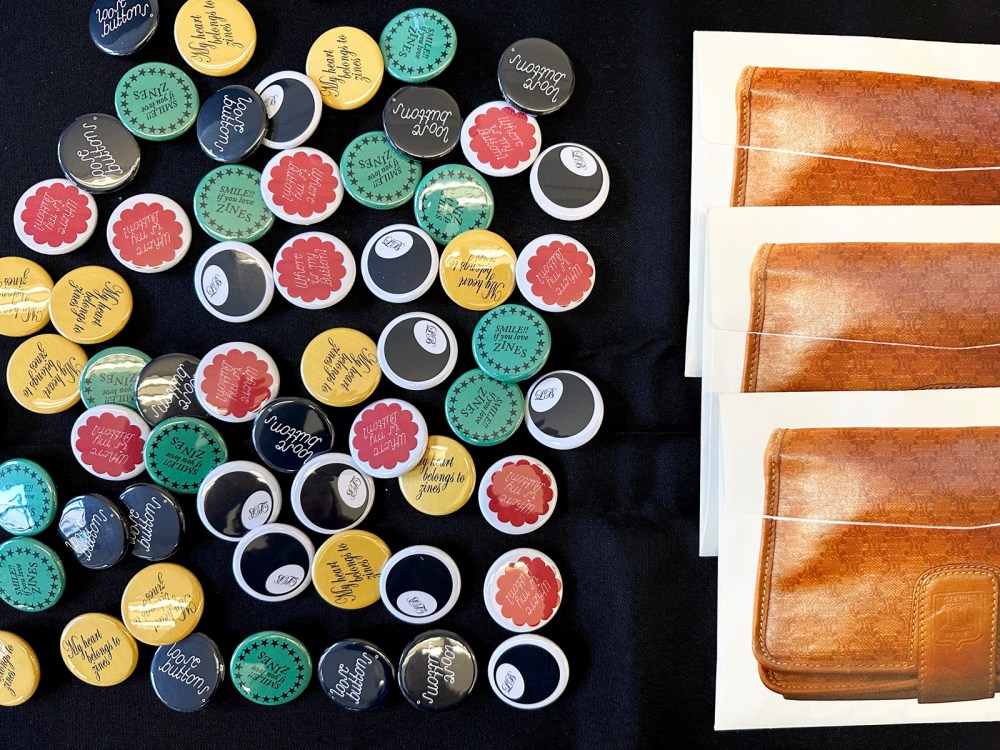
Jen Lieu (left below) and Moe Ebii met as roommates during their first year at Parsons and now live in apartments in two different Manhattan neighborhoods. When I visited their display table at Offset, I immediately loved their work, a collection of buttons—the kind used to fasten clothing and the kind with printed messages—and intriguing pieces printed on paper.
Jen (left) is from Hanoi, Vietnam; Moe from Tokyo, Japan, via Mumbai, India, where her family lived for several years. They are two of the more than 100 students who will graduate this May from Parsons School of Design with BFA degrees in Communication Design.
“I make art for art’s sake,” says Jen. “I enjoy mixed-media work, and through learning about web development I’ve been able to experiment with the ways physical media can interact with the digital world. This has been helpful in creating Loose Buttons, our mostly-print publication that showcases underrepresented, woman-owned, arts- and fashion-based brands and communities in New York City.”
Moe adds, “The name Loose Buttons derives from our packaging: loose papers are mailed in a designed envelope, emulating the looseness of receiving a letter from a friend. The publication is completely self-initiated, and we publish about twice a year.
The first issue, October 2024, featured an interview with Charlotte Van Hardenburgh, an art historian, researcher and curator who teaches typography history at Parsons and has an exhibition space in her apartment. “We were inspired by her commitment to bringing art and design to the local community by creating intimate experiences, compared to those at large institutions,” the designers say.
Grace Gui, a Brooklyn-based knitwear designer inspired by her grandfather’s calligraphy, is the focus of the second edition. Who could pass up opening an envelope graced by this image of a knitted bra?
The third issue is about Dialective, a nonprofit collective that hosts runway shows for new graduates in fashion design.
Bomi, a SoHo boutique that sells an eclectic mix of handmade ceramics, jewelry, clothing, furniture and décor, is the subject of issue 4.
As I spoke with Jen and Moe in person and on Zoom, I couldn’t help but remember being introduced to Aspen, The Magazine in a Box, at a place none other than the Aspen Design Conference in, I think,1970. I remember watching in awe as one of the conference luminaries (could it have been Buckminster Fuller himself?) opened a box and removed, one by one, booklets, folded posters, and maybe a phonograph record or a film reel. Each issue of Aspen, founded by Phyllis Johnson, an editor of Women’s Wear Daily and Ad Age, had a different theme: Pop Art, psychedelics, Asian philosophies, British Art and Culture (which included a contribution by John and Yoko). And each issue had a different designer, including Andy Warhol and Quentin Fiori.
And now we have Jen Liu and Moe Ebii.
Like the Aspen boxes, each Loose Buttons outer envelope starts to tell the story of what’s inside, but it’s not in-your-face like Pop Art or psychedelics, it’s a gentle visual exploration, often in soft earth tones, of what Jen and Moe call “slow and meaningful making.” After opening the envelope, readers pull out a card that introduces them to the subject, a transcript of the designers’ interview with the subject, bookmarks that highlight the subject’s business, and photos that capture New York street style. Then there are stickers and buttons, some with the Loose Buttons logo and some inspired by a clothing tag or other artifact from the subject or her business.
Besides distributing Loose Buttons at community events like the Offset exhibition, the designers have enviable internships. Moe interns at the Metropolitan Museum’s Costume Institute and Jen at Human, a digital studio that characterizes itself as “really good at building early-stage companies and accelerating later-stage brands.”
Currently, they’re super-busy with thesis projects. Moe’s is a series of books, titled 2026, 2091, 4043 and No Date, that contain instructions for readers on “how to leave traces of their world to be decoded in future years.” The dates have meaning, she explains. “The first book is dated 2026, now. The second is 2091, the year I’m statistically expected to die, based on my birth year and the average life expectancy of a Japanese woman. The third is 4043” — follow her carefully here—“because the Rosetta Stone was made in 196 BCE and decoded in 1822, a gap of 2,017 years. So I added 2,017 to our current year.” No Date leaves the future open-ended. “Each book uses a different visual language,” Moe continues. “The first book is in English. “The second is in Arabic, Chinese and Japanese. The third is all photography and archival imagery. The fourth is my own freehand illustrations. And each book is twice the size of the previous one, a physical record of how much harder it gets to hold a message together across time.”
Jen’s thesis, “What Gets Archived, and Who Decides?” is also a series of books, an archive and celebration of small projects that are not usually thought of as art—from YouTube videos to old Pinterest Boards—made by independent creators who had no intention of being seen by the entire public or being archived.
This dedication to slow, meaningful (and sometimes uncelebrated) designing and making of printed books emanates from two young designers who came of age in when many traditional art and design tools were already a thing of the past. At age nine they started “searching out cool fonts” on their iPads. They got their first laptops in fifth grade. High school was during Covid, when all classes were online and, as Moe explains, “there was no opportunity to work on anything physical because digital forms were the only ones available.” Yet neither of them got hooked on digital, and it’s great to see that in this motion-driven world, some young designers remain committed to ink on paper.
There was no opportunity to work on anything physical because digital forms were the only ones available.
Moe Ebii
Come graduation on May 18, they are both hoping for full-time positions. Yet even for two as talented and hardworking these, with several A-list internships under each of their belts, the job-seeking process can be difficult and frustrating, and always with the awareness that their parents have been paying about $90,000 a year for Parsons’ tuition and living expenses.
“The rate in which I’ve actually received a response, even a rejection message, has been very low,” Moe admits. “In the summer I reached out to around 40 New York studios whose work I really liked through online applications and cold emails and heard back from five to seven of them.” Moe includes a few commercial projects in her portfolio because she wants to show that she can be flexible and work in different design genres. “I’m sure my parents want me to settle into something as soon as possible, but they understand that openings in design don’t come up all the time,” she says.
Jen is equally philosophical: “Things are constantly changing, and I prefer to approach art in a present way, focusing on what feels authentic at the moment. I hope to bring this energy into my future practice—but now I can’t articulate what it will look like. I’m unsure about what I’ll be doing, so it helps to focus on the present, and working at Human NYC feels right. Once I graduate, I hope to continue working at design studios, whether at Human or elsewhere. My parents also understand that things take time to come to fruition, having gone through the journey themselves when they were in their early 20s, for which I am grateful.”
Things are constantly changing, and I prefer to approach art in a present way, focusing on what feels authentic at the moment.
Jen Liu
I, personally, am awaiting, post May 15, the ability to see what’s under wraps now: Moe’s “physical record of how much harder it gets to hold a message together across time.” But thinking across time myself, it’s mind-boggling trying to imagine 100 Parsons’ BFA graduates as well as the hundreds of graduates from Pratt, the Cooper Union, the School of Visual Arts, and the many, many other art schools and university design departments around the country and the world descending on New York City as job seekers. Not unlike remembering the unveiling of Aspen magazine more than 50 years ago, I think back to the days when job-seeking meant a telephone call, dropping off a portfolio—the kind that usually came in a black leatherette, zippered case— and calling for an appointment.
Not to worry, Jen advises. “I’m confident in myself,” she asserts, “and know that I’ve always been able to make things happen, even if at times it feels like I’m stagnant. Through the process of looking for internships while in school and learning how to balance school and jobs, I’ve learned to trust myself and be less scared about the future. There is always anxiety around it, but it’s nice to be able to look back and see that I’ve always been able to make something happen. And I’ve found the people around me to be so helpful, from teachers to designers to classmates, and it’s nice knowing that the design community, although it can be competitive, is always open to help you.”
Also,” she adds, “we plan to keep Loose Buttons continuing for as long as we can post-graduation. We don’t currently have subscriptions, but we have an order form on our website: https://fromloosebuttons.com/order.
The post Loose Buttons, A Magazine In An Envelope appeared first on PRINT Magazine.