
When I see a gum wrapper I immediately say in my head, Who is that going to become?
Lyndon J. Barrois
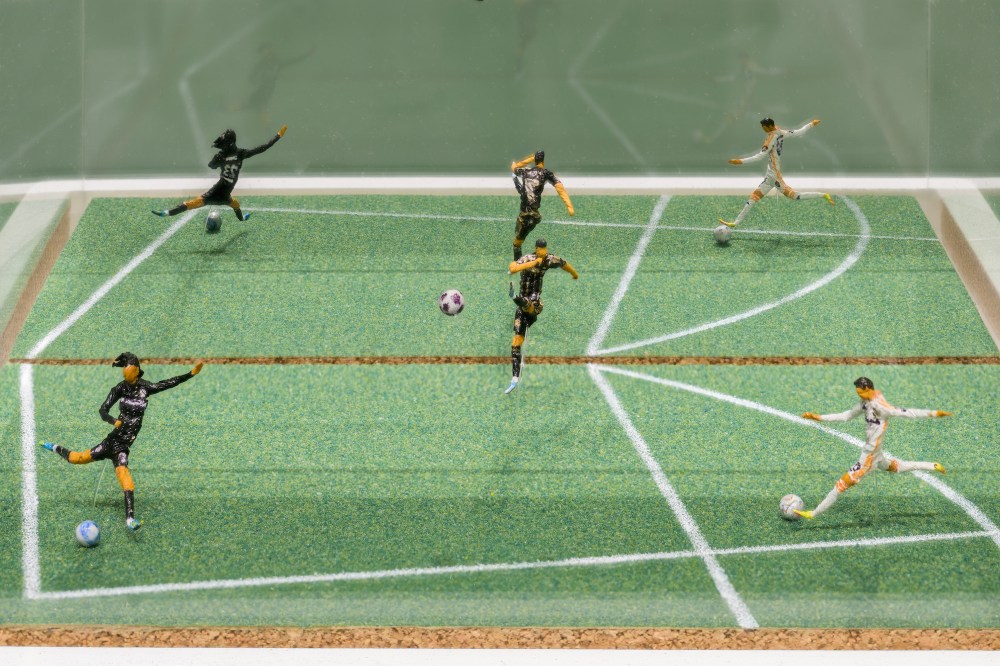
When Lyndon J. Barrois Sr. first started making miniature figures out of gum wrappers as a kid in New Orleans, he never expected where the hobby would take him. Decades later, he now has his first ever solo show on view at the LACMA featuring the gum wrapper miniatures he’s been making ever since. “Fútbol Is Life: Animated Sportraits by Lyndon J. Barrois, Sr.” is a retrospective of Barrois’s gum wrapper sculpting practice while simultaneously celebrating the upcoming 2026 World Cup that will be hosted, in-part, right here in Los Angeles. But Barrois’s journey to this moment has been anything but direct.
Installation photo, Fútbol Is Life: Animated Sportraits by Lyndon J. Barrois, Sr., at the
Los Angeles County Museum of Art, Feb 15–Jul 12, 2026, © Lyndon J. Barrois, Sr.,
photo © Museum Associates/LACMA, by Jonathan Urban
Much like the careers of the professional athletes he creates in one-inch form, Barrois has worked tirelessly on his craft for years without getting the sort of recognition he’s now receiving. But he’s here now, a testament to a genuine love of hand craft and creating something out of nothing. I chatted with Barrois before going to the opening of the show myself to learn more about the winding path he’s taken to this moment and the show itself. Our conversation is below edited lightly for clarity and length.
Installation photo, Fútbol Is Life: Animated Sportraits by Lyndon J. Barrois, Sr., at the Los Angeles County Museum of Art, Feb 15–Jul 12, 2026, © Lyndon J. Barrois, Sr., photo © Museum Associates/LACMA, by Jonathan Urban
So, gum wrappers! Tell me how you first turned to gum wrappers as the central medium for your work? What is it specifically about that material that allows you to work with it in the way that you do?
When we’re kids, all of us draw and paint. For me, I was always curious about not just drawing, but making things. So whatever I got my hands on, whether it was modeling clay, Play Doh, aluminum foil, foam, wire, gum from church pews, all that shit, I would just make stuff out of it. And my mom chewed tons of Wrigley’s gum.
When she discarded the wrappers I realized two things: The first was that there was foil on one side and paper on the other. The second thing was that they’re melded together. Then I was like, if I actually sculpt this with the paper side out, I can color it. And the light bulb went off. Because I had all of these Hot Wheels cars, they were so cool—the doors open, the hood opens, the trunk opens—but nobody drives them. So my 10-year-old brain was like, “This is the dumbest shit ever! Nobody’s driving the cars, they need drivers!” So I actually started to make little people to put in Hot Wheels cars. The scale was right because the wrappers are small and when you make a person out of them they’re only like an inch to an inch and a quarter tall, so they could just sit right in the car! And with the foil I could pose them, and to me they actually moved better than actual action figures and dolls; there were no limitations to their movements, I could pose them however and then repose them because the foil didn’t break down.
Those drivers turned into boxers because there was all this Rocky shit at the time and I was always a big fan of Wide World of Sports. Then those boxers turned into whole teams. I’ve been making them that long, I just never stopped. Even through grammar school, through junior high, through high school, and well into college, I was always making these things, but with a focus on being a graphic designer. So at Xavier under John Scott, who was my mentor, I learned everything—drawing, painting, sculpture, ceramics, print-making, the whole shebang—and I didn’t realize how much of all of those things I was learning from John I was subconsciously putting into these figures.
My senior year when I was trying to figure out what I wanted to do for my senior show, I had this idea to show my gum wrapper figures to John. In my head I was making toys, but he’s like, “Dude, I don’t think you know what you’re sitting on, this is art, this is miniature sculpture.” And then it hit me! Holy shit! How blind have I been to it?
Installation photo, Fútbol Is Life: Animated Sportraits by Lyndon J. Barrois, Sr., at the
Los Angeles County Museum of Art, Feb 15–Jul 12, 2026, © Lyndon J. Barrois, Sr.,
photo © Museum Associates/LACMA, by Jonathan Urban
How did you get into the animation side of your practice?
I wanted to learn stop motion animation so that I could do it with my miniatures. I’d been making them since I was a kid, and since I’d always been interested in the film world and wanted to get into that part of the arts, stop motion with my miniatures seemed like the perfect way to do it. So I went to grad school at CalArts to learn experimental animation through their film school.
So I go to CalArts and I start It’s a Wrapper Films and do a lot of commercial work and interstitials and short films. I did three films at CalArts, a baseball film, a football film (which is in Fútbol is Life) and my horse racing film which was my thesis (and is also part of Fútbol is Life).
But when everyone in the film industry wanted to explore CGI and computer graphics, I realized I had to learn how to use software. So I applied to studios that were teaching animators how to use the software to be more productive and competitive and efficient, and that’s how I got into the visual effects world and became a character animator, then moved up from there as an animation director and supervisor.
Installation photo, Fútbol Is Life: Animated Sportraits by Lyndon J. Barrois, Sr., at the
Los Angeles County Museum of Art, Feb 15–Jul 12, 2026, © Lyndon J. Barrois, Sr.,
photo © Museum Associates/LACMA, by Jonathan Urban
Did you have to put your gum wrapper sculpture and animation practice on hold as your career took you down the digital path? Or did you maintain that on the side?
I never stopped making them. It was a big detour that I had taken to concentrate on all the film work, so even though I was still making them, I didn’t give it the focus that it’s getting now. What got me back into it was, I think it was 2011, I was working in Vancouver, and the iPhone 4s was the first one that you could actually shoot video in HD. So I started to do stop motion on my iPhone. I’d go to work, supervise on all my feature stuff, working with all my animators, and then in the evening, I’d go back to my apartment and take any figures that I had with me or new ones that I made, and I would just make stop motion clips; just clip after clip after clip.
It was so much fun to me to be able to work in a digital realm all day with my visual effects work, but then to be able to go home in the evening and do my analog and tactical work that I love, but doing it with a digital device where I could see it immediately. Since that 4s I’ve been shooting on iPhones ever since.
Installation photo, Fútbol Is Life: Animated Sportraits by Lyndon J. Barrois, Sr., at the Los Angeles County Museum of Art, Feb 15–Jul 12, 2026, © Lyndon J. Barrois, Sr., photo © Museum Associates/LACMA, by Jonathan Urban
At what point did you realize your gum wrapper creations were something special and perhaps might even lead to a solo show at LACMA?
One time my son said to me, “You know, Dad, it’s cool that you’re doing all these movies and shit, but you’re the only one on the planet that’s doing what you’re doing with gum wrappers. You should do more of your own work.” And since he said that, this is probably the eighth museum show I’ve been in, and it’s my first museum solo, which is really special.
My wife is a TV writer so both of our careers are in the arts, and we’ve been collecting art for 25 years. Most people know us as writing television, working on films, and collecting art, but no one really looked at me as a visual artist; there’s the film world, the TV world, but then there’s the art world. Things changed when I started to post my gum wrapper work on Instagram.
Franklin Sirmans [director of the Pérez Art Museum in Miami, formerly the department head and curator of contemporary art at LACMA] had a World Cup show at LACMA in 2014 and I was really trying to get into that show. I tried explaining to him that this is what I’ve been doing all of these years, and it just never clicked to him until I started posting it. Then he went, “Holy shit, man, I never knew you did this. Would you do soccer? Would you do a piece for the show?” And I’m like, “Dude, ding, ding, ding! That’s what I’ve been telling you!” And since I did that piece for that show, everybody knows now. Two years after that I had some more work in a MASS MoCA show in a collaboration I did with Glenn Kaino; I did a lot of miniatures on protest history.
Michael Govan (LACMA CEO) saw that work, and came to my house one day and saw that original piece in my studio. He said, “Shit, man, why don’t we own that piece at the LACMA?” And I said, “Well, you tell me why you don’t own that piece at the LACMA! If you want it, there it is! Just buy it!” And so, he did! So all this time they’ve had it, and now that the World Cup and the Olympic Games are coming back to LA, they wanted to show the piece and have me do work around it.
You know, it’s all timing. These things just happen. You just do the work and enjoy the journey.
Can you elaborate a bit on what you built for Fútbol is Life?
It was fun, it was a hell of a lot of work putting it all together. I did 220 new individual sculptures, and that includes the two giant, life-size ones that I’ve never done before. Marta was the first life-size figure I did, and then Messi is the other one, they’re suspended in the museum.
I’ve done 40 new dioramas to create a timeline from 1930 up to 2023. And I always highlight the women’s game too. Too many times I’ve seen soccer exhibitions where they don’t represent the women at all, and it’s just like, wow, this is just so bizarre to me, because they win everything. They’re so talented. How can we not showcase them in the realm of the World Cup? It’s not even me just trying to be PC, I’m just going, this makes no sense! Who doesn’t remember the image of Brandi Chastain ripping off her shirt and shaking it in her sports bra after they won in 1999? I was so moved by it I even animated it!
Installation photo, Fútbol Is Life: Animated Sportraits by Lyndon J. Barrois, Sr., at the Los Angeles County Museum of Art, Feb 15–Jul 12, 2026, © Lyndon J. Barrois, Sr., photo © Museum Associates/LACMA, by Jonathan Urban
How did you go about making the life-size figures? Are those also made from gum wrappers?
Yes, I found a company that literally made me giant wrappers. So they’re the same scale as gum wrappers, one and a half by three inches, scaled up 62 times, so that’s nine-by-18-feet gum wrappers. Then I just twisted them into life-size figures, posed them, and painted them.
Installation photo, Fútbol Is Life: Animated Sportraits by Lyndon J. Barrois, Sr., at the Los Angeles County Museum of Art, Feb 15–Jul 12, 2026, © Lyndon J. Barrois, Sr., photo © Museum Associates/LACMA, by Jonathan Urban
Let’s be honest: I’m making stuff out of trash.
Considering the winding and lengthy journey you’ve been on with your gum wrapper miniatures, could you ever have imagined it would have culminated in a solo show at LACMA?
Not in my wildest dreams! Let’s be honest: I’m making this stuff out of trash. As artists, we make things out of whatever drives us, who know where inspiration comes from. People say, “Why do you work so small?” And I say, “Because that’s what I started with and that’s what I’m comfortable with.” I’m not limited by the amount, I can make the world I want to create. I can make the game or sport I want to create, whatever. When I see a gum wrapper I immediately say in my head, Who is that going to become? I’ve got thousands of them and I just wonder who are all of these going to become before I’m not on this earth anymore?
The post Lyndon J. Barrois Sr. Depicts the History of the World Cup Through Gum Wrappers at LACMA appeared first on PRINT Magazine.