
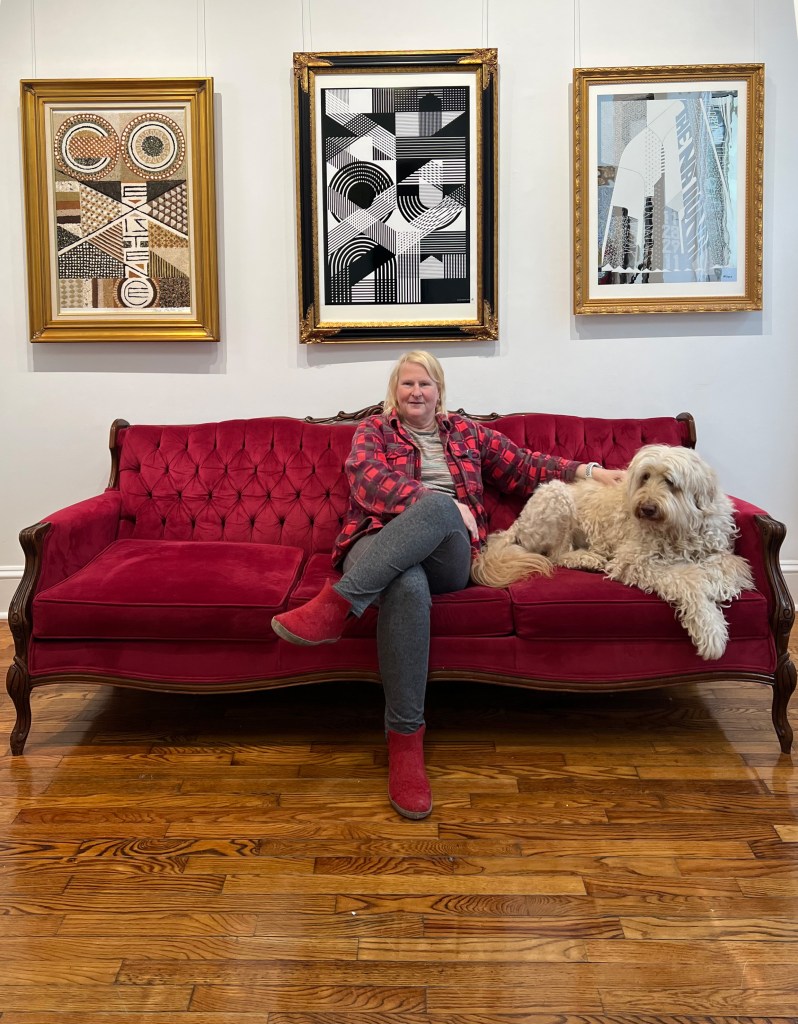
Nestled on the South Shore of Nova Scotia, Canada, the town of Lunenburg is known for its technicolor waterfront, shipbuilding history, and paintings of a particularly famous racing schooner. Unexpectedly, it is now also home to a new kind of cultural institution: Design Art Gallery.
For more than two decades, Marian Bantjes has occupied a singular place in contemporary graphic culture. Revered for her intricate ornamentation, luminous patterning, and typographic experimentation, Bantjes’ work has appeared in over 100 international publications and is held in major museums around the world. This year, the Canadian artist, designer, and writer added a new and unexpected chapter to her career: the launch of Design Art Gallery, a fine art and design space in Lunenburg.
The gallery is a striking proposition, both geographically and conceptually. Lunenburg is a UNESCO World Heritage Site known for its brightly painted buildings, maritime history, and steady stream of tourists seeking Bluenose II memorabilia. Its galleries tend to feature ship paintings, coastal landscapes, and local artists. Into this context, Bantjes has inserted a venue dedicated to the intersection of design and fine art, featuring her own work alongside exhibitions by international designers such as Erich Brechbühl, Niklaus Troxler, Annette Lenz, and Mirko Ilic’s travelling Tolerance Project.
It is, in her own words, “a big-city idea” placed deliberately, and somewhat defiantly, inside a small coastal town. But for Bantjes, who recently relocated to the East Coast of Canada from the West, the decision was personal and philosophical: an embrace of rural life paired with a conviction that design ought to be seen, valued, and collected as art.
In our wide-ranging conversation, Bantjes speaks candidly about the tensions between art and design, the cultural dynamics of Canadian vs. American creative identity, the pleasure she’s found in curating, and the strange, exhilarating experience of introducing global design culture to a town built on lobster traps and fishing boats.
Our conversation is lightly edited for clarity and length, while preserving Bantjes’ wit, honesty, and unmistakable voice.
I asked Bantjes about her choice of a historic, visually coded place like Lunenburg. A small, UNESCO-recognized fishing town doesn’t seem like the most obvious place to open a gallery that centers on globally networked, concept-driven design work. She laughs.
“The answer is pretty simple: it sits there with difficulty,” she says. “It’s a big-city idea to have a gallery that focuses on design, and I’ve been surprised that nothing like this seems to exist anywhere — a commercial gallery that represents designers as artists.”
The gallery is in Lunenburg for one primary reason: she is.
“I didn’t want to move to Halifax,” she explains. “I wanted Nova Scotia, but I’ve become used to rural living after years on Bowen Island. Lunenburg has presence. It’s beautiful, and I am, much to my PR people’s delight, a UNESCO World Heritage Site resident now. It gets a lot of visitors.” But she is keenly aware of where she has landed.
“I’ve arrived in the land of lobster paintings and ship paintings,” she says. “Most galleries represent local artists painting local things. Some people are thrilled to have something new and completely different. Others are bewildered.”
This, in many ways, is the point.
“I wanted people to see work they’ve never seen before. Graphic designers know what’s happening globally; most people don’t.” And yet, Bantjes is not rigid. With a grin, she tells me she has plans for “an All Lobsters, All the Time” exhibition this July. “I’ve met some really good local artists — surprisingly, some former graphic designers — and I’m pulling them into that show.”
The gallery also serves a deeply personal function.
“I wanted a place for my own work,” she says. “When I opened in May, I started with lettering, which is an introduction to my past, then showed my sticker collages, which have shifted from commercial work into artwork. Then, my AI digital vase collages, which are ongoing. And then my patterning work, which bridges my design history and my present as a so-called artist.”
The move east was as pragmatic as it was emotional. “It was just money,” she says bluntly, referencing the high cost of living on the West Coast. “I genuinely prefer it here; the Maritimes are incredibly beautiful.”
For years, Bantjes’ work has existed between design and fine art. The gallery brings that liminal identity into physical form.
It’s a provocation — to the art world and to the design world.”
Much of Bantjes’ career has been at the margins of categorization, neither fully commercial design nor conventionally fine art, yet the gallery formalizes this ‘in-between’ space. I asked how she viewed the opening of the Design Art Gallery. Does she see it as the culmination of her career, or an argument about how design histories might be written differently if we took hybrid practices more seriously?
“It’s definitely a provocation,” she says. “More toward the art world, even though nobody in the art world knows or cares about me. There’s a prejudice against designers — people hear the word ‘design’ and turn up their nose.”
But it’s a provocation to designers, too. “I’ve always maintained that design can be art, and often should be art,” she says. “Many designers disagree. But when I look at the work from AGI members, in Europe, the U.S., and Asia, it’s art. Full stop. Even if it served a design purpose, I’d hang it on my wall.”
She talks about the recent show of posters by Swiss designer Erich Brechbühl. “That work is stunning. It belongs on walls, in homes, in museums. It shouldn’t be treated as ephemera.”
Bantjes doesn’t hesitate when I ask her why the divide between art and design persists. “It comes down to clients and authorship,” she says. “Art is seen as ego-driven, personal. Design is seen as collaborative, commercial, made for the masses. Designers think art is indulgent; art people think design lacks authorship because it’s made with a client.” Her own career illustrates the tension.
“Early on, I was a ‘regular graphic designer’ — type, colors, images, all in service to the client. Later, when I began putting myself into the work, that’s when I became known. That’s when some of it became art.” But she also sees the divide as cultural. “In North America, designers resist ego in their work. In Europe, designers are more comfortable with authorship. Their work feels more personal. It’s a different attitude.”
We are both Canadian, and we can’t help talking about cultural identity, particularly Canada’s complicated relationship with self-promotion. “In Canada, overt self-promotion is a put-down,” she says. “You’re expected to be humble. In the U.S., people want confidence. If I’m self-deprecating, Americans don’t like it,” she laughs. “I’m uncomfortable with both. I’m Canadian enough to feel awkward praising my own work, but Canada frustrates me because talent is so undervalued that people leave, and only then Canada claims them as ‘one of ours.’” Despite her self-deprecation, Bantjes is rightly so developing an online store for her work.
The exhibitions Bantjes has planned— from the Tolerance Project to very personal valentines to conceptually playful group shows — suggest a curatorial approach rooted as much in meaning as in aesthetics. Given that design is being increasingly optimized for platforms and AI, I ask her if she thinks galleries like Design Art Gallery have any responsibility to slow down and reframe design as a practice of contemplation, ethics, and cultural dialogue.
“I don’t know if it’s a responsibility,” she says. “But it would sure be nice.”
She admits she worries about the shift to digital consumption. “Nothing compares to seeing work in person. I’ve seen art I’d only known from books, and the real thing is a revelation,” Bantjes says. “It’s the same with design. I won’t judge competitions online anymore, you can’t see the typography, the details, the movement.”
If people only experience design through screens? Bantjes thinks that’s a great loss. But she’s hopeful that real-life encounters can rekindle curiosity. “Maybe people will think, ‘I didn’t know. I’m going to start seeing things in real life again.’”
As she talks through her plans for winter exhibitions, Bantjes reveals a new internal tension. “I’m realizing how much pleasure I get from the curatorial side,” she says. “When my own work is up, I’m embarrassed if people like it and embarrassed if they don’t. But when I put up someone else’s work, I can gush freely. I’m genuinely excited.”
I ask her how she views her role. “Am I an artist or a curator? Can I be both? I don’t know. Maybe,” she says. “But it’s another dichotomy, another push-pull I’m navigating.”
Design Art Gallery is many things at once: a personal archive, a curatorial laboratory, a challenge to art-world biases, a love letter to design as a cultural form, and a bold experiment dropped, quite intentionally, into a small East Coast Canadian town.
It is also, unmistakably, Marian Bantjes: intricate, rigorous, contradictory, generous, unpredictable, and wholly uninterested in fitting neatly into any one category.
And perhaps that is the point. In a world that still separates design from art, Bantjes has built a place where those distinctions disappear so that new ones can form.
The post Marian Bantjes Launches a ‘Big-City Idea in a Lobster Town’ appeared first on PRINT Magazine.