
Michelangelo Pistoletto rethinks coexistence in ‘Three Mirrors’
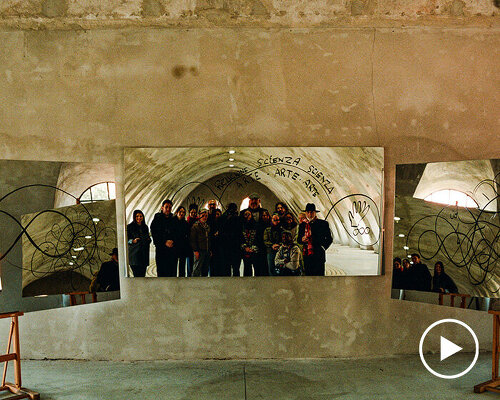
Michelangelo Pistoletto presents Three Mirrors (2026), a moving image commission created in collaboration with public art platform CIRCA and broadcast daily across nine global city screens at 20:26 local time, running through June 30th, 2026. Filmed at Cittadellarte in Biella, the foundation Pistoletto established as a space for rethinking the role of art in society, the work extends one of the artist’s most enduring ideas, presenting the mirror not as image, but as an opening. Here, at the age of 92, Pistoletto returns to the act of drawing directly onto mirrored steel, transforming it into a time-based and performative sequence that unfolds beyond the studio and into the public realm.
Broadcast across multiple cities, Three Mirrors takes place within a network of urban screens spanning London, Milan, Rome, Los Angeles, Seoul, Accra, among others. Rather than a single, fixed audience, the work addresses a shifting public moving through different cities, climates and rhythms. The same image appears against radically different backdrops, from dense nighttime crowds in Seoul to daylight traffic in Los Angeles, reinforcing the idea that the work is not contained within the screen, but shaped by the conditions around it. In this sense, the project resists the idea of the artwork as a stable object, instead operating as a temporal and collective condition that exists across multiple places simultaneously.
First introduced by Pistoletto in 2003, the concept of the Third Paradise returns here with renewed urgency. Conceived as a model for equilibrium between natural and artificial systems, it becomes, in the context of this project, a framework for thinking about coexistence in a time marked by technological acceleration and social fragmentation. In his conversation with Josef O’Connor, founder and artistic director of CIRCA, Pistoletto describes this as a form of ‘preventive peace’, a condition that must be constructed before conflict emerges, rather than negotiated in its aftermath. The work proposes that opposites do not need to cancel one another, but can generate new possibilities through relation, much like the third circle that emerges within the reconfigured infinity symbol.
all images courtesy of CIRCA
a triptych moving from symbol to participation
Structured as a triptych, Third Paradise, Formula of Creation and Statodellarte, Three Mirrors develops through a series of simple gestures that expand into larger conceptual systems. In Third Paradise, the familiar infinity symbol is interrupted, generating a third circle between two opposing forces and proposing a space of balance between nature and the artificial world. This idea evolves in Formula of Creation, where the relationship becomes explicit through the equation 1+1=3, suggesting that the encounter between ‘I’ and ‘You’ produces a collective ‘We’. By the time the work reaches Statodellarte, this logic shifts into the civic sphere, where creativity is no longer framed as an individual act but as a shared social condition, inseparable from responsibility.
Developed through an ongoing dialogue with Josef O’Connor, the project positions itself as a living proposition. The mirror, central to Pistoletto’s practice since the 1960s, operates here as both a visual and ethical device. It does not simply reflect the image, but implicates the viewer. As the Arte Povera visionary tells O’Connor, the viewer becomes part of the artwork and, in that moment, shares responsibility for what it produces. This shift is amplified by CIRCA’s format, which situates the work within highly visible urban screens typically reserved for advertising, transforming them into spaces of reflection rather than consumption.
Three Mirrors (2026) is a moving image commission created in collaboration with CIRCA
a distributed work across screens and cities
Through Three Mirrors, Pistoletto continues to move beyond representation toward what he defines as Statodellarte, or the ‘State of Art’, a condition in which art operates as an organising principle across society, intersecting with politics, education, production and culture. The collaboration with CIRCA reflects this ambition, using the infrastructure of global media networks to work within existing systems and redirect their function. Screens designed to capture attention become platforms for shared reflection, while the act of viewing becomes a form of participation.
Unfolding across different cities, screens, and time zones, Three Mirrors ultimately functions as a distributed work, connecting audiences who may never meet but who momentarily share the same image within their own local contexts. In doing so, it extends beyond a singular installation and becomes a networked proposition that asks not only to be seen, but to be taken up. As Pistoletto suggests, the image is no longer contained within the artwork. It opens itself to reality, inviting the world to enter, and asking in return for attention, responsibility and the collective construction of balance.
the work extends one of the artist’s most enduring ideas
Pistoletto returns to the act of drawing directly onto mirrored steel
a time-based and performative sequence that unfolds beyond the studio and into the public realm
project info:
name: Three Mirrors
artist: Michelangelo Pistoletto | @michelangelo_pistoletto
commissioner: CIRCA | @circa.art
filming location: Cittadellarte | @cittadellarte, Biella, Italy
dates: April 1st – June 30th, 2026
The post michelangelo pistoletto turns global screens into shared space for reflection and coexistence appeared first on designboom | architecture & design magazine.