
12:28 AMHuaqiangbei operates on its own physics. The sprawling electronics market in Shenzhen is the place where flagship smartphones get dismantled, reimagined, and rebuilt into things their original manufacturers never approved and probably never imagined. It runs on American time, buzzes with microscopes and milling machines, and treats the word “warranty” as a polite suggestion. If you want something done to your phone that a brand explicitly decided against, this is where you go.
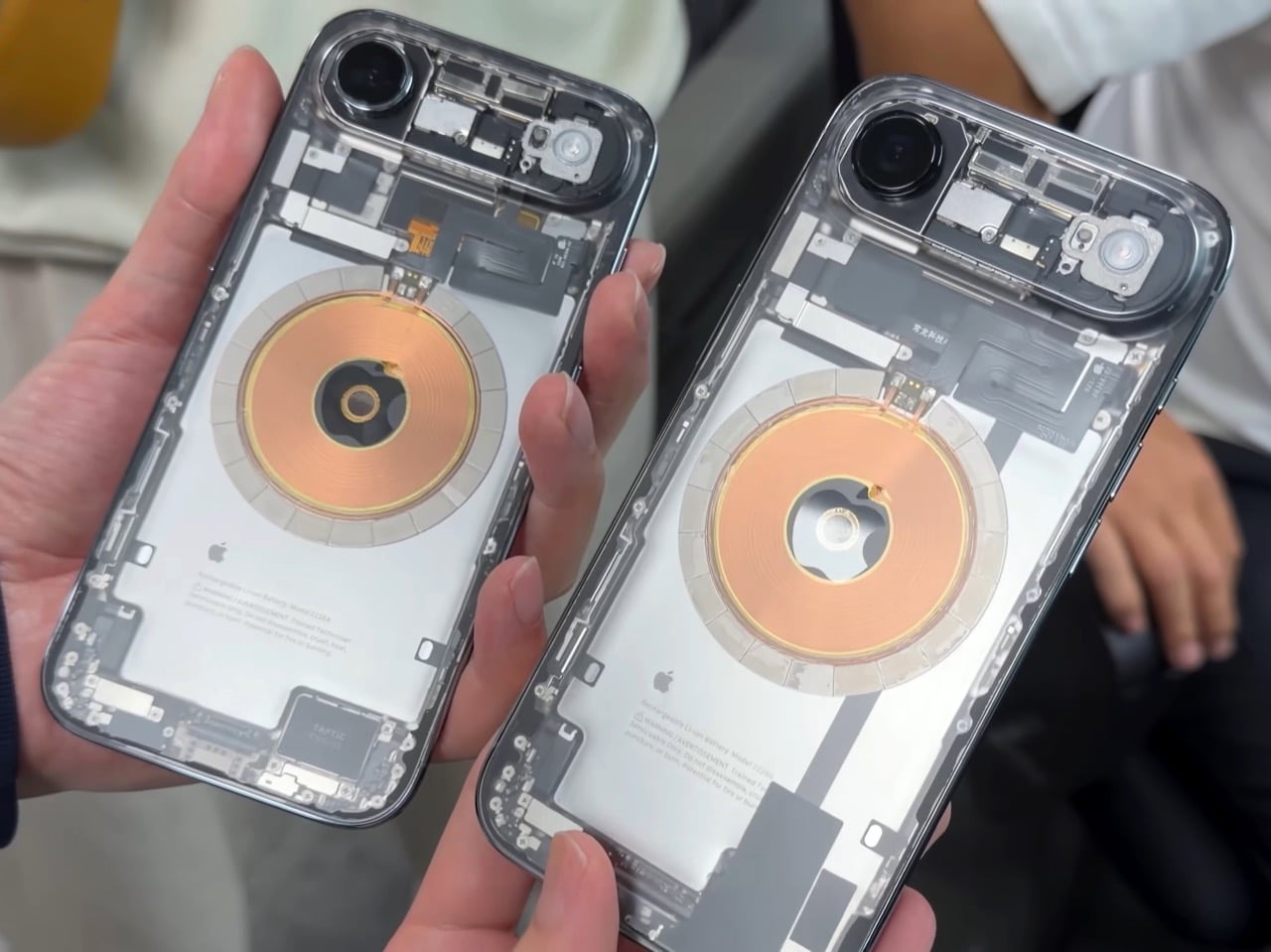
Taiwanese creator Linzin Tech went there with a blue iPhone Air, the thinnest iPhone Apple has ever made and the first one sold without a physical SIM slot anywhere in the world. He left with something that looks like a cyberpunk collector’s piece: a fully transparent-backed iPhone Air with a functioning nano-SIM tray carved directly into its frame, wired into the motherboard by hand, under a microscope, late at night. A Dbrand X-Ray case could never…
Designer: Linzin Tech
YouTuber Scotty Allen built an iPhone with a headphone jack in Huaqiangbei. He also assembled a working iPhone almost entirely from parts bought off the street there. The market has this reputation for turning Apple’s deliberate omissions into solved problems, and the community around it keeps raising the difficulty level. Linzin’s challenge was particularly gnarly because he wanted two separate modifications on Apple’s most space-constrained iPhone ever, one cosmetic and one structural, and both required touching parts of the phone that Apple engineers spent years optimizing down to the millimeter.
The transparent back came first, and the process was a laser job performed on the rear glass panel. Technicians at Changlong Technology stripped the internal paint layer without touching the MagSafe charging coil sitting directly beneath it, which is about as precise as it sounds. Once the coating was gone, the phone’s internals became fully visible through the glass: the battery, logic board, shielding, internal connectors, and the flexible cable running between the upper and lower assemblies with “Changlong Technology” printed right on it. The Apple logo floats above actual hardware now. It looks like a concept render that somehow got approved.
The iPhone Air has no physical SIM slot in any market, globally, which meant Changlong’s team had to use a CNC milling machine to carve a slot opening into the phone’s ultra-thin metal frame. The original Taptic Engine had to come out entirely because there was simply no room for both it and a SIM tray in that chassis. A smaller third-party linear motor went in its place. Linzin estimates the haptic feedback at around 98% of the original, with the main perceptible difference being less granularity between light and heavy vibration patterns. Apple’s Taptic Engine is genuinely one of the finest haptic systems in consumer electronics, so even a 2% degradation is something purists will notice.
Board-level microsoldering connected the new SIM reader to the motherboard, and after a reboot the phone recognized a physical nano-SIM and connected to a carrier on 5G. Hot-swapping requires a restart to register a new card, which is a minor workflow tax. The thermal picture is less rosy. The graphite heat spreader sheets were casualties of the laser process and were not fully reinstated, which pushed operating temperatures noticeably higher under sustained load. Linzin ran 20 rounds of stress testing and confirmed the throttling. IP68 water resistance is also gone the moment the frame gets milled. And on the morning he flew back to Taiwan, the microphone ribbon cable came loose, sending the phone back to Shenzhen for repairs.
Close-up of the machined SIM tray
Here is the thing though. Linzin paid real money for a phone Apple sells for a premium, then paid again to have it modified, accepted degraded thermals, lost water resistance, voided his warranty instantly, and still calls it worth it. His reason is genuinely practical: he changes phones weekly and eSIM-only means a carrier visit every single time. The modification solves a real problem for a specific kind of power user, and it does so with enough visual drama that you would probably auction this thing for three or four times its retail price. Huaqiangbei has been poking holes in Apple’s “impossible” list for years. This one just happens to be the most beautiful hole yet.
The post Modded Transparent iPhone Air with a Working SIM Slot Looks Like Apple and Nothing had a Dream Child first appeared on Yanko Design.