
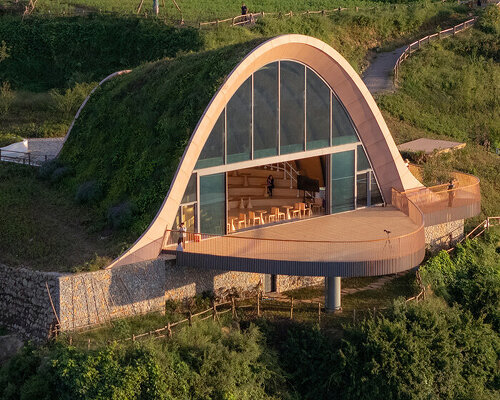
MVRDV embeds a civic pavilion within the hills of Pujiang
MVRDV completes Pujiang Platform, a timber event pavilion and viewing structure embedded into the hills east of Pujiang, southwest of Chengdu, China. Conceived as an architectural extension of the terrain itself, the 414-square-meter pavilion uses earth-covered timber arches to reconstruct the silhouette of a hill that was previously flattened, while framing panoramic views toward the growing town below and the Qionglai Mountains beyond.
Set within a landscape that is rapidly transforming as Pujiang develops into a new sustainable town, the project aims to offer residents and visitors a place for gatherings, ceremonies, and civic use, and to do so with minimal visual and environmental impact. MVRDV shapes the building as a telescopic form that appears almost geological when seen from afar, while becoming legible as a civic structure through its large viewing window and projecting balcony. At night, light spilling from this opening turns the pavilion into a landmark, visible from the plains below without dominating the landscape.‘The hills of this region are truly a spectacular sight, so one of the challenges we faced was to make the most of those views while reducing the impact on the landscape. By adding a hill-shaped pavilion with a green roof we not only minimise our own impact, but we recreated the hill that was there before,’ MVRDV founding partner Jacob van Rijs notes. ‘This act of preserving and respecting nature is the essence of the design, which is continued in the construction approach, using bio-based materials such as wood that are more sustainable and thus have less impact on natural environments such as this one.’
all images © Arch-Exist
rebuilding a flattened hill in Chengdu, China
MVRDV’s design originates from a site-specific observation. The original viewpoint had required cutting into the hill, erasing part of its natural profile. The architects’ response was to reverse that by recreating the missing mass as architecture. An arched timber structure is wrapped in an earth berm and planted roof, restoring the hill while housing an interior space beneath. The pavilion is entered discreetly through a glazed facade embedded into the berm, leading into an interior that slopes with the terrain. The floor descends as the ceiling rises, forming a stepped tribune oriented toward a 10-meter-tall glass facade. Oversized sliding doors allow the interior to open fully onto the balcony, enabling the space to shift between enclosed events and open-air gatherings.
Circulation and landscape are treated as integral parts of the architectural experience. The team retains and extends existing paths on the site, forming a loop that leads visitors through multiple approaches to the viewpoint. A twisting staircase connects these routes and culminates in a secondary circular viewing platform, offering 360-degree views across both the distant mountain range and the immediate hillside environment. Planting strategies reinforce continuity with the surrounding ecology, using species that reflect the existing biodiversity.
MVRDV completes Pujiang Platform in China
timber construction and passive environmental strategies
The green roof, with a soil depth of approximately 10 centimeters, supports grasses, flowers, and small shrubs, while existing waterways are incorporated into rainwater collection and irrigation systems. Material choice plays a critical role in both the environmental and cultural positioning of the project. The timber structure is intended to reduce embodied carbon and also to act as a built demonstration within a context where wood construction remains underutilized. Operational performance is supported through a combination of passive and active strategies. The earth berm provides insulation and thermal mass, layered ceilings enable natural ventilation, and the north-facing orientation of the main façade minimizes unwanted solar gain. Additional energy demands are partially met by a geothermal heat pump, contributing to the project’s China Green Building Label 2-star certification.
a timber event pavilion and viewing structure
embedded into the hills east of Pujiang, southwest of Chengdu
conceived as an architectural extension of the terrain itself
uses earth-covered timber arches form the pavilion
reconstructing the silhouette of a hill that was previously flattened
set within a landscape that is rapidly transforming
framing panoramic views toward the growing town below and the Qionglai Mountains beyond
the project aims to offer residents and visitors a place for gathering
MVRDV shapes the building as a telescopic form that appears almost geological when seen from afar
a twisting staircase connects routes and culminates in a secondary circular viewing platform
offering 360-degree views
the team retains and extends existing paths on the site
planting strategies reinforce continuity with the surrounding ecology
oversized sliding doors allow the interior to open fully onto the balcony
an arched timber structure wrapped in an earth berm and planted roof
project info:
name: Pujiang Platform
co-architect: Sichuan Provincial Architectural Design and Research Institute Co., Ltd. – SADI
location: Pujiang, China
area: 414 sqm
client: Pujiang County Planning and Resources Bureau
sustainability certification: China Green Building Label – 2 Stars
contractor: Chengdu Third Construction Engineering of CDCEG
founding partner in charge: Jacob van Rijs
partner: Wenchian Shi
director MVRDV Shanghai: Peter Chang
design team: Kyo Suk Lee, Olga Marelja, Geert Folmer, Guido Boeters, Cai Zheli, Shanshan Wu, Alexander Forsch, Ilaria Furbetta, Yihong Chen, Jiamen Li, Shing Yat Tam, Yifei Zhang, Cai Huang, Seunghan Yeum, Gioele Colombo, Xinyuan Zhang
MVRDV climate: Alexander Forsch
photographer: © Arch-Exist| @archexist
The post MVRDV completes earth-covered pavilion with viewing deck for public gatherings in china appeared first on designboom | architecture & design magazine.