
mvrdv sculpts a new facade for tiffany & co. beijing
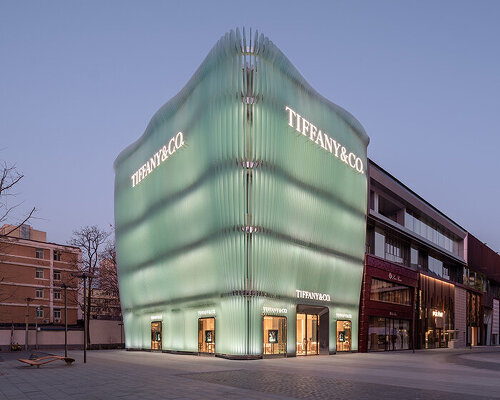
The new Tiffany & Co. flagship store in Beijing has opened in the Taikoo Li Sanlitun district, with a rippling facade designed by Dutch studio MVRDV that gives the building a landmark presence within the dense shopping district. Located at a crossroads in the northern portion of the complex, the four-story building meets a steady flow of pedestrian movement and long sightlines from multiple directions.
The project responds to its site with its continuous envelope of Tiffany Blue which can be read from all directions. This facade behaves as an architectural surface that engages light and movement, allowing the store to read as part of the district’s fabric while maintaining a clear identity associated with the iconic jewelry brand.
images © Tiffany & Co.
the facade of vertical glass fins
The architects at MVRDV wrap the building’s exterior with vertical fins of translucent glass, rising the full height of the Tiffany & Co. Beijing flagship. Each fin carries a gentle curvature, producing a layered surface that shifts with the viewer’s position. The fins create depth and identity without reliance on applied graphics, a strategy which allows material and geometry to carry the expression.
The glass softens views toward the interior while maintaining a sense of permeability. ‘When viewed from an angle, the layering effect of the dense glass fins amplifies the effects of the light, highlighting the facade’s shape,’ explains MVRDV founding partner Jacob van Rijs.
‘The light filtering through and reflecting off of the translucent glass creates a delicate interplay that is constantly changing as you move. And, as you pass close to the building, you see glimpses in between the fins to the jewellery inside.’
the Tiffany & Co. Beijing flagship occupies a four story building at a Sanlitun crossroads
daylight as a design tool
MVRDV harnesses daylight to activate the facade of the Tiffany Beijing flagship through subtle variation. The glass carries a natural blue tone that becomes more pronounced as light passes through multiple layers. At night, integrated lighting embedded within the mounting brackets illuminates the fins evenly to create the soft glow long associated with Tiffany’s visual language.
Attention to construction details shapes the experience. The lighting hardware remains recessed within custom supports, allowing the glass edges to remain visually continuous. This approach keeps focus on the material surface itself rather than its fixings, reinforcing the sense of precision that characterizes the project.
The facade has been engineered for disassembly, with glass fins and brackets designed for removal and future reuse. This strategy extends the life of the system beyond a single retail cycle and reflects an interest in adaptability within its ever-changing commercial context.
MVRDV designs the facade as a continuous surface shaped by vertical glass fins
translucent glass layers adjust with movement and changing daylight
the facade allows partial views into the retail interior
integrated lighting emphasizes the natural blue tone of the glass
MVRDV harnesses daylight to activate the facade through subtle variation
the demountable system supports future reuse of materials
project info:
name: Tiffany Facade Beijing
location: Beijing, China
client: Tiffany & Co. | @tiffanyandco
completion: 2025
photography: © Tiffany & Co.
founding partner in charge: Jacob van Rijs
head of interior: Aser Gimenez Ortega
design team: Simone Costa, Türker Naci Şaylan, Monica Di Salvo, Natalia Lipczuk, Sanel Beciri, Sofia Mermigka Angeli
co-architect: AT ZERO DESIGN LIMITED
contractor: Permasteelisa Gartner Hong Kong Limited
lighting designer: Cooley Monato Studio
The post MVRDV wraps tiffany & co. beijing flagship in rippling facade of translucent glass fins appeared first on designboom | architecture & design magazine.