
The ink on Barcelona was barely dry when Nothing pulled everyone back to London. The Phone (4a) had its big MWC moment just days ago, where journalists and the public got their hands on it, took the obligatory photos, and filed their takes. And then Nothing said: actually, we have another one. The Phone (4a) Pro launched today at Central Saint Martins, the world-famous College of Art and Fashion in London’s Kings Cross, a deliberately art-coded venue for a brand that has always treated its phones as objects as much as devices. This is how Nothing operates in 2026, staggered drops fired in rapid succession to keep the conversation alive, and the strategy is working.
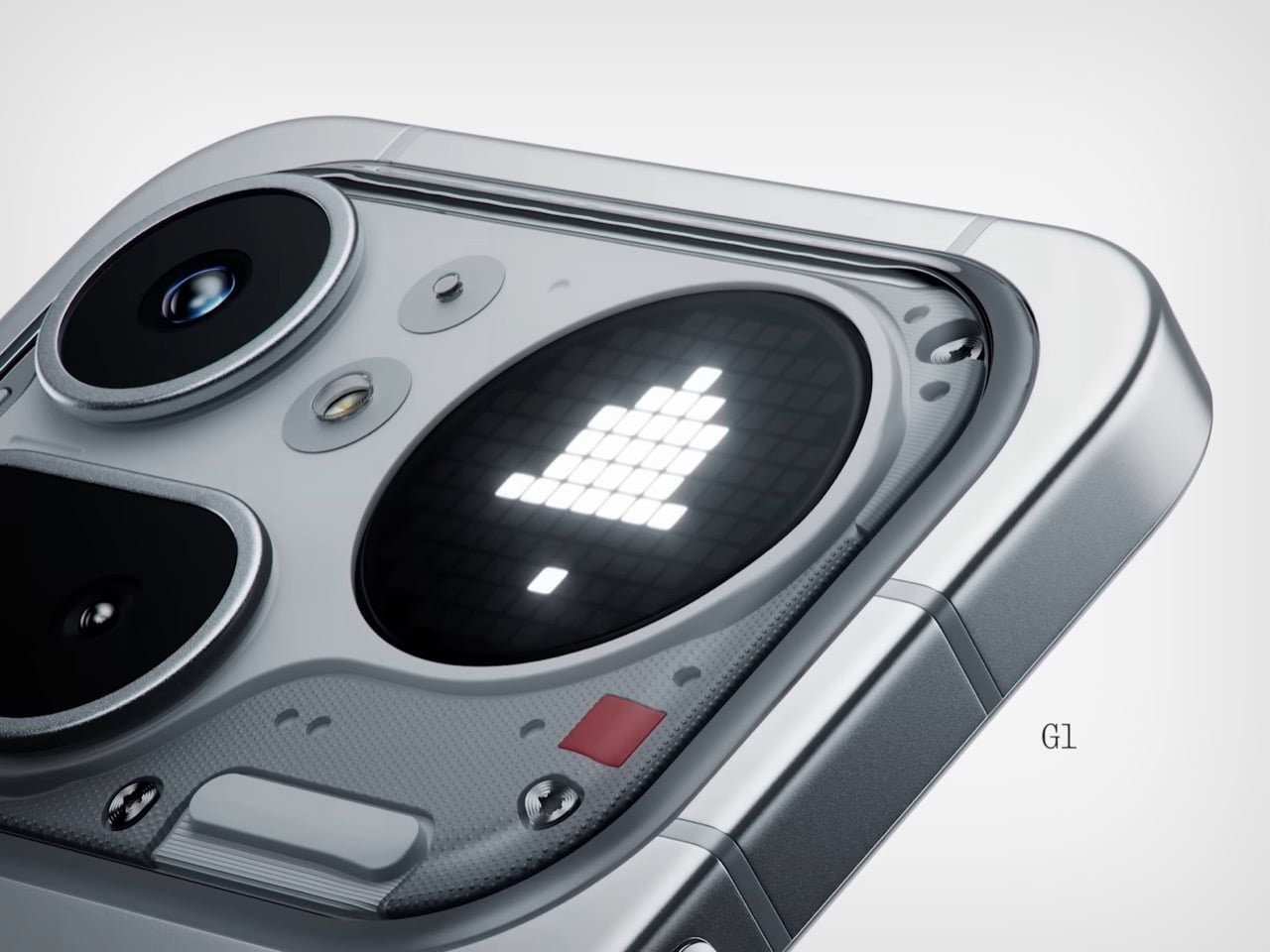
The reason the Pro matters so much this year comes down to a decision Carl Pei made at the start of 2026: Nothing will not launch a flagship phone this year. That puts the Phone (4a) Pro in the role the Phone (3) would have occupied, as the design halo, the statement piece, the device that earns a second look across a dinner table. And so the Glyph Matrix returns. When we covered the Phone (3), the Matrix was the headline, a circular LED array in the top-right corner of the rear panel that could display pixel-style animations, timer readouts, caller signatures, and even a spin-the-bottle mini-game. It was the kind of feature that made you rethink what a phone’s back panel could do. The (4a) Pro’s version runs 137 LEDs against the Phone (3)’s 489. On paper that sounds like a step back. In practice, the circle is 57% larger and the LEDs are twice as bright at 3,000 nits, making for a more visible, punchy display even if the pixel resolution is reduced. The tradeoff is real but not as simple as the numbers suggest.
Designer: Nothing
Compare the (4a) Pro’s rear panel to the (3a) Pro’s and you feel the difference before you can articulate it. We wrote about the (3a) Pro’s camera arrangement at the time, and the word we used was chaos: lenses placed asymmetrically, Glyph LEDs ringing a circular module like someone got excited and kept adding things. The (3a) Pro took cameras arranged asymmetrically with Glyph LEDs around the circular camera module. The (4a) Pro looks like that design went away, thought about what it was doing, and came back with some self-control. The cameras and Glyph system now sit inside a raised transparent plateau, three lenses in a proportional, structured arrangement with the Matrix at the top-left and the red recording indicator tucked below it. Nothing is pushing back on the plateau comparison, but the composure of the layout is undeniable. This is what a camera array looks like when the brief is restraint rather than personality, and it turns out restraint suits Nothing rather well.
That same shift in attitude shows up in the build. The (4a) Pro drops the plastic frame and goes metal unibody at 7.95mm, which is directly relevant to something we flagged in our (4a) coverage: the blue colorway looked cheap against a plastic frame, the color promising something the material could not back up. That tension is gone on the Pro. A metal chassis earns the Silver colorway, gives the Pink something to push against, and makes the whole thing feel like a considered object rather than an aspirational one. The IP65 rating arrives alongside it, with a non-standard but still real claim of 25cm submersion for 20 minutes. The chipset steps up properly too: the Snapdragon 7 Gen 4 brings a 27% CPU uplift, 30% better GPU performance, and a 65% jump in AI processing over the 7s Gen 3 that powered the (3a) Pro. The standard (4a) gets the 7s Gen 4, technically a newer chip but only a 7% performance improvement over the outgoing model. The meaningful generational gains live in the Pro.
On the camera side, the Pro runs Sony’s Lytia 700C, a 50MP 1/1.56-inch main sensor with OIS, alongside a periscope telephoto using a Samsung JN5 50MP sensor at 3.5x optical zoom, extendable to 7x with in-sensor cropping. The system supports 4K Ultra XDR recording, comparable to Dolby Vision, with up to 140x hybrid zoom. The display is a 6.83-inch AMOLED at 144Hz, 1.5K resolution. The Pro comes in Black, Silver, and Pink, while the (4a) ships in Black, Blue, Pink, and White. Both run Nothing OS 4.1 on Android 16, with three OS updates and six years of security patches committed.
Pre-orders for the (4a) open today with sales from March 13, while the (4a) Pro takes pre-orders from March 13 with open sales on March 27. UK pricing is £349 and £499 respectively. Holding the launch at Central Saint Martins was not a neutral decision: it is one of the most culturally loaded art schools on the planet, and Nothing knows exactly what it is saying by being there. Two phones, one week, one city. Nothing is playing the long game with a short runway.
The post Nothing Phone 4a Pro: Metal Build, Glyph Matrix, and a Price That Actually Makes Sense first appeared on Yanko Design.