
The beauty industry has spent decades perfecting what goes inside the bottle. Formulas have become more sophisticated, actives more potent, ingredient lists more transparent. Yet the objects that deliver those formulas have stayed mostly the same. Glass jars, plastic tubes, pump bottles, they’re passive containers designed to hold product, not enhance it. Meanwhile, beauty gadgets promised professional results at home but ended up in drawers, forgotten.
The real opportunity isn’t another breakthrough ingredient or another device. It’s that split second where formula actually meets skin. That’s the insight behind Nuon Medical, a company founded by Alain Dijkstra with roots in medical devices rather than traditional cosmetics. While everyone else obsessed over formulas, Nuon started looking at the packaging itself. We interview Senior Consultant Benny Calderone to get deeper insights into the company’s origins and perspectives.
Designer: Nuon Medical
From Chemical to Physical Innovation
According to Nuon Medical, “For decades, the beauty industry focused on ‘Chemical Innovation’—the juice inside the bottle. Nuon is pioneering the era of ‘Physical Innovation.’ In short: we are solving the ‘Last Inch’ of skincare.” It’s a shift that treats packaging as a performance-critical interface, one that determines whether those actives reach their biological targets or just sit on your skin doing nothing.
Nuon’s journey started with standalone light therapy devices used for hair growth and wrinkle reduction. After nearly two decades making those tools, founder Alain Dijkstra noticed they had a retention problem. They added steps to already crowded routines and mostly ended up unused. For clinical tech to work at scale, it had to disappear into something people already do every day.
By embedding tech into packaging, Nuon eliminated the compliance gap. “We realized that for clinical tech to scale, it must be invisible. By turning the packaging itself into the ‘treatment engine,’ we eliminate the compliance gap.” You’re not being asked to do something new. You’re just upgrading what you already do. From a business angle, this transforms a throwaway bottle into something worth keeping.
Frictionless Intelligence at the Point of Contact
Nuon doesn’t start with sketches or aesthetics. They start with human-factor engineering, figuring out how an applicator should guide contact, path, and speed to deliver the formula correctly every time. The result is what they call frictionless intelligence. “We design for ‘frictionless intelligence.’ If a user has to read a manual, the design has failed,” the company states.
Intelligence gets built into the haptics, the ergonomics, the physical interaction logic itself. The tool quietly guides your motion without you realizing it. The applicator steers where you press, how fast you move, the path you follow, all without instructions. Light therapy, microcurrent, thermal elements, vibration, they’re woven into the interaction, supporting the formula instead of distracting from it.
There’s a tricky balance here. Clinical devices can feel intimidating. Beauty objects need to feel inviting, something you want to pick up every morning. Nuon often prioritizes consistency over intensity. “A tool used daily with proper motion and interaction is far more effective than a high-intensity device left in a drawer,” they note. A lower setting used correctly beats a powerful tool that stays in the drawer.
The Hidden Operating System of Beauty
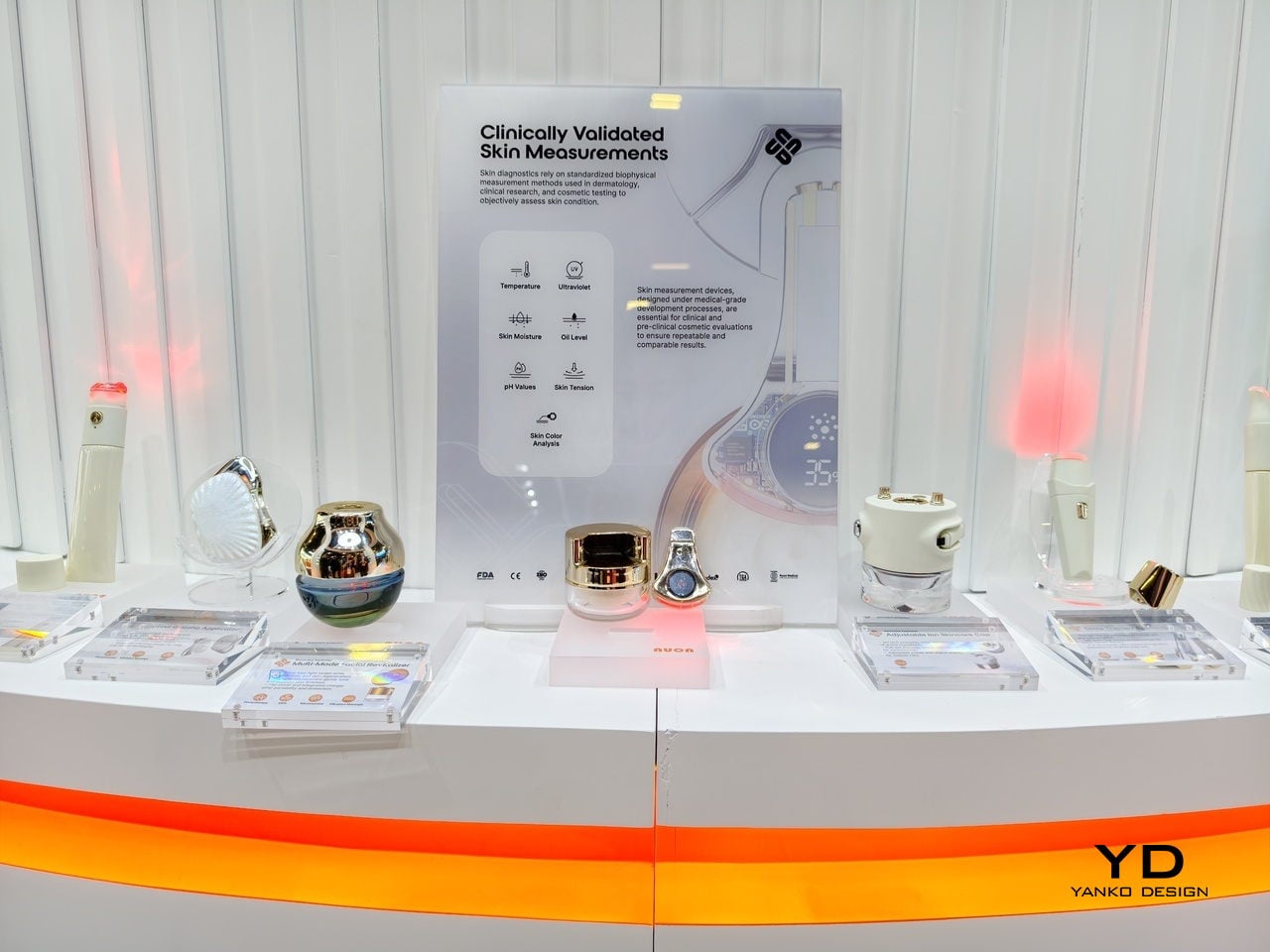
Nuon isn’t a consumer brand. They’re a B2B partner working behind the scenes with global beauty companies. Their modular tech stack works like an operating system, offering a validated foundation that brands dress up with their own materials. Luxury labels use glass and heavy metals. Mass brands use lighter plastics. The intelligence underneath stays the same.
“Nuon is the ‘Innovation Engine’ behind the world’s leading brands. Our philosophy lives in the UX Framework, not the visual skin,” Calderone explains. Brands can apply their aesthetic identity without messing with the validated technology underneath. “We provide the ‘Intelligence’; they provide the ‘Identity,’” he adds. It’s systems thinking applied to beauty packaging.
Data, Sustainability, and the Death of the Dumb Bottle
Once packaging gets smarter, it starts collecting data. Nuon’s applicators can measure skin hydration, texture, UV exposure, and more. But the company is deliberate about how that information gets used. “Data should be a concierge, not a surveillance tool,” according to their philosophy. Diagnostics should inform care, not flood you with vanity metrics. Nuon provides privacy-by-design infrastructure where consumers stay in control.
Then there’s sustainability, where Nuon takes a blunt stance. “Sustainability only scales if it improves the user experience. ‘Green theater’ is asking consumers to settle for less; True sustainability is ‘Assetization,’” the company states. They design the high-tech applicator as something durable that you want to keep. The formula becomes a refill that plugs into that base, separating Durable Intelligence from the Circular Consumable.
It’s not sustainability through guilt. It’s sustainable because the design makes refills the logical choice. You’ve invested in the smart hardware, so of course you’re going to buy the refill. Nuon’s vision is bold. “We are witnessing the death of the ‘dumb bottle.’ In a decade, a passive plastic cap will feel as obsolete as a rotary phone.”
Packaging will become responsive tools that sense conditions and guide your hand in one motion. “Scalp and hair care is the next great ‘blue ocean.’ It’s a category where wellness meets clinical results, and users can immediately feel the benefits of microcirculation and stimulation,” Nuon notes. The broader idea is that everyday objects on bathroom shelves are about to become quietly intelligent without looking like sci-fi props.
Companies like Nuon are writing that next chapter from behind the scenes, proving that clinically meaningful technology doesn’t need to sacrifice what makes beauty objects appealing. It’s a shift from containers to interfaces, from passive to active. If Nuon’s right, we’ll look back at today’s plain bottles the way we look at rotary phones, functional once but hopelessly outdated now.
The post Nuon Medical: Why the Future of Skincare Isn’t Another Serum first appeared on Yanko Design.