There’s a familiar anxiety humming beneath much of today’s creative output; a quiet question about authorship, originality, and what remains distinctly human in an era increasingly shaped by machine intelligence. It’s a tension that many studios are attempting to address through process or positioning. For OFFF Barcelona 2026, Uncommon Creative Studio offers a provocative answer: not just the idea, but the imprint.
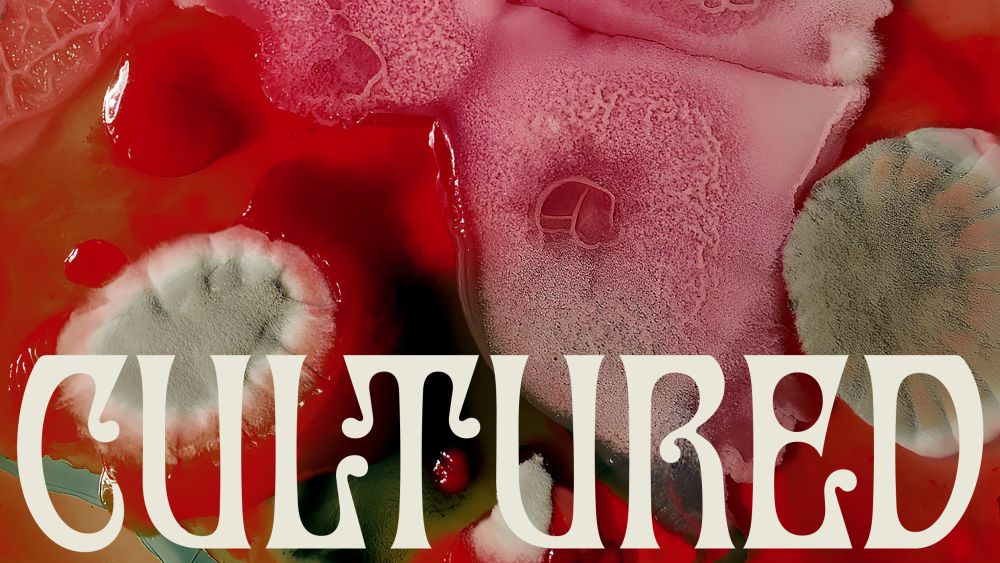
Titled Cultured, the festival’s new campaign reframes branding as something less authored and more grown. At a surface level, it’s a striking visual system — biomorphic typography, organic textures, and a palette that feels lifted from nature at its most saturated. But beneath that aesthetic is a concept that pushes into more uncomfortable, and arguably more necessary, territory: what if the creative community isn’t just represented in the work, but physically embedded within it?
Rather than building a brand for the festival, Uncommon constructed one from it using the creative community not as an audience, but as the medium. The resulting identity resists the polished, over-determined systems that often dominate contemporary branding. Instead, it leans into something more unstable, more alive: a visual language formed through physical traces, collective participation, and the residue of human presence.
To build the identity, Uncommon hosted a series of “Mixer” events across London and New York, inviting creatives to gather, exchange ideas, and unknowingly leave behind something more tangible. Biological traces — fibers, imprints, fragments of presence — were collected from shared surfaces and translated into a bespoke design system. What is typically invisible, the residue of participation, becomes the material language of the brand, resulting not in metaphorical authorship, but literal contribution.
It’s a concept that sits somewhere between a heist and a magic trick, as co-founder Nils Leonard describes it. But beyond the intrigue, there’s a deeper provocation at play. In a cultural moment saturated with trend cycles, design jargon, and increasingly, AI-assisted outputs, Cultured rejects the idea of creativity as an externalized, optimized product. Instead, it insists on creativity as a living system; messy, collective, and irreducibly human. It’s a move that reframes branding not as a fixed artifact, but as a living system. One that accumulates meaning through contact, rather than control.
This is where Uncommon’s philosophy of “design with a capital D” becomes legible. The studio has long operated in the tension between quiet design craft and loud cultural impact, a space where few agencies manage to sustain credibility. In the OFFF identity, that duality is resolved not by compromise, but by expansion. The work is both aesthetically striking and conceptually generous. It doesn’t just communicate culture; it hosts it.
There are clear art-historical echoes here, particularly in the lineage of Yves Klein, whom Nils has been enamored with for a long time and has written about here, whose work explored the body as both subject and medium. But where Klein’s gestures were singular, even theatrical, Uncommon’s interpretation is communal. The campaign expands the notion of authorship outward, distributing it across a network of contributors who may never see themselves as “makers” within the final artifact, yet are fundamentally embedded within it.
The system extends this thinking across every layer. A custom typeface, Hyphae, draws from fungal networks; structures defined by growth, interconnection, and asymmetry. Visual assets developed in collaboration with artist Dasha Plesen, aka the ‘Mold Queen’ known for working with bacteria as a medium, further reinforce the idea of creativity as something that evolves rather than resolves. Even the campaign’s large-scale projection onto the Disseny Hub positions the work not as a static identity, but as a living surface that carries the traces of the community back into the public realm.
What’s most compelling, though, is the underlying assertion: that creativity, at this moment, is not something to be protected from external forces, but something to be reasserted through collective presence. As tools become more powerful and outputs more frictionless, the industry risks drifting toward a kind of creative abstraction in which ideas feel increasingly detached from the people who generate them. In a “serious and pretty dark world,” as Nils Leonard describes it, the project offers a kind of quiet optimism rooted not in technology, but in people. Uncommon’s response is not to reject that reality, but to counterbalance it with something grounded, physical, and participatory.
It’s a subtle but important shift: from branding as a declaration of identity to branding as an accumulation of presence.
For OFFF, a festival long defined by its community, this feels less like a campaign and more like a crystallization of its ethos. As director Pep Salazar notes, the work not only speaks to designers, it is built from them. And in doing so, it reframes the role of the audience entirely. Not as passive consumers of culture, but as its raw material.
For OFFF, the community has always been the core. This collaboration with Uncommon makes that idea tangible. The campaign doesn’t just speak to designers–it is literally built from them. It’s a celebration of shared authorship and the power of gathering, exchanging, and making together.”
Pep Salazar, Director of OFFF Barcelona
Which raises a larger question for the industry: if creativity is, at its core, a collective act, why have we spent so long pretending otherwise?
That question sits at the heart of Uncommon’s approach and becomes even more pointed in the context of emerging technologies that increasingly shape how, and by whom, creative work is made. Rather than positioning itself in opposition, Cultured reads as a kind of reassertion: a reminder that no matter how advanced the tools become, they are still derivative of what has already existed.
Or, as Nils Leonard puts it in a reflection that feels less like a closing statement and more like an opening challenge for the conversations ahead:
“Make no mistake we have an unwelcome guest. They have slept with our greatest poets, stolen the lyric books of our greatest musicians, they know how Kubrick likes his light set, they know what was on Nina Simone’s rider (sausages and champagne, by the way), they are backstage, in our rehearsals, in all our playing and working and they sit in every meeting that we do. But for all of this, all AI has is what has been done. And now we will never have a bigger excuse to let go and just make. Free license to be new. To be dangerous. To be hilarious. To be beautifully wrong like only humans can be. This is the culture we exist in and it is ours to make, together.”
A reminder that the creative community isn’t just the audience for culture, it is the culture.
The post OFFF x Uncommon: The Future of Creativity Isn’t Artificial; It’s Cultured appeared first on PRINT Magazine.