
casetta tessino: a creative’s treehouse cabin
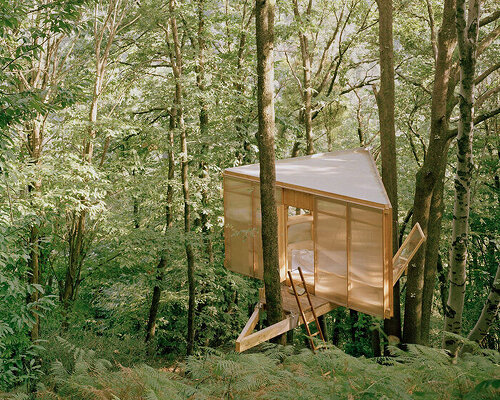
Dubbed Casetta Tessino, a tiny and modern treehouse by Olin Petzold stands in the woods of Valle Onsernone, Switzerland. Completed in early 2024, the elevated timber structure sits apart from an existing house on a steep, forested plot near the village of Loco, positioned as a place for writing and short-term retreat.
The commission came from a Swiss artist and climate activist seeking a secluded writer’s workspace away from the main house. Petzold describes the initial brief as deliberately spare. ‘The idea was to create a place with only the essentials,’ he tells designboom. ‘A place to sleep, a place to sit, and a place to write.’ The reference to Henry David Thoreau’s Walden lends a shared point of departure, with an emphasis on withdrawal and self-sufficiency.
Following completion, the cabin is intended to be shared with other writers and creatives, with its occupation expected to vary with season and user.
images (shot on film) © Peter Tillessen
Olin Petzold’s suspended triangular structure
Casetta Tessino is built by architect Olin Petzold as a response to local zoning regulations, which prohibit additions to the existing building stock and the creation of new foundations. Thus, an elevated structure was set within the forest canopy, sited around 100 to 150 meters from the main house. The cabin hovers among three mature oak trees, accessed by foot along a narrow woodland path.
A freely suspended support system connects three primary beams to the trees, forming an irregular triangular frame. On this, an equilateral triangle defines the floor plan, rotated so that its corners project between the trunks. One face turns toward the slope, while the other two open up and down the valley, aligning views along the terrain rather than toward the main house.
Casetta Tessino sits elevated among oak trees in Valle Onsernone
compact and minimalist interiors
Inside, Olin Petzold’s Casetta Tessino is reduced to a single compact room. The bed is set flush within the floor plane and revealed by lifting four wooden panels when in use. During the day, the surface reads as continuous timber decking. Two fixed planks define the remaining furnishings, one serving as a bench and the other as a desk.
‘The room should feel almost empty when you enter,’ Petzold explains. ‘Everything that is there has a clear task.’ All three facades can be opened, turning the interior into a sheltered platform within the forest. When closed, the space becomes a contained volume with views filtered through translucent surfaces.
a rotated triangular plan is suspended from three trees without foundations
a timber structure wrapped in polycarbonate
The structural frame and interior elements are built from spruce, chosen for its light weight and workability. Larch is used for the exterior timber components due to its durability and resistance to moisture in a shaded, humid environment. The building skin incorporates translucent polycarbonate panels, allowing daylight to permeate the interior while softening direct views outward.
The polycarbonate plays a climatic role as well. In summer, the surrounding foliage shades the cabin, moderating heat gain. In the colder months, with leaves gone, low winter sun passes through the panels and warms the interior air. The material remains visually understated, reading as a pale, diffused surface among trunks and branches.
the project is designed by architect Olin Petzold as a secluded writing retreat
the treehouse built by hand
The remote location shaped both detailing and construction method. All components were designed to be carried by hand, with no machinery brought to the site. Joints and assemblies were simplified so they could be executed without specialist tools or training.
‘This was conceived as a self-build from the beginning,’ says Petzold. ‘The details had to work with what could realistically be done on site.’ Timber became the primary material through necessity as much as intention, meeting structural, logistical, and economic constraints. All materials are inexpensive, though this economy is largely concealed in the finished work.
the interior is reduced to a floor, bed, a bench, and a desk
spruce and larch form the structure and exterior surfaces
translucent polycarbonate wraps the structure and filters forest light
all components were carried and assembled by hand on site
project info:
name: Casetta Tessino
architect: Olin Petzold
location: Valle Onsernone, Switzerland
completion: 2024
photography: © Peter Tillessen | @peter.tillessen
The post olin petzold hides minimalist ‘casetta tessino’ treehouse in the woods of switzerland appeared first on designboom | architecture & design magazine.