
tools become luminous artworks
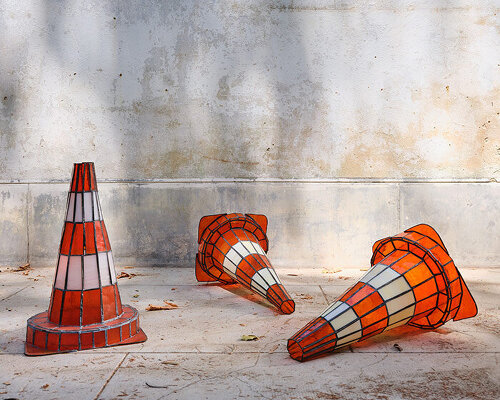
Artist Pia Hinz approaches stained glass through objects that carry a strong association with labor and use. Ropes, shopping carts, traffic cones, and agricultural components appear across her sculptural work, each translated through colored glass using traditional techniques. The forms remain immediately legible, which keeps their original context present even as the material shifts.
This choice sets up a direct contrast. These are objects built for pressure, repetition, and durability. In glass, they hold a different kind of presence. The outlines stay intact, but the expectations around weight and handling change, which affects how the viewer reads them in space.
PHAOS, 2023. Musée Crozatier, Exposition ÉCHO Land&Street Art, Le Puy-en-Velay, France. image courtesy the artist
pia hinz contrasts fragility and force
The glass work of artist Pia Hinz hinges on the relationship between fragility and force. Industrial tools usually imply durability and impact, while stained glass carries associations with delicacy and light. Bringing the two together creates a tension that runs through each piece.
That tension does more than create visual contrast. It changes how value is assigned to the object. A rope or a traffic cone shifts from something purely functional into something observed, even contemplated. The object moves away from use and toward interpretation, without losing its recognizable form.
CONES, 2024. image © Grégoire d’Ablon, courtesy the artist
construction and visual language
Pia Hinz works within the framework of stained glass, using colored segments joined by metal lines. These joints define the geometry of each object, mapping its structure in a way that remains visible. The construction stays exposed, which keeps attention on how the piece is made.
Color operates as part of that structure. Sections of red, green, or yellow are distributed across the surface in a way that guides the eye. Each segment carries a slightly different density, which affects how light passes through. The composition emerges through these divisions rather than through applied decoration.
PRECIOUS WHAT?, 2024. image courtesy the artist
light as output
Light activates the work once it is placed within a room. As it passes through the colored surfaces, it casts tinted reflections onto nearby walls and floors. These projections extend the object beyond its physical boundaries, creating a secondary layer that shifts throughout the day.
This aspect connects the work back to the architectural origins of stained glass. In Hinz’s pieces, that relationship is condensed into a smaller scale. The surrounding space becomes part of the composition, with light acting as a variable element that continues to change.
PRECIEUX CHARGEMENT, 2023, Collectif du Château de Verchaüs, Viviers, France. image courtesy the artist
positioning within contemporary practice
Pia Hinz places stained glass within a contemporary sculptural context while maintaining its technical foundation. The work aligns with a broader interest in revisiting traditional materials through new formats and subject matter. Glass becomes a medium for rethinking objects that are usually defined by utility.
At the same time, the practice extends beyond small-scale pieces. Ongoing architectural projects suggest that these ideas translate across different scales, from handheld objects to built installations. The material carries a consistent role in both cases, shaping how light and structure interact.
GLASSROPE, 2024. image courtesy the artist
LUMEN, 2024. image courtesy the artist
LIQUID SOURCE, Espace Atypique Arles, France
CHAINE, 2025. image © Grégoire d’Ablon, courtesy the artist
project info:
artist: Pia Hinz | @piahinzpiahinz
The post pia hinz reworks industrial tools into delicate stained glass objects appeared first on designboom | architecture & design magazine.