
Cellulose makes up plant-based plastic that dissolves
Researchers at the RIKEN Center for Emergent Matter Science in Japan develop a plant-based plastic that dissolves in water in just a few hours without leaving any residue. The current study builds on the team’s previous research, where they made a recyclable plastic that could melt in the salt water within hours. This time, the new version moves closer to manufacturing. The researchers present the plant-based plastic that dissolves based on cellulose, which is typically found in greenery and is produced in large quantities every year.
For the current model, the team adopts carboxymethyl cellulose, a polymer that comes from wood pulp and is already approved for food and medical use. The challenge is to find a second component that can connect with it in a controlled way, and after testing different options, the researchers use a compound based on guanidinium ions, which carry a positive charge. When the cellulose and guanidinium compound are mixed in water at room temperature, their opposite charges pull them together, and the same connections that hold the material together can also come apart in salt water, allowing the plant-based plastic to dissolve over time when it enters the ocean.
all images courtesy of RIKEN Center for Emergent Matter Science
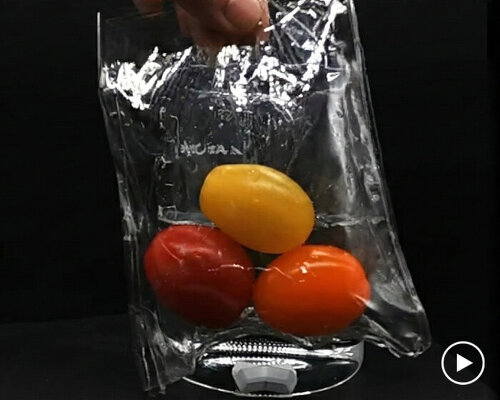
Stretchable, biodegradable container melts in water over time
Early samples of the plant-based plastic that can dissolve show an issue. The cellulose that the research team added made the plastic too rigid, so the material behaved more like glass than packaging. To change this, the team looked for a plasticizer, which is a small molecule mixed to adjust movement inside a material. After many tests, they used choline chloride, a compound already approved as a food additive, and by changing its amount, the team was able to control how the plastic behaves. With one ratio, the plastic holds shape. With another, it stretches to more than its original length. The same system can also form a thin film, which means that the plant-based plastic that dissolves can also match different product sizes and needs using the same base recipe.
The researchers are able to keep the material’s transparency, just like the current plastic offered these days, and it can be processed using standard methods and supports recycling, so it can be reused a few more times. Because the ingredients are common and approved, the path to real-world use is shorter than for many experimental plastics. While the earlier work focused on proof of concept, this new stage is about use, showcasing that the cellulose material from plants and wood pulp can help create a modern container that doesn’t leave pollution in the sea. The research doesn’t promise to replace all plastics, but it shows one path forward: that is, by redesigning material structure at the molecular level, it becomes possible to reduce long-term pollution.
the test video shows that the plant-based plastic dissolves in a couple of hours
the container is made of cellulose, which is found in plants
previously, the researchers developed a recyclable plastic that melted in seawater
there’s a process named ‘desalting’ that helps the recyclable plastic melt
project info:
name: Supramolecular Ionic Polymerization: Cellulose-Based Supramolecular Plastics with Broadly Tunable Mechanical Properties
institution: RIKEN Center for Emergent Matter Science (CEMS)
researchers: Zhenghong Chen, Yang Hong, Hiroyuki Inuzuka, Kiichi Mizukami, Takuzo Aida
study: here
The post plant-based plastic dissolves in water in just few hours without leaving any residue appeared first on designboom | architecture & design magazine.