
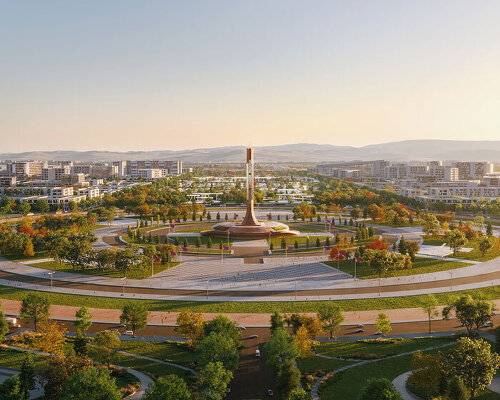
Tenger City: Squareone Atelier’s Proposal for New Satellite City
Tenger City is an urban planning proposal by Sydney-based practice Squareone Atelier, awarded as a Top 3 Winner in the Hunnu City International Urban Planning Competition 2025. The project proposes a new satellite city located approximately 52 kilometers south of Ulaanbaatar, Mongolia, with phased development planned between 2025 and 2045. The proposal forms part of Mongolia’s broader Ulaanbaatar 2040 Masterplan and the national Vision 2050 framework, which aim to support decentralization, resilience, and long-term urban growth.
The masterplan introduces a model for contemporary Mongolian urbanism informed by the spatial openness of the steppe and the country’s nomadic traditions of movement and adaptability. Central to the proposal is the concept of a ‘City Without Walls,’ defined by a porous urban structure that prioritizes landscape continuity, ecological systems, and visual connections to the horizon. Rather than imposing rigid boundaries, the city is organized as an open framework that allows urban development to grow alongside natural systems.
Tenger City is structured as a network of interconnected districts, each supporting specific civic and economic functions. These include a University Hub focused on education and research, a Medical Hub for healthcare and innovation, an Economic Free Zone supporting trade and enterprise, an Administrative District for governance, and a Cultural and Civic Core designed to host public events and performances. Recreational spaces such as Naadam Park form a central component of the urban layout, while wholesale markets, industrial areas, and logistics precincts are positioned at the periphery to support economic activity without disrupting residential and civic zones.
all images by CG Record, courtesy of Squareone Atelier
Landscape-Driven Urbanism Anchors Squareone’s City Proposal
Landscape infrastructure plays a primary role in shaping the city’s spatial and environmental performance. Constructed wetlands, water retention basins, and natural drainage corridors are integrated into the urban fabric to manage water, restore ecological balance, and support biodiversity. These systems are designed to be implemented incrementally, allowing environmental regeneration to guide the pace and direction of urban growth.
The proposal incorporates principles from international urban planning models, including superblocks, mixed-use corridors, and transport-oriented development. These strategies support the creation of a 20-minute city, where daily amenities are accessible by walking or cycling. Mobility networks emphasize public transport and pedestrian movement while maintaining uninterrupted views across the surrounding landscape.
‘In Mongolia, the horizon stretches endlessly, without barriers, with only sky and land. That feeling led us to believe that a future city should not begin with enclosure, but with openness,’ shares Squareone Atelier’s lead architect. The Hunnu City International Urban Planning Competition was initiated as part of a national development program led by the Government of Mongolia to guide the planning of the Khushig Valley area near Chinggis Khan International Airport. The competition, held between July and November 2025, attracted hundreds of architecture and urban planning practices worldwide and concluded with the selection of five finalists by an international jury.
the proposal outlines a new satellite city located 52 kilometers south of Ulaanbaatar, Mongolia
the masterplan draws inspiration from the openness of the Mongolian steppe
nomadic traditions of movement and adaptability inform the city’s spatial structure
a porous urban framework prioritizes landscape continuity and open horizons
the city is organized as a network of interconnected districts
urban growth is designed to evolve alongside natural systems rather than replace them
project info:
name: Tenger City
architect: Squareone Atelier | @squareone.atelier
lead architects: Quoc Uong, Naranbaatar Erdenebaatar
design team: Quynh Vu, Anh Nguyen, Minh Nguyen, Quan Pham, Leah Uong, Ha Hoang
visualization: CG Record | @cgrecordstudio
visualization team: Nguyen Manh Hung, An Nguyen, Duy Nguyen, Long Le, Nhi Nguyen, Hoang Nam, Trang Dai
early supporters: Teejay Ferrer, Langelo Nguyen
consultants: Tuong Nguyen
location: Ulaanbaatar, Mongolia
designboom has received this project from our DIY submissions feature, where we welcome our readers to submit their own work for publication. see more project submissions from our readers here.
edited by: christina vergopoulou | designboom
The post porous urban framework shapes landscape-driven mongolian city masterplan proposal appeared first on designboom | architecture & design magazine.