
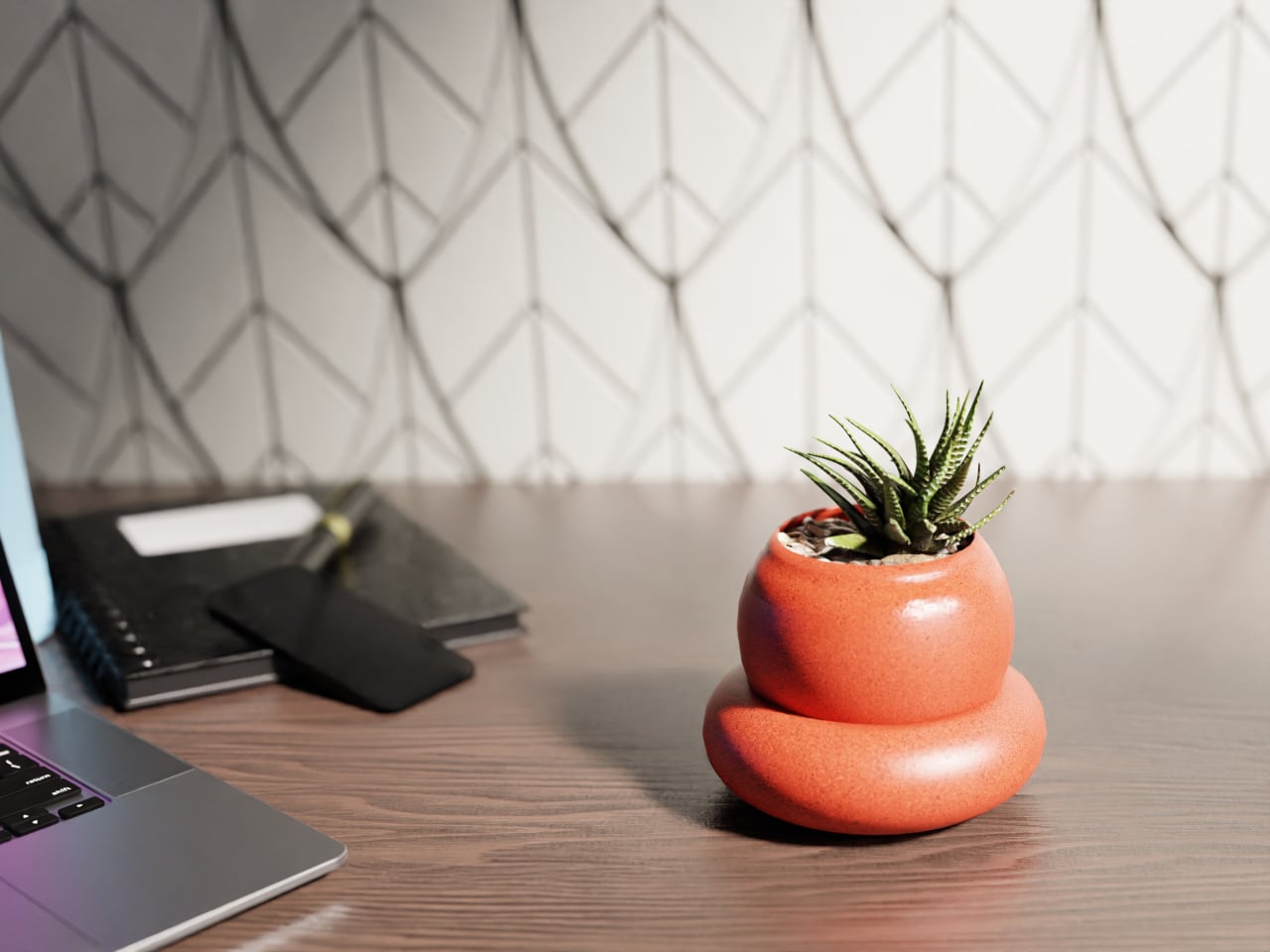
Most desk plants live in simple pots that depend entirely on memory. Watering is irregular, overwatering and underwatering are both common, and busy workdays do not help. Planters are usually treated as decorative containers, not as systems that could manage themselves. Posha is a self-watering desk planter that starts from a different premise, embedding care into the object instead of into the user’s to-do list or relying on guilt when leaves start to droop.
Posha is a compact desk planter built around a passive self-watering system. It separates water storage from the soil zone, with a concealed reservoir at the base and a wick or capillary pathway that draws moisture upward only as the plant needs it. The roots stay hydrated without sitting in water, which reduces overwatering and stretches the time between refills in a way that suits distracted desk life and unpredictable schedules.
Designer: Ayush Kumar Singh
Early explorations focused on proportions and water behaviour, how much water a compact planter should realistically store, how fast it should release moisture, and how to keep the system stable without adding visual clutter. Several internal layouts were tested to balance soil volume, reservoir capacity, and airflow, so the plant remains healthy while the planter stays small and unobtrusive on a work surface next to keyboards and coffee cups.
The form is deliberately minimal, so from the outside it reads as a simple desk object rather than a technical product. The complexity is pushed inward, where the water chamber, soil separator, and wicking element work together as a single system. The geometry avoids sharp transitions so water can distribute evenly, and the top opening is sized for common indoor plants without making planting or pruning awkward when you need to swap species.
Refilling is straightforward and non-disruptive; the water inlet is integrated into the form so it does not dominate the appearance, and the reservoir can be topped up without removing the plant. The system is designed to be reusable and serviceable, allowing the planter to be cleaned or replanted over time rather than treated as a disposable object that gets tossed when the first plant fails or the season changes.
What defines Posha is not a single interaction but how it behaves over weeks of use. The soil stays consistently moist, the plant experiences less stress, and the user interacts with it less frequently but more intentionally. Plant care shifts from a daily responsibility to an occasional check-in, better suited to desks, studios, and workspaces where attention is already stretched thin, and memory is unreliable at best.
Posha demonstrates how small functional decisions, like separating water and soil and hiding the reservoir, can significantly change user behaviour and plant health. By working quietly in the background and doing one job well, the self-watering desk planter supports healthier plants and a calmer relationship between people and the living things they keep nearby, which is a surprisingly meaningful outcome for such a small piece of desk real estate that could have easily stayed simple and decorative.
The post Posha Self-Watering Planter Lets You Forget Watering for Weeks first appeared on Yanko Design.