
Adaptive Reuse of Post-War Mennonite Church in Rotterdam
Powerhouse Company’s Muziekwerf is the adaptive reuse of Rotterdam’s last Mennonite church into a permanent rehearsal and concert venue for youth-focused music programs. Commissioned by the philanthropic foundation Droom en Daad, the project transforms a sober post-war church building from 1951 into a multifunctional cultural space located behind Hofplein. The intervention introduces facilities for youth orchestras, pop choirs, and emerging musical talent while retaining the architectural identity of the original structure.
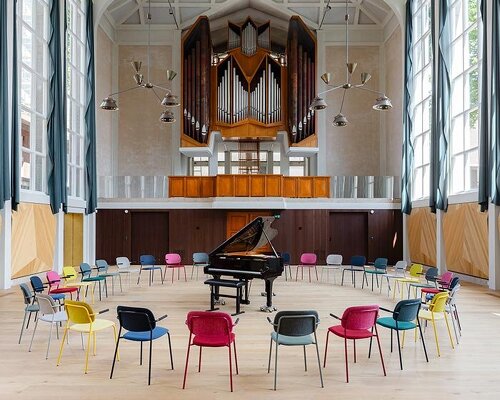
The project builds on the cultural and historical significance of the former Mennonite church through a strategy of preservation and selective intervention. Key architectural elements were retained, including the original plastered concrete cassette ceiling, which now forms the structural and spatial basis of the main music hall. The 1954 Flentrop organ was preserved and integrated into the program, extending its use to rehearsals and performances. New lighting elements, including large chandeliers, articulate the height and volume of the former church hall without altering its primary structure.
A circular design approach informed both material reuse and sustainable construction strategies. Original church pews were repurposed into seating and wall paneling in the foyer, while slate tiles from the former hall were reused in the entrance area and as baseboards. Existing wooden window frames were restored rather than replaced, maintaining the building’s material continuity. Additional sustainable measures include the use of recycled PET for seating, restored Bakelite hardware and lighting fixtures, climate-positive marmoleum flooring, and recyclable PVC roofing. New tiles were introduced in ton-sur-ton compositions that align with the existing finishes.
all images courtesy of Powerhouse Company
Muziekwerf’s Layered Interiors Support Performance
Interior spaces were individually designed to respond to varying acoustic, spatial, and functional requirements. The concrete structure necessitated targeted acoustic interventions, integrated without concealing the building’s original materiality. A restrained palette of soft colors and exposed concrete surfaces emphasizes the layered history of the building. Design elements such as plaster ceiling clouds, concrete window frames, original tiles, and references to 1950s detailing establish continuity between old and new.
Environmental comfort was addressed through integrated building systems. Underfloor heating was installed in music studios to eliminate radiators along the windows, maintaining unobstructed daylight access. In larger spaces, ceiling-mounted radiant panels allow the concrete trusses to remain visible. Light oak flooring and sound-diffusing wall panels introduce warmth and acoustic control, referencing the former church benches through material continuity. Natural light is enhanced through the use of blue velvet curtains and reflective glazing along the balcony, directing light into the upper portions of the structure.
Urban connectivity was strengthened through the introduction of a new front entrance, the only newly constructed element in the project. Positioned between surrounding buildings and a nearby waterway, the entrance features an undulating reflective ceiling inspired by water reflections. This transitional space connects the exterior public realm with the interior foyer, offices, and music studios. Enlarged window openings and the reuse of church benches support visual and physical engagement with the adjacent public square. The design team at Powerhouse Company collaborates with Droom en Daad on the project, repositioning the former church, previously concealed within the urban fabric, as a public cultural facility. Muziekwerf demonstrates how adaptive reuse, material continuity, and carefully calibrated interventions can transform a heritage structure into an accessible space for contemporary cultural production, supporting new forms of collective use while preserving architectural identity.
Muziekwerf adapts Rotterdam’s last Mennonite church into a youth-focused music venue
the 1951 post-war church is transformed into a multifunctional cultural space
the plastered concrete cassette ceiling defines the main music hall
new chandeliers articulate the scale of the former church hall
original architectural elements guide the adaptive reuse strategy
interior spaces are tailored to specific acoustic and functional needs
recycled PET chairs and restored Bakelite fixtures support sustainable design
a new entrance introduces an undulating reflective ceiling inspired by water
the former church is repositioned as a public cultural facility for youth
restored wooden window frames preserve the building’s material continuity
material reuse follows a circular design approach throughout the project
light oak floors and acoustic panels introduce warmth to the interiors
original church pews are repurposed as seating and wall paneling
Powerhouse Company repositions the former church as a public cultural facility
project info:
name: Muziekwerf
architect: Powerhouse Company | @powerhousecompany
location: Rotterdam, Netherlands
area: 930 sqm
client: Droom en Daad
partner in charge: Nanne de Ru
designboom has received this project from our DIY submissions feature, where we welcome our readers to submit their own work for publication. see more project submissions from our readers here.
edited by: christina vergopoulou | designboom
The post powerhouse company adapts rotterdam’s 1951 post-war church into youth music venue appeared first on designboom | architecture & design magazine.