
transforming rail infrastructure into civic public realm
Xuzhou East Station Plaza, designed by ARTS GROUP, repositions a high-speed rail forecourt as an integrated urban public space. Located at the junction of the Beijing-Shanghai and Longhai rail corridors, Xuzhou East Railway Station serves approximately 13.8 million passengers annually and connects 181 cities within China’s national rail network. While the original station efficiently organized vehicular circulation, it lacked spatial definition, pedestrian integration, and civic presence.
The East Plaza project forms part of the broader High-Speed Rail New City development. The site sits above a multi-level underground parking facility and coordinates with three metro lines, multiple station entrances, arrival halls, and an elevated departure deck. Circulation unfolds across several vertical layers. Rather than masking this infrastructural complexity, the design treats it as the basis for a three-dimensional public realm. Within the master plan, a major green corridor extends toward the station. The plaza marks the terminal point of this axis, redefining the forecourt as a civic threshold rather than a residual transfer space. Linear landform architecture frames the station building, establishing directional clarity and spatial depth. Calibrated paving geometries radiate toward the facade, reinforcing the station’s role as an urban gateway while referencing Xuzhou’s historic identity as a regional crossroads.
all images courtesy of ARTS GROUP
integrating mobility, landscape, and urban identity
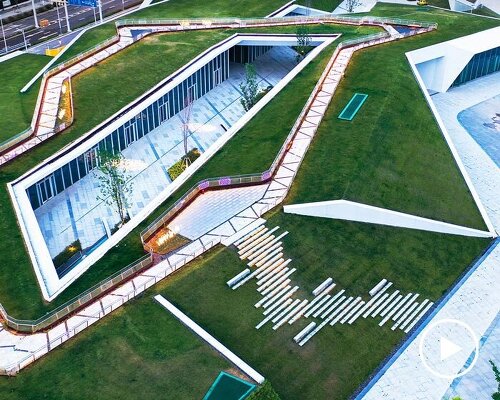
To activate the site beyond peak transit periods, the design team at ARTS GROUP embeds two commercial street volumes within the plaza structure. Configured in an hourglass plan, these blocks modulate the scale of the forecourt and introduce daily amenities for commuters and nearby residents. The commercial streets reduce perceived walking distances, provide sheltered pedestrian routes, and create active frontages along key edges. Above these volumes, the project introduces a three-dimensional landscape park. The roofs of the commercial structures become accessible green slopes that merge with the plaza topography. This integration of architecture and landscape dissolves the mass of built form into landform, allowing commercial infrastructure and open space to coexist within a continuous spatial system.
The elevated park functions as ecological infrastructure, incorporating stormwater absorption, shaded seating areas, and connections to surrounding residential podium gardens. Public space is distributed across ground level, terraces, and roofscapes, forming a layered environment where transit movement and everyday urban life intersect. A central objective of the project is station-city integration. The design establishes clear pedestrian links to adjacent neighborhoods, reduces vehicular dominance at grade, and aligns spatially with broader urban planning axes. The station forecourt shifts from a peripheral mobility zone to a defined civic node within the High-Speed Rail New City.
Completed between 2020 and 2022, Xuzhou East Station Plaza operates simultaneously as transport infrastructure and public landscape. The project demonstrates how large-scale transit platforms can accommodate operational demands while supporting civic identity and public activity. Through coordination between transportation engineering, architecture, and landscape design, the plaza presents a model in which infrastructure and urban space function as a continuous system.
Xuzhou East Station Plaza redefines the high-speed rail forecourt as integrated urban public space
the redesigned forecourt strengthens pedestrian integration and civic presence
built above a multi-level parking facility, the site coordinates with three metro lines
infrastructural complexity becomes the foundation for a three-dimensional public realm
commercial roofs transform into accessible green slopes above the streets below
the forecourt is redefined as a civic threshold rather than a residual transfer space
calibrated paving geometries radiate outward, reinforcing the station’s gateway role
architecture and landscape merge within a continuous topographic system
public space extends across ground level, terraces, and roofscapes
two commercial street volumes are embedded within the plaza structure
an hourglass plan configuration modulates the scale of the expansive forecourt
linear landform architecture frames the station facade and guides movement
the completed plaza operates simultaneously as transport infrastructure and civic landscape
project info:
name: Xuzhou East Station Plaza
architect: ARTS GROUP
location: Xuzhou, China
designboom has received this project from our DIY submissions feature, where we welcome our readers to submit their own work for publication. see more project submissions from our readers here.
edited by: christina vergopoulou | designboom
The post radiating paving and green roofs recast xuzhou rail station as urban gateway and public realm appeared first on designboom | architecture & design magazine.