
PROS:
Strong portrait camera performance for the price range
Huge 7,000mAh battery with 80W wired charging
CONS:
No wireless charging
The realme 16 Pro+ seems to be a modest upgrade in the company’s Number Series. While it is not packed with major improvements in every area, it tries to win you over as a well-rounded package built around design, battery life, and cameras. On paper, it still reads like a wish list: a 200 megapixel main camera with 3.5x telephoto, a 6.8 inch 144 Hz AMOLED display, a 7000 mAh battery with 80 W charging, IP68 and IP69 protection, and a Naoto Fukasawa-designed back made from bio-based silicone.
It also arrives with a few important caveats. The Snapdragon 7 Gen 4 chipset is carried over from the realme 15 Pro rather than being a big step up, and the rumoured pricing pushes the 16 Pro+ toward affordable flagship territory rather than a classic, value mid-ranger. That raises a clear question. Does the mix of master level design, big battery stamina, and creator-focused camera hardware do enough to justify the price, or are you better off with a more conventional spec monster? We took a closer look.
Designer: Naoto Fukasawa x realme
Aesthetics
For the realme 16 Pro+, realme partnered again with world-renowned product designer Naoto Fukasawa. The brand has previously collaborated with Fukasawa on the realme X Master Edition, X2 Master Edition, GT Master Edition, and GT2 Pro Master Edition, and this new phone continues that lineage. The design fuses natural elements with contemporary style in what realme calls the Urban Wild Design, aiming to bring a calmer, more tactile character to a very modern device.
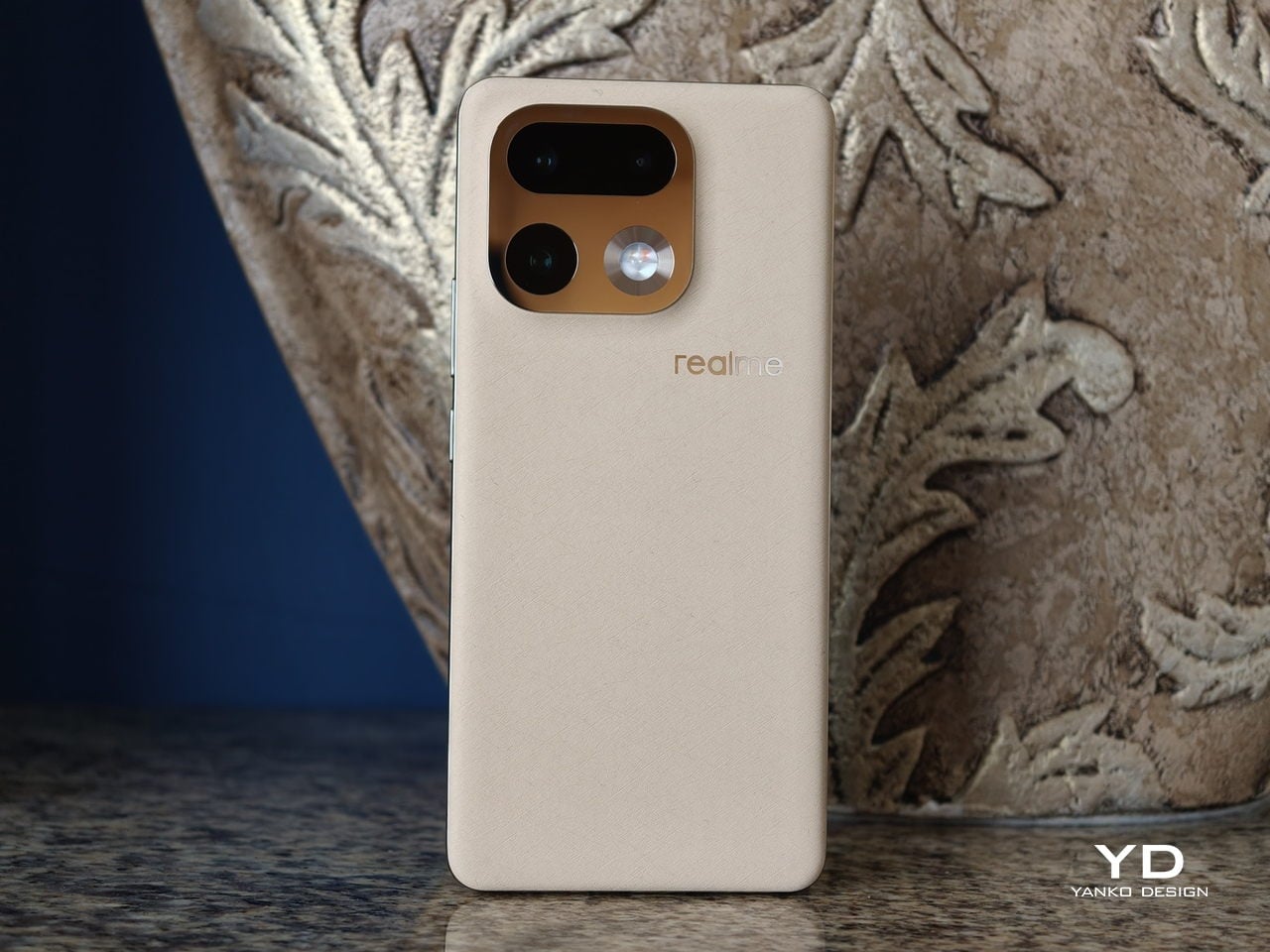
The Urban Wild Design is articulated through a deliberate contrast of the mirror-polished camera deco set against a natural texture back panel. The back is built around what realme calls a Metal Mirror Camera Deco, a mirror finish metal plate that frames the lenses like a piece of jewellery on top of a matte, softly grained surface. The back panel uses a bio-based organic silicone derived from plant-based straw, processed with an eco-friendly method that the brand positions as an industry-first eco material. The result is a surface that feels soft, finely textured, and grippy, with a visual warmth and calmness you do not usually get from glass or glossy plastic.
The 16 Pro+ comes in two colors in most markets. Master Gold is described as the soft golden glow of ripened wheat, with a gentle shimmer that catches the light without looking flashy. Master Black is inspired by the smooth, muted sheen of river pebbles, giving a more understated and refined look. Each variant features a color-matched mirror-polished camera bump and side frame, so the camera island, mid frame, and back panel read as one coherent piece rather than separate parts.
Ergonomics
On paper, the realme 16 Pro+ is not a small phone, yet it feels more considered than the raw numbers suggest. The phone is 8.49 mm thick and weighs 203 g, which puts it firmly in the large phone camp without feeling unwieldy. The square camera bump does not protrude too much, and its sloped edges merge into the back panel to create a smooth transition. The back panel resists fingerprints and smudges quite well, though the glossy camera bump is a different story and picks up marks easily.
Thanks to the balanced weight and the gentle flow from the slightly curved display to the slightly curved side frame to the slightly curved back panel, the phone is very comfortable to hold in the hand. The volume rocker and power button are positioned where they are easy to reach, so basic controls fall naturally under your fingers. The fingerprint scanner, on the other hand, sits close to the bottom edge of the screen, which makes the move from unlocking the phone to actually using it feel a bit less smooth than it could be.
Performance
Since there was no Pro+ version of the realme 15, there is no direct predecessor of the realme 16 Pro+, but many specs are unchanged from the realme 15 Pro, including the chipset. The 16 Pro+ is powered by Snapdragon 7 Gen 4, Qualcomm’s upper mid-range chipset. While it does not deliver brute flagship power, it is more than strong enough for long gaming or browsing sessions without noticeable throttling. In daily use, the chipset has no trouble keeping up with realme UI 7.0, based on Android 16. Swiping through the 144 Hz interface feels fluid, apps open quickly, and multitasking between social media, messaging, and browsing remains consistently smooth.
The realme 16 Pro+ features a 6.8-inch AMOLED display with a 1280 by 2800 resolution and up to 144 Hz refresh rate. According to the spec sheet, it supports a 240 Hz touch sampling rate, 1.07 billion colors, 100 percent DCI P3 coverage, a 5,000,000 to 1 contrast ratio, and a peak brightness of 6500 nits. It is a sharp, bright, and vibrant panel that looks flagship-grade and comfortable in day-to-day use.
Realme brings a 200 megapixel camera to its Number Series for the first time. The triple camera setup consists of a 200 MP main camera, a 50 MP 3.5x telephoto camera, and an 8 MP ultra wide camera, with a 50 MP front-facing camera handling selfies. In the camera app, you can choose between Vibrant and Natural color modes for the rear cameras, depending on whether you prefer punchier social media-ready shots or a more restrained look.
The 23 mm equivalent 200 MP main camera uses Samsung’s HP5 sensor with an f/1.8 aperture lens and both optical and electronic image stabilisation. It can capture very detailed shots with a wide dynamic range in good lighting conditions, and stabilisation helps keep images sharp when light levels drop. In the standard Photo mode, you also get an AI composition feature that analyses your framing and suggests small adjustments for a stronger composition, nudging you to tilt, reframe, or shift your subject for a more balanced shot. This tool is not available in Portrait mode, but it is genuinely helpful for quick point-and-shoot photography.
The 80 mm equivalent 50 MP 3.5x telephoto camera uses Samsung’s JN5 sensor behind an f/2.8 aperture lens, again with OIS and EIS. Portrait mode lets you shoot at 1x, 1.5x, 2x, 3.5x, and 4x, and results across these focal lengths are consistently strong, with pleasing separation and natural-looking depth. realme also packs in a wide range of dedicated Portrait filters, so you can switch between more cinematic, vintage, or punchy looks without leaving the mode.
The 15 mm equivalent 8 MP ultra wide rounds out the rear trio. It does the job for landscapes, interiors, and group shots, but image quality is more functional than exciting, with less detail and dynamic range than the main and telephoto cameras. On the front, there is a 50 MP OmniVision OV50D selfie camera with an f/2.4 aperture lens. This is unusually ambitious for the class. It can capture crisp selfies with plenty of detail.
As for video, the main and front-facing cameras both support 4K recording at up to 60 FPS. The telephoto and ultrawide cameras are limited to 1080p at 30 FPS, which feels a bit disappointing on the telephoto side, especially given how capable it is for stills. It would have been nice to see at least 4K 30 fps from the zoom camera to fully match the rest of the system.
realme 16 Pro+ is built around a huge 7000 mAh battery, and you feel that capacity in day-to-day use. With this much headroom, it comfortably handles a full day of heavy messaging, social media, camera use, and streaming, and lighter users can easily stretch into a second day without reaching for the charger. When you finally do need to charge, the 80 W wired charging support keeps downtime short.
Sustainability
realme 16 Pro+ makes a stronger effort on sustainability than many mid-range phones. The most visible element is the back panel material. Instead of conventional petroleum-based plastic or glass, realme uses a bio-based organic silicone derived from plant-based straw, processed through an eco-friendly method. It is designed to be safer for the skin, gentler on the environment, and more resistant to aging, dirt, and wear, which should help the phone look fresh for longer and reduce the urge to replace it early.
Durability also plays into sustainability. The phone carries both IP68 and IP69 ratings, meaning it is tested for dust tightness, immersion in water, and high-pressure water jets. In practical terms, that level of protection makes the 16 Pro+ far more likely to survive everyday accidents, from rain and spills to brief drops into water. A device that shrugs off this kind of abuse is less likely to be written off early, which again extends its usable life.
On the software side, realme commits to three years of Android OS updates and four years of Android security patches. That is not at the very top of the industry, but it is long enough that you can realistically keep the phone for a full contract cycle and beyond without falling behind on major features or basic security. Combined with the durable hardware and more sustainable back panel material, it makes the 16 Pro+ feel like a phone designed to be used hard and kept in service rather than quickly replaced.
Value
At the time of writing, realme has not confirmed official pricing, but multiple leaks suggest the realme 16 Pro+ will start at INR 39,999 (around $445) for the 8 GB and 128 GB variant. The 8 GB and 256 GB model is rumoured to land at INR 41,999 (around $470), while the 12 GB and 256 GB version could reach INR 44,999 (around $500).
If these figures hold, the 16 Pro+ will sit at the upper end of the mid-range bracket, nudging into affordable flagship territory. In that context, the phone’s value depends on what you care about most. For users who prioritise a premium design, camera versatility, a truly huge 7000 mAh battery, a bright 144 Hz AMOLED display, and sustainability, the package looks competitive.
Verdict
realme 16 Pro+ is not a revolution for the Number Series, but it is a carefully tuned evolution that leans into design, cameras, and battery life instead of chasing raw specs in every direction. The Naoto Fukasawa Urban Wild Design, bio-based silicone back, and Metal Mirror Camera Deco give it a distinctive look and feel, while the solid ergonomics and IP68 plus IP69 ratings make it more robust than many mid-range rivals. Snapdragon 7 Gen 4 is familiar rather than exciting, yet in practice, it keeps realme UI 7.0 and the 144 Hz AMOLED display running smoothly, and the 7000 mAh battery with 80 W charging turns it into a genuine all-day workhorse.
As for the camera, the realme 16 Pro+ consistently turns out pleasing portraits across its various focal lengths, with good subject separation and flattering rendering. The front-facing camera also performs well. Where things get complicated is value, because the rumoured pricing nudges the 16 Pro+ into premium mid-range territory rather than classic budget-friendly mid-range. If you prioritise a phone that looks and feels special, lasts comfortably through heavy days, and gives you reliable portrait and selfie performance, realme 16 Pro+ makes a strong case for itself even as a modest generational upgrade.
The post Realme 16 Pro+ Review: Naoto FUkusawa Helped Make a Battery Beast Beautiful first appeared on Yanko Design.