
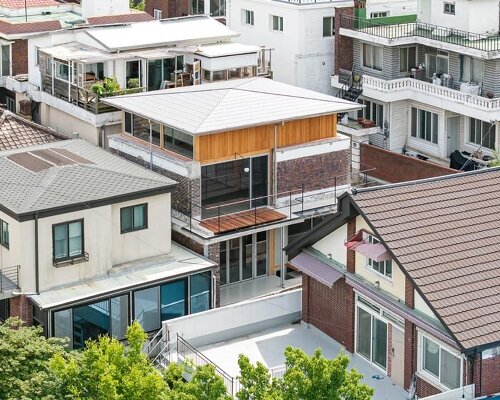
A.CO.LAB Architects renovates 1969 Seoul residence
Painter N’s House by A.CO.LAB Architects is a renovation project of a single-family residence originally constructed in 1969 in Yeonhui-dong, Seoul. Rather than demolishing and rebuilding, the project focuses on preserving the existing structure and adapting it to meet contemporary spatial requirements. The design approach treats the building’s aged and irregular condition as a record of lived experience, integrating new architectural systems within its historical fabric.
The renovation addresses both the lifestyle of an artist couple who had inhabited the house for more than a decade and the broader character of the surrounding neighborhood. Instead of erasing structural and environmental limitations through reconstruction, the project resolves them through targeted interventions. The existing building envelope is retained, and its imperfections are understood as part of a social and material archive.
To maintain the scale of the alleys and the established texture of the village, the exterior was not fully reclad. External insulation was removed to reveal the original brickwork, and missing decorative bricks were sourced from a nearby redevelopment site, dismantled and reused to complete the facade. This material continuity reinforces the relationship between the renovated house and its urban context.
all images courtesy of A.CO.LAB Architects
old and new materiality interplay in Painter N’s House
The design team at A.CO.LAB Architects inserts a new structural framework within the retained brick shell, extending from the basement to the attic. Organized as a regular three-dimensional grid based on a 田-shaped plan, the system negotiates the uneven floors and walls of the original house while enabling vertical and horizontal expansion. Wood was selected for areas of direct human contact due to its tactile qualities, while metal was used for exposed ceiling structures. The second floor was constructed entirely in wood.
Responding to the stepped topography at the foot of the mountain, the attic extension was limited in height to preserve neighboring views. The original first-floor slab, positioned above a former underground air-raid shelter, was removed and replaced with a raised wooden floor integrated into the new structural system. This intervention creates a continuous yet articulated relationship between the basement and first floor, with the raised floor extending outward to form a porch.
Interior components, including shelving, movable tables, storage units, lighting, and bathroom partitions, are organized according to the logic of the structural grid. Roof eaves and gutters protect the wooden cladding of the attic extension, while additional insulation and brass drainage elements address water infiltration between the existing outer wall and the new inset structure.
Painter N’s House is a 1969 residence renovated in Yeonhui-dong, Seoul
Constructed using accessible materials such as wood, recycled brick, metal, and standard fixtures, Painter N’s House project demonstrates how renovation can operate as a primary architectural strategy. By embedding new structural logic within an existing shell, the house negotiates continuity, material reuse, and spatial adaptation within the framework of a 1969 dwelling.
existing brick walls are preserved as part of the renovation strategy
the original building envelope remains intact
targeted interventions replace demolition and reconstruction
a new structural framework is inserted within the existing shell
wood, recycled brick, and metal shape the renovation’s material palette
a three-dimensional grid follows a square-shaped plan
wood defines areas of direct contact and the second floor
metal structures remain exposed at the ceiling
the attic extension is limited to preserve neighboring views
built-in elements align with the structural grid
the aged condition of the house is treated as a material archive
the facade maintains the scale and texture of the village
reclaimed bricks were sourced from a nearby redevelopment site
living areas open entirely to the residence’s courtyard
project info:
name: Painter N’s House
architect: A.CO.LAB Architects | @a.co.lab
lead architects: Isak Chung, Jinpyo Hong
location: Yeonhui-dong, Seoul, Korea
designboom has received this project from our DIY submissions feature, where we welcome our readers to submit their own work for publication. see more project submissions from our readers here.
edited by: christina vergopoulou | designboom
The post reclaimed brick skin and wooden frame update 1969 seoul residence appeared first on designboom | architecture & design magazine.