
reused Timber reconstructs Micro-Village along the mountain
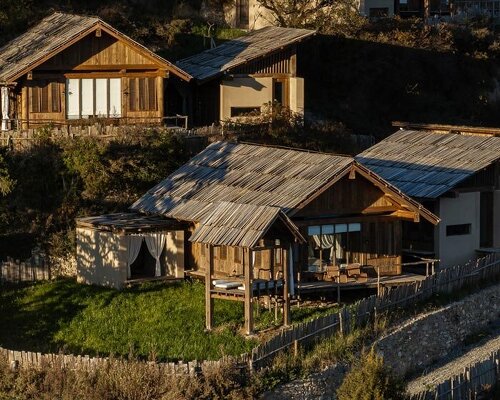
Located on a ridge at an altitude of 3,000 meters in Jiuzhaigou, China, Songtsm Travel Hotel Jiuzhai project transforms a micro-village of eight existing wooden cabins into a small-scale resort. The site, defined by its proximity to clouds, dense fir forests, and rocky terrain, is approached through a design strategy that prioritizes continuity with the existing landscape and built fabric. Rather than a conventional renovation, the intervention focuses on reusing aged timber, preserving structural traces, and reinforcing the relationship between architecture and its environment.
The project consists of 12 detached guest units, each occupying a plot of 150–180 sqm, with a built area of over 80 sqm. The units are organized into four clusters, where functions such as living rooms, bedrooms, soaking pools, and tea pavilions are distributed across separate volumes. This fragmented arrangement reduces the scale of each intervention and establishes a dispersed spatial system across the terrain.
Material selection is centered on timber construction. Existing wood elements are retained and reintroduced, while new structures follow similar construction logic. The architectural language references Tibetan vernacular dwellings through the use of wooden shingles and tiled roofs, ensuring visual and material continuity with the region. The emphasis on untreated or minimally processed materials allows surface textures, aging, and environmental exposure to remain visible.
aerial view of Songtsm Travel Hotel Jiuzhai in Jiuzhaigou, China | all images by You Pu
Layered Spatial Sequences Connect Interior Living with Landscape
Each guest unit is conceived as a sequence of spaces rather than a single enclosed volume. Transitional zones, including dedicated living areas, operate as intermediate spaces between interior and exterior conditions. These areas support a gradual shift from enclosed, protected environments to more open, landscape-oriented spaces. The spatial organization prioritizes privacy while maintaining visual connections to the surroundings.
Openings and transparent surfaces are positioned to frame views of the surrounding landscape, integrating natural elements into the interior environment. Large glazed sections allow daylight to penetrate deep into the spaces, while also enabling continuous observation of changing weather conditions, from cloud movement to night skies. Outdoor areas are oriented to support activities such as stargazing and direct engagement with seasonal variations. The integration of water elements is addressed through timber-lined soaking pools, positioned as part of each unit’s spatial sequence. These elements reinforce the relationship between material, atmosphere, and use, extending the tactile qualities of wood into areas of direct contact.
The central lobby is designed as a collective interior space defined by material continuity and reuse. Aged wooden panels line the ceiling, while textured plaster walls introduce a contrasting surface condition. Furnishings are composed of reclaimed or aged elements, contributing to a consistent material palette and reinforcing the overall spatial identity. The construction approach minimizes intervention on the site. Existing cabins are retained where possible, and new structures are inserted with consideration for topography and vegetation. Songtsm Travel Hotel Jiuzhai project by Hangzhou Thinking Design Studio avoids large-scale ground modification, allowing the built environment to remain embedded within the existing landscape.
a resort set on a ridge at 3,000 meters altitude
transformation of an existing micro-village of wooden cabins
reuse of aged timber preserves material memory
existing structures retained and extended across the site
wooden shingles and tiled roofs reference local typologies
twelve detached guest units distributed in clusters
lobby interior shaped by reclaimed wood and textured plaster
transitional zones mediate interior and exterior conditions
spaces organized as a sequence rather than a single volume
openings frame views of forest, sky, and mountains
surfaces left untreated to reveal aging and texture
project info:
name: Songtsm Travel Hotel Jiuzhai
architect: Hangzhou Thinking Design, Hangzhou Lanting Design
lead designer: Wu Xiaoyong
location: Jiuzhaigou, China
area: 8092.81 sqm
photographer: You Pu
designboom has received this project from our DIY submissions feature, where we welcome our readers to submit their own work for publication. see more project submissions from our readers here.
edited by: christina vergopoulou | designboom
The post reclaimed timber reassembles a cluster of cabins into a mountain resort in china appeared first on designboom | architecture & design magazine.