
Redefining perceptions: Human Hair as Material for Design
This research-based design project by Laura Oliveira investigates discarded human hair as a potential raw material for sustainable design applications. Human hair is produced continuously and in large quantities through everyday grooming practices, yet it is almost always treated as waste once separated from the body and typically disposed of in landfills. Despite its material properties, strength, flexibility, and durability as a keratin-based protein fiber, its reuse remains uncommon within design and material research contexts.
The project proposes an alternative approach by collecting human hair from local professional salons and transforming it through textile and biomaterial processes. All material was sourced with informed consent, ensuring ethical collection practices. Once gathered, the hair was cleaned and systematically sorted by length, color, and texture to support controlled experimentation.
felted samples | all images by Laura Oliveira and Mayra Deberg
examining circular approaches to material use and waste
Material development focused on hands-on testing through a combination of traditional textile techniques and bio-based fabrication methods. Felting and fiber blending were employed to explore hair as a non-woven material, both independently and in combination with wool. These processes resulted in dense yet lightweight surfaces with varying tactile and visual characteristics. In parallel, human hair was tested as a reinforcing fiber within bio-based matrices, using natural binders such as resins and glycerin. Through controlled heating, mixing, and molding, the fibers were incorporated into composite material samples.
The outcome of the project by designer Laura Oliveira, led by Raul Pinto, is a series of experimental material samples that demonstrate the technical and aesthetic potential of human hair when recontextualized as a design material. Beyond material performance, the work also addresses cultural and ethical considerations surrounding hair, which is widely accepted while attached to the body but often rejected once removed. By repositioning human hair within a design and material research framework, the project examines how alternative material choices can support more circular production systems and encourage critical reflection on notions of waste, value, and sustainability.
carded samples with different percentages of human hair
carding detail
needle felting sample
biocomposite sample
needle felt balls
non-woven fabric
detail of the non-woven fabric’s drape
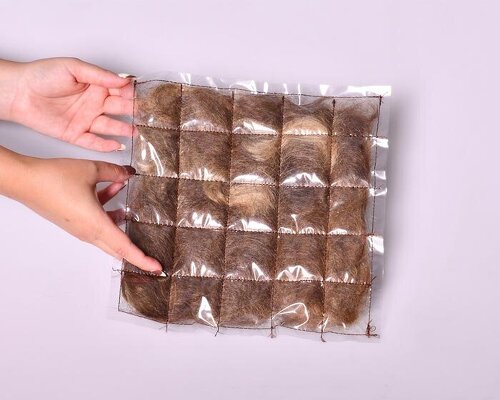
hair as a filling material
human hair mixed with pine resin
human hair mixed with pine resin
biotextile mainly made from human hair and glycerin
project info:
name: Human Hair Waste as Raw Material for Design
designer: Laura Oliveira
thesis advisor: Raul Pinto
photographers: Laura Oliveira, Mayra Deberg
designboom has received this project from our DIY submissions feature, where we welcome our readers to submit their own work for publication. see more project submissions from our readers here.
edited by: christina vergopoulou | designboom
The post recontextualizing human hair waste as potential raw material for design appeared first on designboom | architecture & design magazine.