
Papercrete Structure Defines a Porous Installation by Raza Zahid
Morphosis by Raza Zahid is an experimental installation that transforms discarded paper into a living spatial system. Developed through research into paper waste and the cultivation of microgreens on paper substrates, the project explores how growth, decay and material reuse can coexist within an architectural framework.
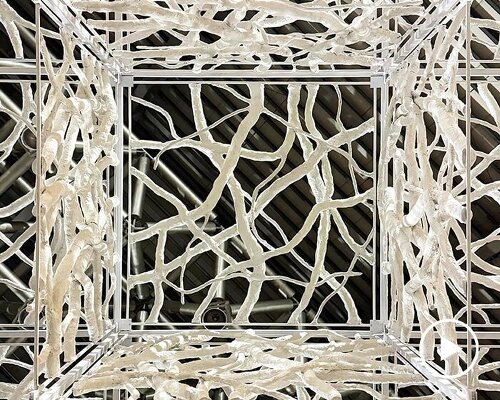
The installation occupies a 5 × 5 × 5 meter volume defined by slender powder-coated metal frames, each supporting clusters of hand-formed papercrete branches. Drawing from traditional paper-mâché techniques, shredded paper is reconstituted into a structural medium capable of maintaining form, texture, and the capacity to host plant growth. Collectively, these panels create a porous spatial envelope that reconstructs the visual and structural memory of a tree. Each component is unique, shaped by hand and marked by material traces, producing variation in density, light, and shadow throughout the volume.
Spatial conditions within the installation vary as one moves through it: passages shift between compression and openness, light filters through uneven surfaces, and shadows interact dynamically across the structure. The resulting environment occupies a space between interior and exterior, evoking the scale and texture of a grove within an industrial setting.
light and shadow weave a quiet maze on the floor | all images courtesy of Raza Zahid
Biological Processes and Craft Activate a Living Material System
Morphosis incorporates a temporal dimension by cultivating microgreens directly on the papercrete surfaces. The growth and eventual decay of vegetation introduce cyclical changes, making the installation responsive to time and biological processes. Surface becomes landscape, and structure functions as a host for life.
The project by designer Raza Zahid also engages with craft and fabrication. It involves intensive manual processes and the training of makers to understand the behaviour of papercrete, bridging traditional knowledge with contemporary experimental practices. This integration of material innovation, ecological processes, and handcrafted production situates Morphosis as both a spatial experiment and a living demonstration of sustainable, material-conscious design.
By combining recycled materials, biologically active surfaces, and modular construction, the installation introduces organic complexity and softness into a rigid industrial environment, creating a spatial condition that recalls ecological systems within urban and manufactured contexts.
enclosed by paper branches
branches gather in unique compositions, creating shifting layers of opacity
through the lattice of paper branches
greenery begins to envelop the structure
every assemblage of branches and greenery is unique
a tall narrow entrance heightens both verticality and intimacy
a vertical of branches rising 5 meters
a lattice of hand-formed papercrete branches form a porous, tree-like spatial structure
a dialogue between the organic and the industrial
papercrete branches feature layered textures and embedded microgreens
exploring the panel joinery system
successful growth of greenery on the first panel
microgreens taking root on papercrete
project info:
name: Morphosis
designer: Raza Zahid | @razazahid
dimensions: (L) 5 m X (W) 5 m X (H) 5m
materials: Recycled Paper, Metal, Adhesive/Binder, Microgreens
collaborator: Areeba Imran
commissioned by: Institute of Architects, Pakistan for the IAPEX 25
exhibition: Expo Center, Lahore, Pakistan
sponsored by: Architects World
designboom has received this project from our DIY submissions feature, where we welcome our readers to submit their own work for publication. see more project submissions from our readers here.
edited by: christina vergopoulou | designboom
The post recycled paper waste turns into a branch-like lattice in a living spatial installation appeared first on designboom | architecture & design magazine.