
XXXI.studio Develops an Adaptable Interior for Lupita restaurant
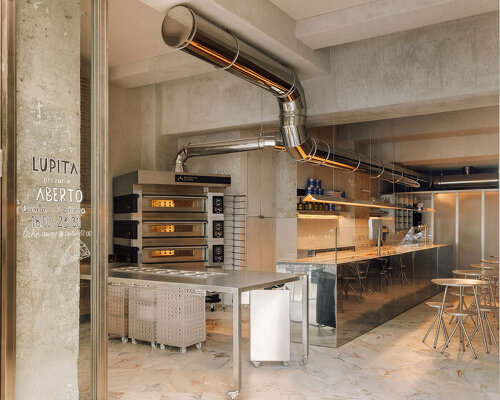
Architectural practice XXXI.studio introduces Lupita’s latest Lisbon location, a pizza restaurant situated in Alvalade, Portugal. The new location introduces an architectural approach centered on production, visibility, and operational clarity. The project expands on the brand’s earlier Cais do Sodré space by positioning pizza-making as the primary spatial and visual driver. The restaurant’s fully open facade exposes the interior directly to the street, treating the preparation process as a continuous, public-facing activity.
XXXI.studio’s strategy prioritizes preservation and adaptability. Existing features are maintained whenever possible, and when absent, new interventions are introduced to simulate the presence of prior layers. This approach supports long-term ecological goals by allowing the space to accommodate future tenants without major structural changes; identity is instead defined through movable elements and equipment.
all images by Francisco Nogueira
Workflow-Driven Interior Shapes Lupita’s Open Production Space
The design brief centered on accommodating high-volume production. The acquisition of an adjacent unit allowed for the creation of a dedicated pre-production and storage facility, enabling the main space to serve exclusively as a customer-oriented environment. Inside, the layout is intentionally minimal. Stainless steel counters organize the workflow, defining the circulation and production sequence. Seating is limited, with stainless steel tables and stools positioned along the exterior edge to maintain a direct visual and spatial connection between staff and visitors.
The full-height opening on the street front reinforces the studio’s principle of maximizing openness. By removing conventional signage and dissolving the boundary between interior and exterior, the space stands out among its commercial neighbors and presents the culinary process as the central element of the experience. The result, developed by XXXI.studio, functions as a case study in how architectural decisions can support intensive operations while shaping a clear and transparent brand identity.
Lupita’s new Alvalade location designed by XXXI.studio
the restaurant’s architecture centers on production and visibility
a fully open facade connects the interior directly to the street
exterior tables and stools maintain interaction between staff and visitors
pizza-making becomes the primary spatial and visual focus
movable elements define the restaurant’s identity within the space
the main interior space is reserved for customer-facing activity
stainless steel counters organize workflow and circulation
the interior layout highlights operational clarity and efficiency
floating polished stainless steel ducts contrast the raw concrete ceiling
minimal seating emphasizes the production-focused layout
project info:
name: Lupita, Alvalade
architect: XXXI.studio | @x.x.x.i_studio
design team: Carlos Aragão, Teresa Cayatte, Manuel Amigo
constuction team: Hugo Maia, Teresa Cayatte, Elena Rossi, Rafaela Marques
location: Lisbon, Portugal
area: 72 sqm
photographer: Francisco Nogueira | @francisconogueira
designboom has received this project from our DIY submissions feature, where we welcome our readers to submit their own work for publication. see more project submissions from our readers here.
edited by: christina vergopoulou | designboom
The post reflective steel interiors and open facade bring lisbon’s street activity into pizza restaurant appeared first on designboom | architecture & design magazine.