
Renzo Piano to redesign montparnasse retail slab
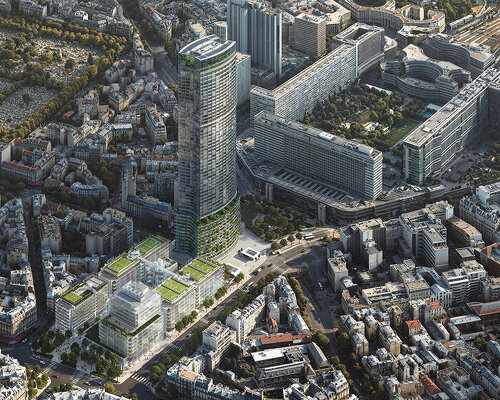
Renzo Piano Building Workshop (RPBW) unveils a new vision for the Ensemble Immobilier Tour Maine-Montparnasse, a large-scale urban retrofit that transforms a closed 1970s retail complex into an open, pedestrian-focused piece of Paris. Commissioned by the co-owners of the Montparnasse Commercial Centre and the CIT Tower, the project unfolds in parallel with the ongoing redevelopment of the adjacent Montparnasse Tower, led by Nouvelle AOM. The two interventions aim to recalibrate one of the most contested sites of the city, shifting it from an inward-looking megastructure to a permeable urban district grounded in daily life, movement, and public space.
The architects aim to open the site back to the city. New pedestrian routes cut through the block, linking Rue de Rennes, the Montparnasse station, and neighboring streets across three Parisian arrondissements. Ground floors become transparent and permeable, allowing visual and physical continuity through the site.
A large planted piazza anchors this plan. Conceived as a protected civic space, shaded and removed from traffic, it is designed to host everyday activities rather than monumental gestures. Cafés, terraces, cultural programs, and sports facilities activate the square throughout the day, positioning it as a shared living room for the neighborhood.
images courtesy of RPBW
From inward retail complex to Parisian city block
Originally designed by AOM and built between 1969 and 1973, the Ensemble Immobilier Tour Maine-Montparnasse occupies the former Montparnasse train station site, composed of the tower, the commercial center, and the CIT Tower set above it. Conceived during an era of slab-based urban planning, the complex was focused on separation, elevation, and internal circulation. Over time, these strategies produced a fragmented condition, detached from the surrounding neighborhoods.
RPBW’s proposal responds directly to this legacy, reframing the commercial center as a contemporary Parisian block, one that reconnects streets, restores ground-level continuity, and reintroduces public life where it had been pushed aside. New buildings are scaled to harmonize with the surrounding urban fabric, reinforcing the perception of a coherent block instead of a megastructure. Programmatically, the architects introduce a mix of cultural, residential, commercial, and sports uses, including student housing, offices, and local retail. This diversity supports proximity-based daily life and extends activity beyond retail hours, contributing to a more inclusive and walkable environment. Architecture here operates more as a framework for encounter, movement, and coexistence, aligning with broader shifts in how Paris approaches large inner-city transformations.
a large-scale urban retrofit that transforms a closed 1970s retail complex into an open, pedestrian-focused piece
Reuse as structural and environmental logic of the project
RPBW retains the existing structural grid as the backbone of the intervention, reducing material consumption and embodied carbon and positioning reuse as a central design driver. Where new volumes are introduced, they take the form of lightweight timber structures, allowing additional programs to be integrated with minimal structural intervention. Conservation, transformation, and selective demolition result in a project that treats the inherited fabric as a resource.
Commissioned in 2022, the project experienced a pause in 2023 as amendments to Paris’s Land Use Plan were debated. Design work resumed in 2025, with discussions aligning planning, environmental, and client objectives into a unified vision for both the commercial center and the CIT Tower. In late 2025, the Council of Paris voted in favor of the project in a bipartisan decision, followed by the signing of a protocol agreement between the City of Paris and the EITMM in January 2026.
the project unfolds in parallel with the ongoing redevelopment of the adjacent Montparnasse Tower
a large planted piazza anchors this plan
RPBW retains the existing structural grid as the backbone of the intervention
project info:
name: Ensemble Immobilier Tour Maine-Montparnasse (EITMM)
architect: Renzo Piano Building Workshop | @rpbw_architects
project: Montparnasse Commercial Centre and CIT Tower
location: Paris, France
client: EITMM Commercial Centre owners’ association; EITMM CIT Tower owners’ association
design team: A. Giralt, P. Colonna, J. B. Mothes (partner and associates in charge)
The post renzo piano to open paris’s montparnasse commercial center back to the city appeared first on designboom | architecture & design magazine.