
NextOffice Reconfigures 1970s Tehran Home as a Cultural Center
The Poet’s House by NextOffice is the restoration and adaptive reuse of a 1970s residential building in downtown Tehran, formerly the home of Iranian poet and dissident Ahmad Shamlou. The project converts the house into a cultural center while retaining key architectural features of the original structure, including its brick facade, rounded corners, and expressive lintels characteristic of the period.
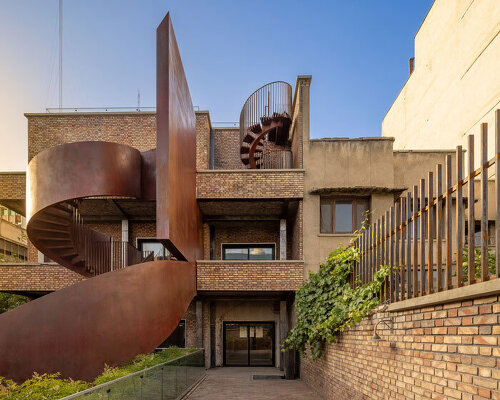
The intervention centers on a second-floor interior wall inscribed with a handwritten poem by Shamlou addressed to his wife and muse, Aida. Rather than treating the inscription as a preserved artifact, the design extends this wall into a spatial and semi-structural element that organizes circulation throughout the building. Known as the ‘Aida Wall,’ the new steel structure rises from the courtyard to the rooftop, forming a three-dimensional promenade that connects interior programs and visually opens the house toward the surrounding city.
the Poet’s House is the adaptive reuse of a 1970s residential building in downtown Tehran | image by Parham Taghioff
Steel Intervention Reinforces the Poet’s Brick House by NextOffice
The original building’s brick load-bearing structure required reinforcement to accommodate the new public program, which includes exhibition spaces, a library, bookstore, café, and restaurant. The structural intervention was made explicit rather than concealed, with the steel wall functioning as both reinforcement and architectural framework. This strategy establishes a clear dialogue between the existing masonry structure and the inserted contemporary system.
Through this reconfiguration, the formerly private courtyard is repositioned as a public open space, supporting the building’s transformation from a domestic setting into a cultural venue. The steel intervention is deliberately reversible, allowing for its removal without permanent alteration to the original structure. Material selection by design studio NextOffice emphasizes contrast and adaptability, with steel chosen for its capacity to weather over time and respond formally through cutting, bending, and articulation.
The Poet’s House demonstrates an approach to adaptive reuse that balances preservation with transformation. By integrating structural necessity, spatial organization, and cultural reference into a single architectural element, the project reframes a private residence as a public institution while maintaining the legibility of its original form and history.
the project transforms the former home of poet Ahmad Shamlou into a public cultural center | image by Ehsan Hajirasouliha
original architectural features, including the brick facade and rounded corners, are retained | image by Parham Taghioff
structural reinforcement is expressed rather than concealed within the design | image by Parham Taghioff
the steel element functions as both architectural framework and structural support | image by Mahdi Kamboozia
a clear dialogue is established between the original masonry and contemporary steel insertions | image by Parham Taghioff
the intervention is designed to be reversible without permanent alteration to the original building | image by Parham Taghioff
named the Aida Wall, the steel intervention organizes circulation across the building | image by Parham Taghioff
the project balances preservation with architectural transformation | image by Ehsan Hajirasouliha
the project introduces exhibition spaces, a library, bookstore, café, and restaurant | image by Ehsan Hajirasouliha
steel is selected for its adaptability and capacity to age over time | image by Ehsan Hajirasouliha
the Poet’s House by NextOffice repositions a private residence as a public cultural institution | image by Parham Taghioff
project info:
name: The Poet’s House
architects: NextOffice
lead architect: Alireza Taghaboni
design team: Elnaz Kharaghani, Hoodad Zoroufchiyan, Meysam Ebrahimi Moaghaddam, Roza Bemani, Ali Ghods, Farzad Farasat, Hadi Irani, Gelare Geranseresht, Negar Mansouri, Mohammad Motamedi, Elahe Babaei, Homa Asadi, Asal Karami, Shadi Bitaraf, Marziyeh Norouzi, Mohammad Amin Abedin, Soroush Attarzadeh, Ehsan Ahani, Saba Salehi, Mohammad Mardi, Ali Jahani
location: Tehran, Iran
photographers: Ehsan Hajirasouliha, Parham Taghioff, Mahdi Kamboozia
designboom has received this project from our DIY submissions feature, where we welcome our readers to submit their own work for publication. see more project submissions from our readers here.
edited by: christina vergopoulou | designboom
The post sculptural steel staircase and wall breathes new life into iranian poet’s 1970s home appeared first on designboom | architecture & design magazine.