
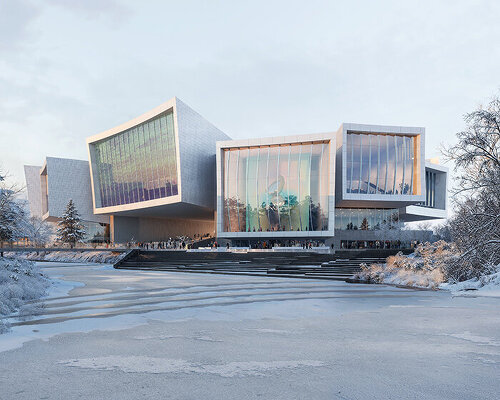
Snøhetta returns to beijing with radiating art museum
Developed in collaboration with Beijing Institute of Architectural Design, the project marks Snøhetta’s second major cultural commission in the Chinese capital after the Beijing Library. Set within the rapidly developing eastern district, the museum takes shape as a large-scale civic building positioned to support Beijing’s expanding cultural infrastructure while addressing the everyday rhythms of the surrounding neighborhood.
The program spans more than 110,000 square meters and accommodates fine art, contemporary practice, design, and forms of intangible cultural heritage. Alongside exhibition spaces, the building includes areas for research, storage, education, and public gathering. The ambition centers on a museum that operates as a civic interior capable of both hosting large audiences and supporting quieter forms of study.
Snøhetta and BIAD are selected to design the Beijing Art Museum | visualization © Proloog
a design driven by the concept of ‘vision’
Snøhetta, together with BIAD, frames its proposed Beijing Art Museum around the idea of ‘vision,’ understood as both the act of looking and the responsibility of stewardship. This concept guides spatial organization as collections are gathered inward while views are opened outward, This way, art is displayed in dialogue with the surrounding city.
The museum sits directly above an active metro line and incorporates a transit node at its base. From this infrastructural core, spaces expand outward in a radial composition. Curved, layered facades introduce a soft edge to the volume to mediate between interior galleries and exterior public space. The surface articulation encourages movement around the building and supports a continuous relationship between architecture and landscape.
galleries spiral outward to frame views of the surrounding district | visualization © Proloog
a large circular atrium
At the center of Snøhetta’s Beijing Art Museum, a large circular atrium organizes circulation and orientation. The space rises through multiple levels, drawing daylight deep into the plan and establishing visual connections across floors. Semi-open exhibition zones and social areas line the atrium, creating moments for pause and encounter alongside more controlled gallery environments.
Primary galleries, storage, and support spaces wrap the atrium in a gradual spiral, extending into outward-facing volumes that frame views across Tongzhou. These projecting forms allow visitors to alternate between focused engagement with artworks and broader awareness of the city beyond the walls. The experience emphasizes movement, orientation, and shared visibility across the building.
a radial massing strategy organizes the building around a central atrium | visualization © Proloog
landscaping connects the museum with the city
The surrounding landscape continues the radial geometry of the architecture, shaping plazas, planted areas, and outdoor exhibition zones. Paths and open spaces support informal gathering and public use throughout the day. Architecture, interior, and landscape read as a continuous spatial field that extends the museum’s presence into the district.
Environmental strategies include rooftop photovoltaic panels and an integrated water management system aligned with sponge city principles. These measures support energy generation and seasonal water control while contributing to long-term resilience.
Construction began on December 31st, 2025, with completion planned for 2029.
the museum builds on Snøhetta’s previously built Beijing Library | visualization © Snøhetta
project info:
name: Beijing Art Museum
architect: Snøhetta | @snohetta
location: Beijing, China
collaborator: BIAD
status: ongoing
area: 118,861 square meters
visualizations: © Snøhetta, © Proloog | @proloog.tv
client: Beijing Fine Art Academy
construction management: Beijing Investment Group Co.,Ltd,
concept, schematic design: Snøhetta, BIAD
construction design: BIAD
The post snøhetta plans spiraling galleries with curved glass facades for beijing art museum appeared first on designboom | architecture & design magazine.