
Sofitel Wuhan Hotel Design Maps Wuhan’s Cultural Identity
Located in Wuhan, Hubei Province, China, Sofitel Wuhan is conceived as a spatial interpretation of the city’s geographic, cultural, and historical identity. The interior design, led by Bei Yang, Design Partner of CIDA Shanghai, integrates local references with the brand’s contemporary design language, positioning the hotel as a point of connection between regional heritage and international hospitality. The project was awarded the Gold Award for Conceptual Design of Hotels & Resorts at the London Design Awards 2025.
The design concept draws from Wuhan’s role as the historic ‘Thoroughfare of Nine Provinces,’ a crossroads formed by the convergence of major rivers and trade routes. This idea is translated into the architectural and interior organization through a series of themed spaces that collectively form a spatial map of the city. The hotel podium functions as the primary conceptual framework, with each area referencing a specific landmark or cultural element, including the Yellow Crane Tower, Guqin Terrace, Wenjin Academy, the Yangtze River Bridge, Optics Valley, Han Opera, and Chu Embroidery. These spaces are designed as distinct yet interconnected zones, shaping the overall circulation and spatial logic of the hotel.
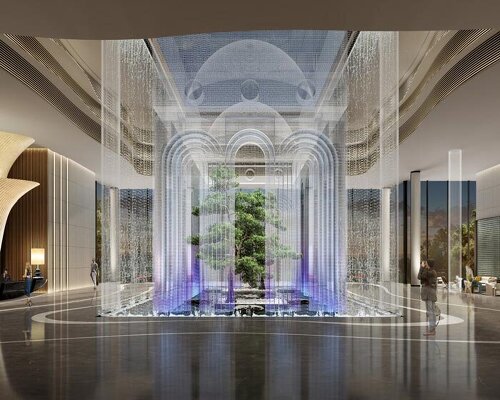
The lobby and lobby lounge are centered on the theme of the Yellow Crane Tower, which informs both the layout and the architectural expression of the interior. Natural light introduced through skylights plays a key role in defining the space, supporting a design approach that extends architectural concepts from the exterior into the interior environment. At the center of the lobby, a large-scale installation references Yuantong Hall at Gude Temple, a historical structure known for its synthesis of Eastern and Western architectural influences. This installation serves as a focal point within the atrium, emphasizing the dialogue between Chinese cultural references and Sofitel’s French design heritage.
a central skylight invites natural light, defining the interior design theme and style
hotel features Layered Contrasts and Water-Inspired Design
Contrasting design elements are used throughout the lobby to differentiate the space from conventional luxury hotel interiors. The juxtaposition of Chinese and Western architectural languages, along with variations in material, form, and scale, establishes a layered visual experience and encourages movement and interaction within the space. The atrium is further defined by a water curtain installation integrated into the surrounding glass walls. Programmable content allows the display to adapt to different operational and atmospheric requirements.
Water-related motifs are repeated across the interior, with ripple patterns applied to ceilings, floors, and wall surfaces. These elements reinforce the project’s conceptual link to Wuhan’s rivers while creating distinct visual conditions between daytime and nighttime. Through the integration of local cultural references, architectural symbolism, and contemporary interior strategies, Sofitel Wuhan presents a cohesive design narrative that aligns spatial experience with the city’s historical identity and global hospitality standards.
the installation was inspired by the Yuantong Hall of Wuhan’s Gude Temple
the lobby design blends soft, wave-like sculptural elements with textured surfaces & warm lighting
the lobby references traditional Chinese architecture while embracing Western influences
transparent columns and panoramic windows create an open and welcoming, refined space
the semi-transparent screen adds layering, while floor curves guide flow
project info:
name: Convergence of Waters, Crossroads of Cultures – Sofitel Wuhan
interior designer: Bei Yang
design team: Bei Yang, Kevin Sheng, Yvonne Lyu
location: Wuhan, Hubei, China
designboom has received this project from our DIY submissions feature, where we welcome our readers to submit their own work for publication. see more project submissions from our readers here.
edited by: christina vergopoulou | designboom
The post sofitel wuhan translates wuhan’s cultural crossroads into interior hotel space appeared first on designboom | architecture & design magazine.