
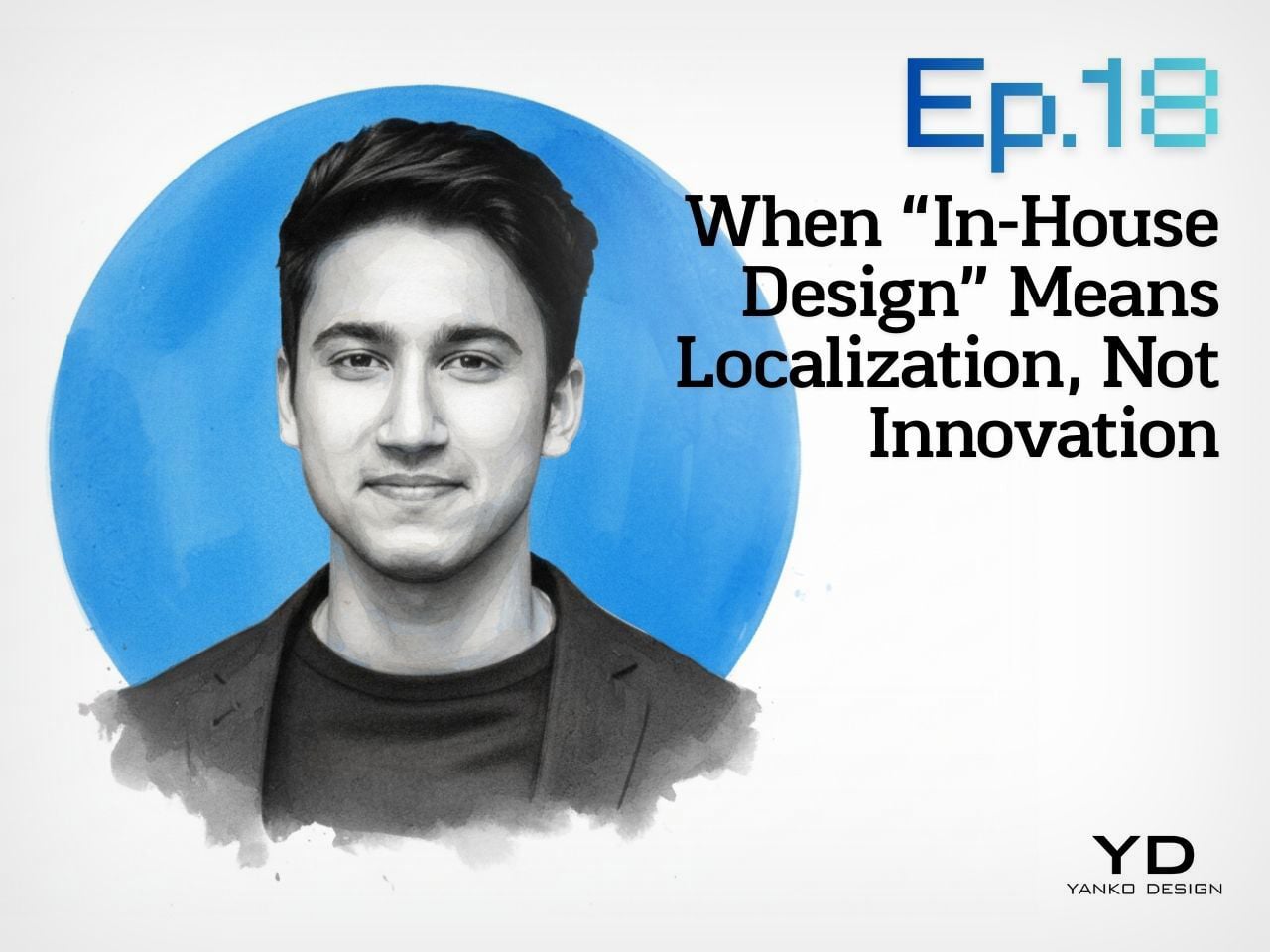
Yanko Design’s weekly podcast, Design Mindset, continues to bring raw, unfiltered conversations about what it really means to work in design today. Episode 18, Powered by KeyShot, tackles a topic many Indian designers experience but rarely discuss openly: the uncomfortable gap between what brands promise about design investment and what actually happens behind closed doors. Each week, the podcast peels back the layers of design practice, exploring not just the creative work but the professional realities that shape it.
This week’s guest, Ayush Singh Patel, brings a perspective shaped by years at the intersection of ambition and reality. Currently Associate Director of Industrial Design at Noise, where he leads audio and accessories categories, Ayush previously spent time at boAt Lifestyle, leading five sub-brands and contributing to the design of everything from wireless headphones to smartwatches to grooming products. His experience spans the full product lifecycle, from concept to launch, but more importantly, he’s navigated the complex dynamics of being an in-house designer in India’s explosive consumer tech ecosystem. What unfolds in this conversation is a candid examination of derivative design, creative ownership, and what it takes to push for genuine innovation when the system is built for speed and cost efficiency.
Download your Free Trial of KeyShot Here
From “Glorified Localization” to Building Design Credibility
The conversation opens with a striking admission from Ayush: “I joined brands that proudly call themselves design driven, expecting to lead innovation. Instead, I found myself in meetings where the brief was literally make it look like this western brand, but make it cheaper. That’s not design leadership, that’s glorified localization. The real question isn’t whether Indian brands invest in design. It’s whether they invest in their own design vision or just outsource the thinking and ask internal teams to clean up the execution.”
Ayush’s own hiring story reveals how this dynamic begins. He wasn’t selected for his industrial design expertise or technical knowledge. “All they liked was the kind of portfolio work that I put out on Instagram and Behance, and they liked those pretty images. So there was no technicality in my interviews. They just wanted that sort of outcome for their products.” It took nearly a year and a half to convince stakeholders of what he could actually contribute beyond aesthetics. His first real opportunity came through rendering. In 2018-2019, e-commerce was entirely image-based, and conceptual renders performed exceptionally well. “Anything that was sold online on platforms like Amazon or Flipkart was truly image-based, right? Everything was about how glorified of a concept you can showcase.” The results were immediate: sales increased because customers were convinced to buy what they perceived in those images, not the reality of the products. This success created the opening for deeper design involvement.
The Strategic Path from CMF to Original R&D
Once sales growth validated design’s commercial impact, Ayush introduced CMF (Color, Material, Finish) as the next frontier. “I came and said there’s a thing called CMF design. So you can start with something as small as color. You don’t have to pay a lot of money, you can talk to the Chinese manufacturers, you can add those colors. And then obviously, it will change the game completely, because now people will have more options to buy from.” The Indian market’s aesthetic inexperience became an advantage. Consumers were looking for cheap technology that looked different, and without established reference points for good or bad aesthetics, bold CMF choices stood out on crowded e-commerce platforms.
The impact was substantial. “Through colors, we crossed over that thing where design can be weighed down, not in terms of aesthetics, but colors. And that’s what made the company grow from almost 90 crore revenue to 200-300 crore revenue.” The next step involved tweaking aesthetics of Chinese-sourced products with small mold modifications. “The reception from the customers was bonkers. It did not lead to as much sales because obviously it drove the costs a little high. But the way people understood that there’s something beyond buying a product from China and launching it, they saw in and out development, right? Someone cared about every bit of visuals that went out. There were specific colorways, people were somehow glorifying luxuriousness.” This gradual proof of concept finally convinced leadership to commit resources. From 2022 onwards, the company began developing its own products, marking a shift from localization to original design.
“Think Inside the Box”: Design Process for Fast-Paced Markets
Ayush’s philosophy directly contradicts traditional design education. “I’ll say something controversial here. Since design school, you’re somehow pushed to think outside the box, which is obviously a place where you can actually drive some sort of innovation. But if you work in a company that’s going for mass production, catering to large audiences at a fast pace, these consumers are not normal consumers. They’re not faithful to you. There are so many brands in the same market, so you have to innovate as fast as possible. And obviously, if you understand the market, innovation comes with time.” The solution challenges design orthodoxy: “The shortest way for you to reach innovation is change the outer aesthetics. If you think outside the box, you incur a lot of R&D costs. That will go through numerous approvals, numerous discussions back and forth from your manufacturing units. And that’s basically a lead time of one and a half to two years. In that time, there’ll be five to ten competitors who will come and go.”
The practical framework becomes clear: “We realized it’s a place where we need to set up our process in which we think inside the box, because an earphone or a speaker will look like an earphone or speaker. That’s the example I give to any person I ever hired. If you’re trying to design a car, it will look like a car. You cannot make it look like a plane.” The design process itself had to be restructured to bypass sketching and go straight to 3D. “There’s no point for us to sit down and make a sketch and me going to a founder who has nothing to do with the design process, who doesn’t care about why it takes you so much time. He only cares about: have you made something for me that I can produce.” Perhaps most revealing is Ayush’s assessment of what the job actually entails: “Design is the easy job. Design is literally five percent of what I actually do. Ninety-five percent is, irrespective of whether it’s a design by me or my team, I have to go and meet so many people from different teams who don’t care about what it took you to make this design. And just go there and be open-ended to receiving any kind of feedback and just sell that design. Being a great designer doesn’t mean you can design something, it’s how well you can sell it to other people.”
The Copy-Paste Reality and Cultivating Real Creativity
The copy-paste culture creates fundamental challenges for original work. “When there’s no good design, there’s no bad design, then there’s only the design that is known. So what you see is what you can weigh. Any person who’s beyond design will never be able to appreciate that as something new. And for a company that’s super price-critical, for a company that wants to innovate every six months, they’ll only want a bet that’s tried and tested.” When given explicit instructions to copy, Ayush developed a strategy of creative resistance: “I’ll be put in a position by a certain CXO or member I’m reporting to, basically laid out saying copy this. And I would come up being smart enough, trying to make a window, and I’d say okay, I’ll copy this, but I’ll give you my understanding of what it should look like. And then I would be basically thrashed, and they would say no, I told you to copy this. So I would end up going as close as it is to the inspiration, but I was still trying to stay away from it. The winning situation for me is how well can I sell that this looks like that, but it’s not the same, but this will work for you.”
The impact on designers working in these environments is profound. “We’re basically finishing up all the resources left for aesthetics, because there’s no innovation to back it up, right? So there will be a time where I’ll end up using all the innovations in terms of CMF at that given price tag. And the next people who take my position will not have anything left to innovate on. The people who I hire as interns or full-timers will come and explore the same thing that we did three years back. You’re following the same pathway that I did ten years back or five years back. So you’re bound to make the same mistakes to reach there.” His advice to his team reflects the only path he’s found to sustained growth: “The only way you can cultivate creativity is by doing something beyond what you’re getting paid for. I would just ask these people working with me to spend more time outside. The real work for a designer begins after the nine to five. Once you go back home, the kind of people you interact with, the kind of platforms you sit on, maybe Yanko Design, maybe Behance, any platforms that can somehow make you ask a question. People used to ask me, how are you able to execute things so fast? I optimized my working by making so many mistakes in my personal projects that I can go to my office next morning and do the same thing in half an hour.”
Speaking Up: From Skill to Creator
For Ayush, the path to changing the industry starts with designers finding their voice. “I think for designers to speak up. In a room, I’ve been the biggest introvert my entire life. But I realized if I don’t speak up, no one will care about design. And it’s on the place of basically shouting design, not just talking about it. Being in a place where you can speak up, and just taking that narrative, just start with being the face of design in the company. Maybe you’re in a junior role or a senior role, start sharing opinions. Even the people working within my team at the moment are very shy in terms of sharing opinions to a founder or to a person from a different team. They’ll slide in my DMs and say, this is what I feel. And I say you should be open about it. If you don’t share it, they will never respect your opinions.”
The fundamental shift needed is in how designers are perceived. “At the moment, designers are seen as skills rather than creators. That’s the one narrative that I’m completely against and I try to push off. People should start seeing you as creators, because if they believe you’re a skill, then they’ll always try to guide you to do a certain thing, maybe copying designs or just following exactly what they’re asking you to do. In that process, you’ll burn out faster than anything because you’re trying to follow someone else’s vision of something. You’re just becoming a tool in between. Better than being a tool, you become a creator when you start speaking out and defending everything you’ve learned.” When challenged to prove an in-house team could outperform an expensive European consultancy, Ayush’s answer centers on empathy and collaboration: “An in-house team can always win through a solution which I call just talking to people. Any person who’s somehow involved in the process, if you truly talk to them and empathize and learn their side of work in the process, then you can create a solution that’s not only good-looking but also satisfying their needs.” His mentoring philosophy distills to a single essential quality: “The cheat sheet is, how much do you love it? That’s the biggest cheat sheet. If you’re not in love with it in India, you will not sustain. And a love beyond boundaries, a love that cannot be sacrificed, a love that you never turn away from.”
The conversation reveals an uncomfortable truth about design investment in India’s fast-growing consumer tech sector. The issue isn’t whether companies use the word “design” in their marketing or mission statements. The question is whether they empower internal teams to think or simply execute, whether they’re building design capabilities or just design departments. Ayush’s journey from rendering specialist to R&D leader demonstrates that change is possible, but it requires designers to be strategists, salespeople, and advocates as much as creatives. It demands proving commercial value repeatedly, speaking up even when it’s uncomfortable, and cultivating skills outside of work hours that will never appear in any job description.
For designers navigating similar environments, Ayush’s experience offers both validation and a roadmap. The constraints are real, the frustrations legitimate, but within those limitations, there’s still room to push boundaries, build trust, and gradually shift the conversation from “make it cheaper” to “make it ours.” You can connect with Ayush on LinkedIn or book a mentoring session with him on ADPList, where he’s been recognized as one of the top ten mentors multiple times.
Design Mindset premieres every week, bringing honest conversations about what it really takes to build a design career in today’s industry. Episode 18 is Powered by KeyShot, the 3D rendering and visualization software helping in-house design teams compete with the visual quality of global agencies.
Download your Free Trial of KeyShot Here
The post “Stop Treating Designers as Tools”: Ayush Singh on Ownership, Burnout and Speaking Up in Indian Brands first appeared on Yanko Design.