
orchard house: a sustainable home for england’s green belt
Orchard House by Studio Bark is a three-bedroom home set within a restored orchard in England’s Green Belt. Built for a young family with deep ties to the land, the house occupies the site of a former working orchard once tended by grandparents.
Memories of fruit picking and machinery shaped the brief, tying the architecture to a landscape defined by seasonal change. Three years after completion, the house and orchard have matured together, with replanted local species reestablishing structure and productivity across the site.
The home was conceived under Paragraph 84 of the National Planning Policy Framework, a policy which restricts isolated new homes in the countryside, while allowing exceptions for dwellings that are high-quality and environmentally sustainable.
images © Jim Stephenson
two cubes linked by a pitched-roof bridge
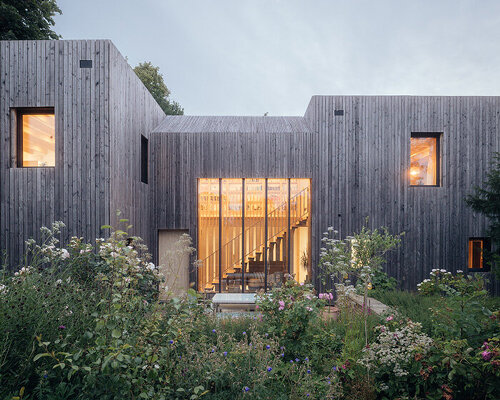
The design by Studio Bark is composed of two near cubic volumes set apart and connected by a pitched-roof timber bridge. The architects orient each cube to frame distinct views, one facing east across open fields, the other turning southwest toward woodland. Between them, a double height link forms a quiet internal ‘street’ lined with bookshelves and rooflights. This space becomes a gradual transition between kitchen and living spaces.
Founder Wilf Meynell describes the composition as ‘two almost perfect cubes linked by an open two storey bridge, making the most of the small site and capturing the best views to the eastern sunrise and the western sunset.’
The bedrooms occupy the lower level, where ceilings are lower and glazing more restrained, maintaining cool internal conditions. Above, kitchen, dining, and living areas sit beneath exposed timber beams and generous openings, creating an upside down arrangement that brings family life into the canopy of the orchard.
Studio Bark’s Orchard House sits within a restored orchard in the Green Belt
Studio Bark’s low impact architecture
The timber-framed Orchard House follows a materials strategy by Studio Bark which centers on locally-sourced, low impact elements. Silvery larch cladding wraps the exterior, weathering into the surrounding vegetation and softening the mass of the building. Concealed manual shutters sit flush behind the cladding line, providing solar shading and security without disrupting the facade.
Inside, ash parquet flooring was crafted from a tree felled on site due to dieback, embedding the building in its own ground. Meynell notes that a bespoke detail was developed to integrate the shutters discreetly, while a concrete Trombe stair introduces thermal mass to the core.
Foam glass aggregate foundations made from recycled glass support the super insulated timber frame, paired with triple glazed windows and two large solar arrays with battery backup. The approach reduces both construction and operational carbon.
two near cubic volumes are linked by a pitched roof timber bridge
silvery larch cladding weathers gently into the surrounding landscape
ash parquet flooring was milled from a tree felled on site
living spaces are located upstairs to capture views of fields and woodland
a concrete Trombe stair and super insulated timber frame support low energy performance
replanted fruit trees and wildflower meadows restore biodiversity across the site
project info:
name: Orchard House
architect: Studio Bark | @studiobark
location: United Kingdom
completion: 2025
photography: © Jim Stephenson | @clickclickjim
The post studio bark shapes low carbon ‘orchard house’ as two silvery larch-clad cubes appeared first on designboom | architecture & design magazine.