
Daxing Jizi Design installs OctaPlay in shougang park, beijing
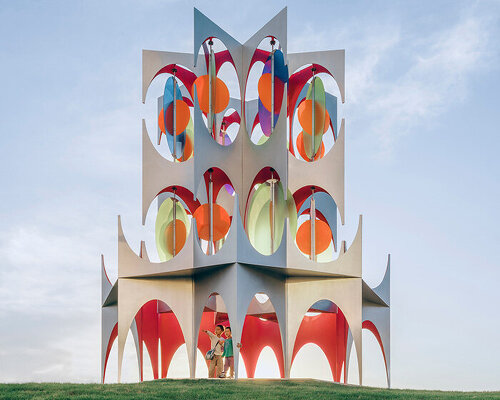
Daxing Jizi Design inserts OctaPlay, a public art installation, into a site defined by monumental industrial remains in Beijing, reframing the heavy material legacy of the area through movement, color, and atmospheric change. The lightweight, kinetic structure is commissioned for Yong Ding He Ji, a cultural and lifestyle destination unfolding along the Yongding River at the foot of Shijingshan. Set within Shougang Park’s vast former steelworks, the installation takes its name from its eight-sided geometry. Its octagonal frame and folded surfaces recall paper origami, a contrast to the rigidity of the industrial environment.
The designers describe the project as a topological translation of Shougang Park’s iconic smokestacks. Still, instead of vertical mass, OctaPlay disperses volume into semi-transparent elements that rotate and overlap. Suspended colored discs move gently with the wind, their shifting alignments producing an ever-changing composition of light and shadow.
all images by Zhu Yumeng, unless stated otherwise
wind-driven installation reframes the industrial landscape
In their early design ideas, the Chinese team at Daxing Jizi Design explored weaving overlapping metal sheets. As the project developed, this approach evolved into a combination of folding and nesting, paired with both heavy and light materials. Color became central in the later stages. While the metal framework of OctaPlay was initially conceived in black, prolonged time on site led the team to reconsider. Surrounded daily by dark industrial structures, they introduced silver surfaces with soft peach tones on the reverse, subtly lightening the installation.
Wind becomes the invisible conductor of the installation, animating the suspended elements and determining their rhythm. As sunlight passes through the rotating discs, colored reflections drift across the ground, turning visitors into participants within a temporary field of light.
Yong Ding He Ji occupies a complex terrain where riverbanks, mountains, and factory relics coexist. The broader development follows a strategy of minimal intervention and spatial extension, allowing architecture, art, and commercial programs to emerge from the existing ground. OctaPlay operates within this logic and responds to the surrounding chimneys and steel structures, translating their scale and symbolism into an abstract, human-scaled form.
OctaPlay by Daxing Jizi Design stands within Shougang Park’s former steelworks
suspended colored discs through folded metal surfaces | image by Li Haibin
the installation stands between industrial relics and surrounding hills
the installation invites visitors to move through shifting fields of color and shadow
OctaPlay reinterprets the vertical mass of smokestacks
cut-out openings and folded edges define the human-scaled structure
suspended discs rotate gently, producing overlapping chromatic effects
the folded structure frames light, color, and movement
layered geometry and rotating colored elements
wind-driven colored discs animate the installation
an ever-changing composition of light and shadow | image by Kong Fansheng
wind becomes the invisible conductor of the installation | image by Kong Fansheng
octagonal frame and folded surfaces recall paper origami | image by Kong Fansheng
snow transforms OctaPlay into a seasonal landmark | image by Yong Ding He Ji
project info:
name: OctaPlay
artist: Daxing Jizi Design | @daxingjizi
location: Yong Ding He Ji, Shougang Park, Beijing (Shijingshan District, left bank of Yongding River)
area: 50 square meters
project director: Xie Qiongzhi
lead designer: Zeng Zhenwei
design consultant: Li Wenhai
structural engineering: AND Office
client: Yong Ding He Ji
photographer: Zhu Yumeng | @yumeng_zhu_coppakstudio, Kong Fansheng
The post suspended colored discs move through daxing jizi design’s folded installation in beijing appeared first on designboom | architecture & design magazine.