
JeeYoung Lee transforms blank rooms into physical dream spaces
Seoul-based artist JeeYoung Lee has long explored the idea of dreams as spaces that can be entered and examined, making use of the blank room as a backdrop.
Working within the confines of her studio, Lee builds each scene by hand before photographing it, with her own body placed amongst the composition. While the scale remains domestic, almost contained, every surface is activated. This approach positions the room as an active field where the mind takes shape as a series of physical spaces, be them vibrant and playful or mystic and ethereal.
Resurrection, 2011
stage of the mind: environments built from imagination
As part of her Stage of Mind series, artist JeeYoung Lee’s environments carry a high density of visual information. Objects accumulate across floors and walls, and each element carries a clear association. A network of stones hover mid-air around a figure in motion, suspending a moment that feels held in place. Undulating fields of fans or leaf-like surfaces suggest natural landscapes, with watercolor hues lending dreamlike textures.
Emotions are translated into spatial arrangements that can be read almost immediately. The rooms often function as constructed diagrams, where anxiety, compulsion, or anticipation are given physical structure. At times, this directness can feel insistent, though it establishes a clear relationship between interior thought and external space.
Nightscape, 2012
into the mist: dreams as abstracted atmospheres
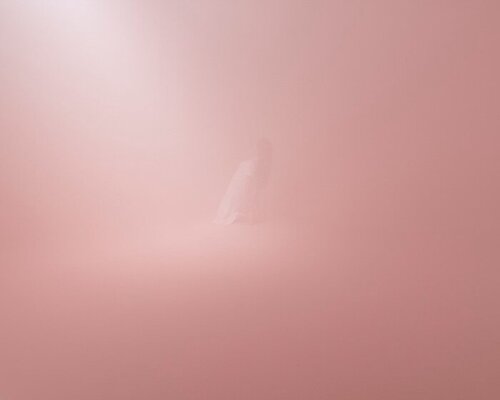
JeeYoung Lee explores the concept of the dream from another angle with her ethereal series, Into the Mist. This shifts away from the density of Stage of Mind, and reduces the room instead to just atmosphere and light. Objects recede, and color takes on a leading role in defining space. Abstracted figures appear within gradients that soften edges and dissolve boundaries, creating environments that feel continuous rather than segmented.
In these works, the room is still present, though it is defined by tone and depth rather than by physical structure. A seated figure becomes partially absorbed into a pale field, while another stands within a soft gradient that transitions from pink to violet. The space feels less bounded, and orientation becomes less certain.
The absence of overt symbolism opens the work in a different way throughout this series. The viewer spends more time adjusting to the space, gradually noticing how the figure emerges and recedes within it. This way, the room begins to operate as a condition rather than a constructed scene.
Salvation, 2020
building rooms from dreams
JeeYoung Lee’s practice positions the room as an active threshold where internal experience becomes spatial and shareable. Each environment begins as a private mental image, then takes on physical form through an uncanny sense of scale. These works allow others to step into a space that once existed only in thought.
Throughout the series Stage of Mind, this translation is direct and fully articulated, while through Into the Mist, it becomes more abstract, shaped by atmosphere and perception. Across both bodies of work, the room holds a specific function: it gives dreams a place to exist outside the mind, and still retains a sense of intimacy that keeps the experience grounded in the body.
Maman, 2025
Secret Garden, 2018
Contact, 2024
Dialogue, 2020
Meditation, 2016
project info:
artist: JeeYoung Lee
The post the anatomy of a daydream: how jeeyoung lee builds her inner world appeared first on designboom | architecture & design magazine.