
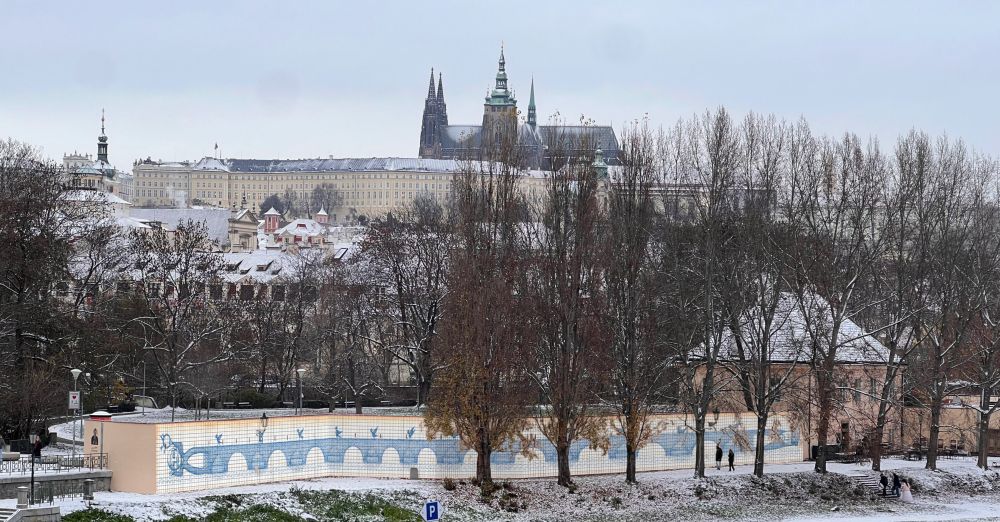
“I hope the wall will be introduced in May 2026 in Prague,” the award-winning children’s book illustrator Peter Sis told me. He was discussing a mural called the “Velvet Bridge” that celebrates the Velvet Revolution leading to the democratic “Czecho-slovak republic” from Jan Masaryk to Václav Havel. “It was off and on for the past seven years because of politics. Now a right-wing government with red hats takes over in January, so anything can happen.”
The wall was created in Portugal as a memory of its president Mário Soares, who donated the first presidential limousine, his personal Renault, to Czech President Havel in November 1989. Upon the demise of the Communist government in 1989 it was discovered that there was no efficient way to run the new republic. There was chaos—no computers or electric typewriters to process government documents and no motor pool to transport officials to state events. And thus the democratic leader, Soares, will long be remembered for his support and generosity.
“The choice of a Portuguese vernacular artform is not accidental,” Sis adds. “The late Soares and the Portuguese people were the first to recognize and support Havel and the Czech people in 1989.” Even the building materials also are nods to Portugal.
Azulejo tiles have graced the walls and facades of public and private buildings in Lisbon for hundreds of years. In modern times Azulejo tile murals, designed by the leading artists, have been placed in public spaces in cities around the world. The Velvet Bridge was originally commissioned by Arts for Amnesty, which is now now Arts for Human Rights and Dox Art Center in Prague.
Sis’ sketches and detailed drawings for the commemorative mural follow below.
Above and below: A sampling of sketches and graphic elements employed in the creation of the Velvet Bridge.
The post The Daily Heller: A Wall in Prague That Invites People In, Not Out appeared first on PRINT Magazine.