
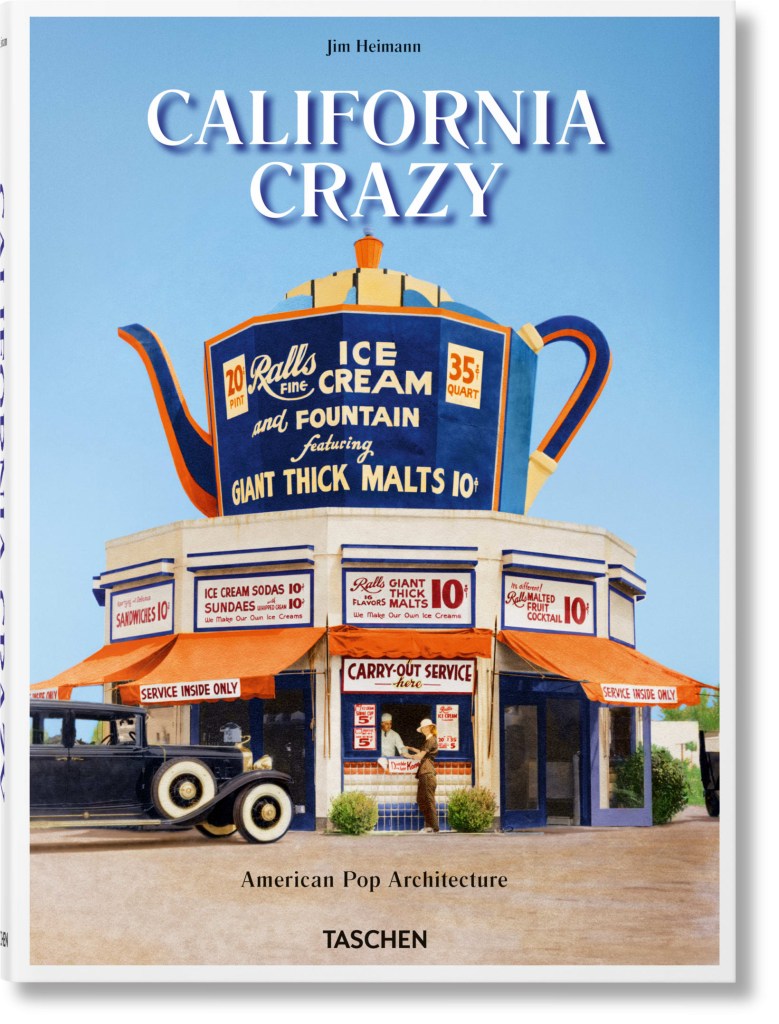
In 1980, Los Angeles historian Jim Heimann—whose preservation and documentation of West Coast vernacular design has been a primary source of pop-culture artifacts—published his first thin volume about eccentric roadside architecture. That book, California Crazy, was the bible for commercial/folk art and advertising in the U.S. for over 20 years.
Forty years after it premiere, Taschen, where Heimann is the resident Los Angelino pop-cult editor, has released a richly expanded new edition. California Crazy and Beyond is packed with eye-bulging, mind-altering, awe-inspiring environmental eclecticism in the form of madcap restaurants, motels, service stations, and businesses shaped like hot dogs, animals, airplanes, pianos, and other anomalies. They are what is called architecture parlante (“speaking architecture”) designed to loudly telegraph their respective function, purpose and (since I’m using French) raison d’etre through form (a large dog), shape (a common doughnut), or decoration (a native American wigwam motif).
Paris, London, Rome and every other city in the world has its landmarks that speak to ages, eras and epochs. Los Angeles, one of the world’s largest urban sprawls and ground zero of fantastical Americana, has its road- and street-side attractions. The California style “developed in the age of the automobile,” writes Heimann. “Thus it became, by default, the only city to develop around the needs and possibilities of the car.” What Los Angeles (and, by extension, the rest of the state from top to bottom) lacked in historical buildings, it made up for in undeveloped space: “A wide geographic area … and an optimistic attitude that anything was possible.”
California’s crazy approach to all things ephemeral has to do with the fact that it is a traveler’s dream world. The architecture of the ’20s through ’50s reflected a transient aesthetic somewhere at the end of the rainbow. It is no surprise that America’s most famous amusement park—Disneyland—was first sited outside of L.A. in Anaheim. It was just the tip of the crazy iceberg. Architecture parlante, which arguably influenced the 1939 New York World’s Fair’s World of Tomorrow, was a an aggressive kind of billboard. Not that California didn’t have its share of highway signs, but in the ’20s and ’30s when many of the most iconic (and witty) structures were conceived, the outdoors was the best platform for unmistakable adverts that would appeal to the growing sub-culture.
While every state in this shopping-mall nation of ours once had its indigenous (rather than global) visual languages, California naturally was the craziest (in the ideal sense), in part because of the immigratioin and migration of so many people seeking new possibilities or invention, that it absorbed and adapted all of them into what Heimann so lovingly, continuously and thoroughly assembled into a single volume that is essential reading (and looking) for anyone interested in the nascence of spectacular conspicuous consumption.
One final note: If you buy this book only for its initial end paper, you’ll be a contented consumer.
The post The Daily Heller: Architecture That Says What it Does appeared first on PRINT Magazine.