
The Polish émigré Arthur Szyk (pronounced schick, like the razor) (1894–1951), began his career in 1914; he illustrated over 30 books, created scores of caricatures and portraits as covers for Colliers and Time magazines, numerous cartoons for PM (the 1940s ad-free liberal/left daily), the New York Post, and Esquire, as well as posters, medallions, stain glass, and a large body of work on Judaic themes. One of the most prolific visual satirists of his day, his World War II anti-fascist imagery is comparable to Goya’s Disasters of War, but his mission went beyond topical satire—art was an engine of spiritual transcendence. A victim of antisemitism in his native country, forced to move to Paris, England, and later the U.S., he fought for a free Polish state as both soldier and artist, and later devoted his energies helping to building a Jewish state. Indeed almost all his art, including numerous books of illustrated fairy tales, was imbued with appeals for social justice.
To call Szyk a ‘cartoonist’ is tantamount to calling Rembrandt a dauber or Chippendale a carpenter,” declared an editorial in a 1942 Esquire. In fact, with articles about him published in The New Yorker and the New York Herald Tribune, among others, his artistic renown was undisputable. Szyk was one of the first public figures to take direct action in bringing attention to the Holocaust as it was being perpetrated. The intricate, miniature size of his artwork stands in striking juxtaposition to the magnitude of the themes it confronted and the human rights violations it exposed. Yet time has a way of eroding memory, and Szyk’s art had receded into the past until a major revival was triggered by Ervin Ungar, who created a foundation in Szyk’s name, organized exhibitions, published books and preserved work that had scattered throughout the world. Two years ago he sold this extensive collection to the Bay-Area based Taube Philanthropies, which is committed to making Szyk’s art relevant given that he covered many of the same issues of human rights facing us today.
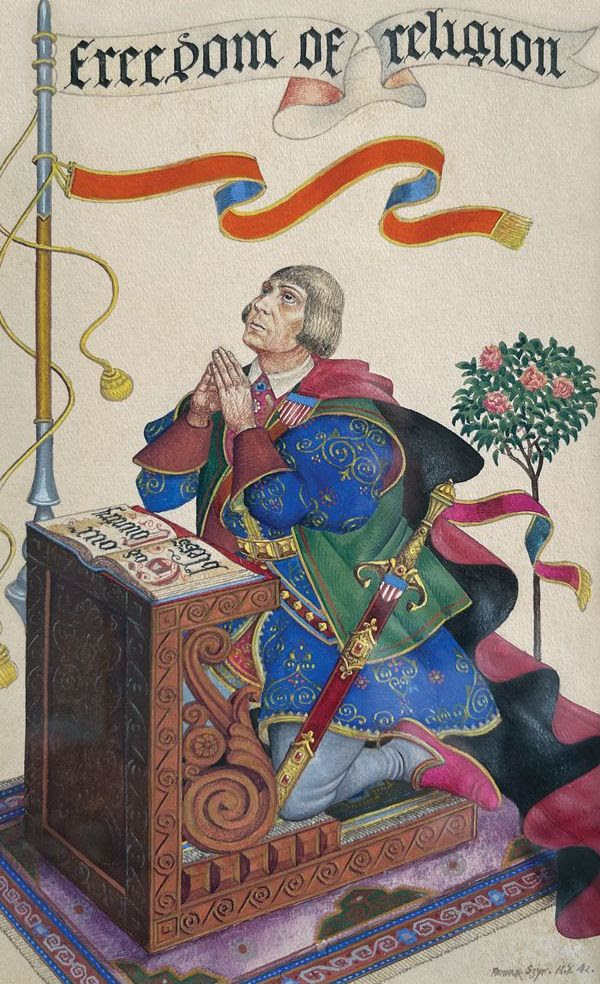
One of his most powerful artistic expressions was an interpretation of FDR’s foundational Four Freedoms speech. Norman Rockwell‘s version is more well known, but Szyk’s is nonetheless enduring for its allegorical underpinnings.
Irvin Ungar continues to push Szyk’s work and message. He contributed items recently to the Museum for Jewish Heritage in New York, and is acquiring more work to build another collection. “Several years ago, I set out to create for sale, an exact facsimile of Arthur Szyk’s Four Freedoms artwork,” he said recently. “The limited-edition four high-resolution giclée prints are now available for purchase.”
At this historical moment when America is celebrating its 250th anniversary and democracy is at the crossroads, these exquisite prints can serve to inspire and remind us of the essential four freedoms all good people strive for in human society. Visit the project website for a full description and details on how to order.
The post The Daily Heller: Arthur Szyk and FDR’s Four Freedoms Revisited appeared first on PRINT Magazine.