
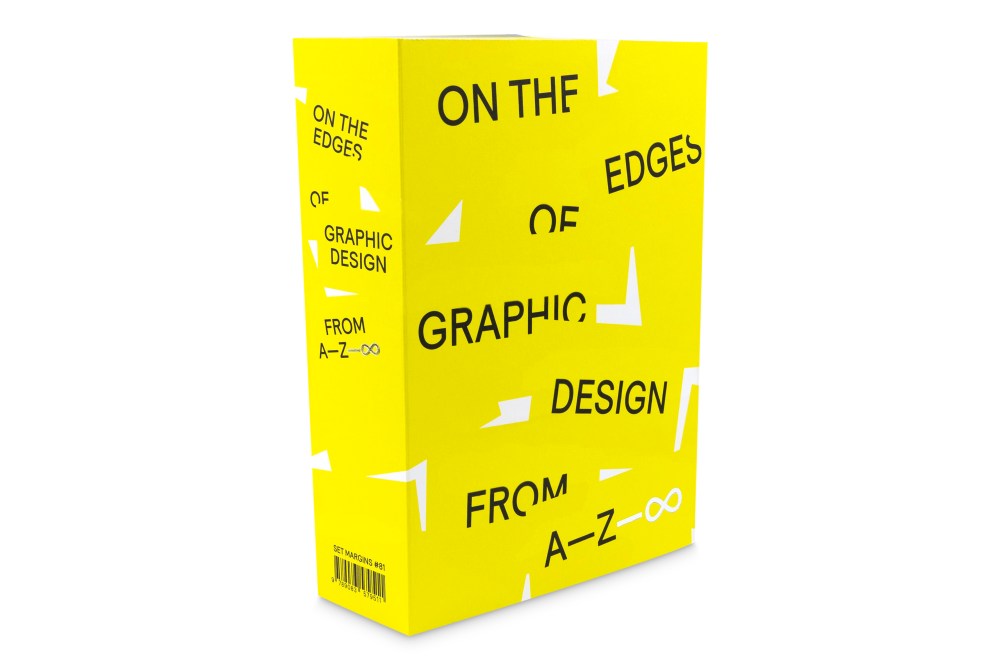
Bubbling up from A—Z Presents, the Berlin-based space for experimental graphic design, comes On the Edges of Graphic Design From A—Z by Anja Lutz. The book brings together six years of ideas, projects and questions derived from a desire to create a place where the graphic design community can define the boundaries of the field together. From its founding, A—Z has been less about presenting finished work and more about offering a platform for experimentation, collaboration and reflection.
Here, Lutz gives us a briefing on the A–Z space and the book that commemorates its output. (Thanks to Jason Grant of Inkahoots for the tip.)
All photos by Annette Behrens
This is a voluminous survey of the new and next in graphic design. How and when did A—Z Presents develop?
A—Z started in April 2019. My book design studio and publishing house had moved to a new location that has a nice extra space with a large window and visibility onto a lively road in the center of Berlin. I had the idea to use it to collaborate, explore and showcase different graphic designers and their individual practices that take a more “experimental” approach—meaning they explore and practice the discipline in unorthodox ways and at intersections with other disciplines. I wanted to bring these designers, who have inspired me, into the space and to contribute to a broader view and discussion of what graphic design can be.
From the beginning, I understood A—Z not only as an exhibition space but as a curatorial and research-led framework, a place to test, observe and discuss different modes of practice. What was conceived as a two-year project has now been ongoing for six years, with over 30 exhibitions, events and workshops, and various “chapters,” such as “Counter Sessions,” “A—Z Out & About” and “A—Z Collective,” which ran the space as a collective for one year.
You call this an “Index for alternative graphic design.” How do you define alternative?
Alternative and experimental are both words that are related, but ultimately fall short, and that I use for lack of a better term (I should invent one …). What I want to explore are aspects of cultural creation that grow from graphic design (or visual communication, communication design, visual culture—or whatever you want to call it) and go beyond the problem-solving, applied realm.
Rather than focusing on solutions, this work is concerned with modes of inquiry: how we think about and practice the discipline, how design produces knowledge, and how meaning emerges through visual, material and social processes. How can we push its boundaries, and what happens at the intersections with other disciplines? I see A—Z as a form of research that investigates, discusses and shares these different approaches.
As this project spans six years, the evolutionary process must have progressed with lightning speed. When the word Edge is used, as it is in your title, isn’t there a danger that given new technologies and philosophies, the edges will get dull too quickly?
When I use the word edge, I do not mean the “newest” or “latest invention.” I rather mean the edges of the discipline and where they intersect or overlap with other disciplines. I consider these areas of overlap—or the in-between areas, which cannot be clearly defined and defy usual categories—as spaces where graphic design enters into dialogue with other disciplines, operating in a transdisciplinary and often liminal way.
I find these areas to be very fertile ground for new ways of thinking and practicing. Placed in a broader context, the last decades have been dominated by increasing specialization in the field, often at the cost of transdisciplinary and collaborative approaches, which I believe are vital for addressing complex contemporary challenges. In this sense, the “edge” becomes less an attribute and more a methodological stance. And I see graphic design as a central discipline, since communication will always be a key factor.
Timelessness and standards are not my concern. I rather look for a fluid, shifting, curious and lively form of practice. For me, diversity in the field and in approaches to graphic design includes different cultures, identities, age groups and career stages. This diversity is not only representational, but epistemic—it introduces different ways of knowing, making and understanding design.
This is why, at A—Z, I have invited some very established and mature designers alongside very young and upcoming ones, as well as designers from the Western world and from other continents and backgrounds (for example, Revealing > Recording > Reflecting, a research project with Huda AbiFarès and others on women graphic designers from Southwest Asia and North Africa). I look for a broad understanding of the “what,” “why” and “how,” and for the exchange of this knowledge.
Among your features is an exhibition titled The Library of Shapes, Texts and Structure, which I find particularly resonant. Can you explain its relevance in your overall conception?
Andrea Tinnes’ wonderful exhibition was the very first one, and it combined a number of issues that I find very inspiring: typography shown in an abstract, artistic way; a systematic approach in the combination of the 13 printing plates, which created innumerable strong visuals; and her personal design library, which gives insight into how Andrea reflects on and collects the shapes, texts and structures around her.
Another aspect is the categorization of her personal design library across more than 4,000 black-and-white pages and how these relate to the free-form visual expression of the color prints. In this sense, the library functions as an archive and a taxonomy—a system of organizing perception and experience. Andrea organized her library by turning elements (for example, the texture of pebbles) into individual glyphs and organizing them as fonts, which offers an unusual way of using—and subverting—the type design tool.
Would it be right or wrong to say that what is progressive today is a retooling of the edges of yesterday?
The new tools, for me, are new areas of overlap, offering both possibilities and challenges. What might be old—or timeless, as you asked before—are the ways of approaching them. Questioning, curiosity, undermining, reappropriating, subverting, exploring, experiencing, sharing, recombining, undoing, embodying, exposing, refusing, experimenting, systematizing—these can be understood as recurring methodological attitudes rather than stylistic gestures. They generate endless variations, forms and new understandings.
The multisensory aspect is very important. A focus primarily on sight (and maybe sound) is lopsided. As long as we are sentient beings, we act and comprehend with all our senses (also touch, smell, taste) and physical experiences reach and inform deep layers of our being and understanding. From this perspective, graphic design should be understood as an embodied and performative practice.
The performative pieces at A–Z—such as those by The Rodina, combining direct interaction and dialogue with the audience, digital input that turns into tactile interactions with paint, or the Tape-Work performance by Niklaus Troxler in dialogue with jazz improvisation, as well as the hands-on workshop with Marc van Wageningen (aka Novo Typo), to name just a few—have pushed the boundaries of graphic design to include more senses.
What I find particularly exciting at the moment is the combination of physical movement and somatic experience with code and digital tools, and how these create digital environments. Two designers I find especially interesting in this area—both of whom contributed to the “—∞” section of the A—Z book—are Luna Maurer (formerly part of Moniker) and Katharina Neijdl.
With AI and its potential for radical change looming and in the works, how do you want your reader to use A—Z?
A—Z, as a book, I hope will be used as a rich source of inspiration—of people, ideas, projects and talks—that encourages work which thinks and practices outside the box. I like the idea of the physical book traveling, collecting traces, notes and folded corners … the way only physical objects can.
A—Z, the space, will continue to be in flux—as a form of research in itself that questions its role and what it can contribute to the discussion around graphic design. A current focus is on continuing to show marginal voices and practices, and on creating a physical space that allows for community, networking and discussion. And, witnessing how the world is developing, I also wonder whether soon we may need to turn A—Z into a space for organizing and designing political resistance.
The post The Daily Heller: Berlin’s A–Z Presents, Where Graphic Design Boils appeared first on PRINT Magazine.