
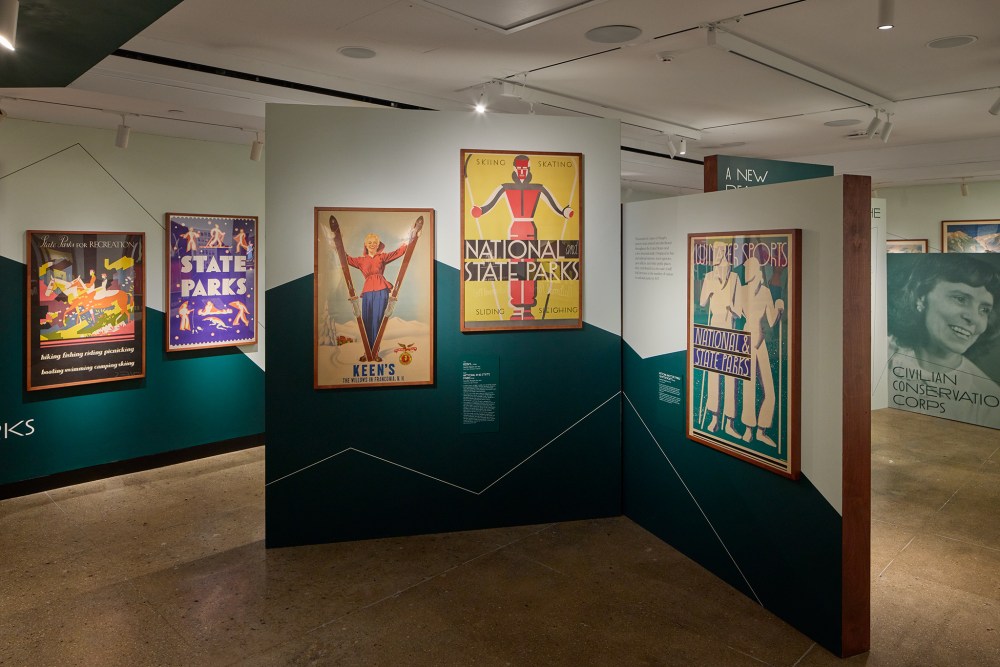
Little-known, but highly visible in her varied roles as designer, illustrator, production manager, landscape architect and copy editor, Dorothy Waugh created 17 posters between 1934 and 1937 as part of a major campaign to promote tourism to U.S. National Parks during the Great Depression. President Franklin Delano Roosevelt promoted the parks to raise morale, stimulate the economy and enable a beleaguered populace to enjoy natural environments and reduce the pressures of urban existence. “There is nothing so American as our National Parks,” claimed FDR. “The fundamental idea … is that the country belongs to the people … for the enrichment of the lives of all of us.” Waugh’s posters were rendered in a contemporary modernistic fashion and they forged the Parks Service identity while expressing the narrative that freedom was manifested throughout the system.
It was rare for a woman in the 1930s to be an ersatz brand strategist (although the profession did not exist yet). And Waugh was unique for, in fact, having a career as a prolific commercial artist, children’s book author/illustrator and production manager (for the Alfred A. Knopf publishing house). She was also among precious few women who had creative jobs in Chicago’s advertising agencies.
Now, Waugh’s work is the focus of a Poster House New York exhibit through Feb. 22. Below, curator, scholar and collector Mark Resnick (whose previous exhibition at Poster House featured Lester Beall’s work for the Rural Electrification Administration), and who also wrote the show’s catalog, reveals more about the gumshoe efforts to find Waugh’s lost legacy.
How did Dorothy come on your radar?
In the 1990s, two of Waugh’s striking posters for the National Park Service caught my eye as I passed by the window of a prominent gallery in New York City. I had never heard of her.
Once you had her in your sights, what was the process of uncovering her story?
Well, I turned to the usual book and periodical sources, but I was soon dismayed. Few writers had taken note of Waugh. And those that had, while highly complimentary of her work, especially her NPS campaign, maintained that little was known of the designer or the circumstances surrounding the posters and their making. That seemed quite odd to me, especially because the work was so good, the national campaign had been highly visible, and very little is done for the government without leaving a record. I felt confident that deeper research would reveal a lot. But that would have to wait, as I had a consuming job as an executive in the film industry, my wife and I were raising our young sons, and on the side I was curating a large exhibition and writing an accompanying book on the history of the American poster (both entitled The American Image: US Posters from the 19th to the 21st Century). During the 2010s, however, I was able to piece together visits to the National Archives; the Waugh Family archives at The Jones Library in Amherst, MA; the School of the Art Institute of Chicago, from which Waugh had graduated with honors in the latter 1920s; and the Library of Congress. As I’d suspected they would, the primary documents in those repositories told the tale.
Her work is illustrative and typographic. Do you think she possessed a definitive style?
Waugh’s style covered a very broad range, from illustrations in the manner of children’s books to cutting-edge Modernist; and she designed different, often innovative, lettering for each composition. Waugh had strongly advocated that the NPS mount its first-ever poster campaign and was determined that the series look different than any prior U.S. government posters—bold new images to convey bold New Deal messages. Hers was a distinctive brand of American Modernism. To some extent it drew upon European Avant-Garde art and design movements, but, even then, combined them without regard to purity or dogma. Moreover, it embraced American commercial illustration, subject matter, popular culture, and iconography. I suppose I’d call it an eclectic American Modernism, at once Avant Garde and accessible.
How did she retain such a longtime client as the National Park Service?
Well, I should note that Waugh began her work for the NPS as a landscape architect—another area in which she was highly trained—on a project for the Civilian Conservation Corps. That project was pivotal in readying the parks for increased tourism, and her adept handling of it propelled her within the agency. She became responsible for the production of all NPS materials requiring sophisticated graphic design and she was soon one of only two women in prominent positions within the agency, where her employment spanned 1933–1937. Her NPS campaign set the stage for the subsequent deluge of government-issued posters. Many other agencies, including the Federal Art Project, the Rural Electrification Administration, and multiple World War II propaganda bureaus, soon mounted highly ambitious campaigns of their own, a surge in government posters that would continue through much of the 20th century.
She also worked as production manager at Knopf. Did she work with Sidney Jacobs, who was the longtime production director?
Immediately after leaving the NPS in 1937, Waugh was hired by Alfred Knopf personally (he was joined in this, I believe, by Blanche Knopf). Waugh’s job was to establish and head a Books for Young Adults Division. She must have had some interaction with Jacobs, but I don’t have any record of that.
Her leadership of the division was successful, contributing to the publishing house’s prestige and revenue through many award-winning books. She was hands-on with the books from pitch to distribution—editing, helping design, and cleverly marketing them. (A fun fact: She created what we’d call a brand extension—her “Borzoi Puppy” moniker was a riff on the publisher’s full-grown canine mascot.) Her efforts proved the value of Knopf having a separate division, prior initiatives at the publisher having stalled.
The division’s books were often by major talents who, eager to collaborate with Waugh, agreed to work for the first time in the youth category. Awards included repeat recognition in the prestigious Fifty Best Books of the Year list of the American Institute of Graphic Arts. From her platform at Knopf, and continuing for decades thereafter, Waugh also published a steady stream of articles and interviews for the field.
Where else did she work?
Waugh’s work at Knopf was all-consuming. She left after three years there, in 1940, to find employment that, while stimulating, would allow her to pursue her many other talents, interests and deferred projects. A position as head of public relations at the Montclair Public Library in New Jersey proved perfect. It was a renowned regional library—modern and beautiful and it had just been selected by IBM for the nation’s first experiment in the computerized circulation of books. For the next 25 years, Waugh, commuting from her apartment in Manhattan, created exhibits, produced radio programs, organized special events and oversaw all publicity materials for the library. Impressed, Montclair’s mayor also retained her to head public relations for his office.
With the library as home base, in the early 1940s Waugh also served as a design educator at top art and design schools. At Parsons, she organized and taught the school’s first-ever course dedicated to lettering and typography. (Another fun fact: Graphic design luminary E. McKnight Kauffer simultaneously served as a critic in the same department, Advertising Design.) And at Cooper Union, she taught Advanced Advertising Design for Wartime Service.
She was also able to resume work on her own books. Every few years she wrote, illustrated and designed in its entirety another well-received book, usually aimed at young adults. These works often showcased her ability as an amateur scientist and her great talent, lauded by theNew York Times, for scientific illustration. Beyond such “auteur” publications, by the late 1950s she had also collaborated as a designer, illustrator or editor on more than 40 other books.
Her variety of yet other freelance work was remarkable. She worked as a journalist for major outlets; a poet for a host of publications; a cultural commentator and interviewer (she had her own regional radio program and did some television); and an author/illustrator of how-to articles for popular magazines. She continued to be a gifted watercolorist and maintained a vibrant craft practice.
After retiring from the library in 1965, at age 70, she added historian and biographer to her repertoire. At 94, she published the last of two deeply researched books on Emily Dickinson—which, insisted the foremost Dickinson scholar, Yale professor Richard Sewall, “every student of the poet must take into account.”
Why do you think she did not have a bigger reputation in the field?
She did have a substantial reputation in the field. For example, in 1941 A-D Magazine, perhaps the country’s leading graphic design journal, did an extensive article on Waugh and declared, “If taste, high purpose and skill add up to anything in the graphic arts—and they certainly do—Dorothy Waugh should be considered one of our best people.”
But a fuller answer to your question is that, by the end of her 100-year life in 1996, Waugh had fallen into obscurity and died without an obituary. We can readily speculate on the reasons. Waugh was a woman. (Studies have shown that news outlets are considerably more likely to select similarly accomplished men than women for obituaries.) Unmarried and without children, she had no surviving immediate family to attend to her legacy. She did her most public work, for the NPS, early in her career. And her artistic practice emphasized design, illustration, craft and accessible writing, none of which tend to be critical darlings.
But I’d add something else: As you can see, Waugh was a polymath and her pursuit in rapid succession of so many careers likely—and ironically—contributed to her lack of renown today. She chose to go as broad in her pursuits as she went deep, and to keep moving (never, for example, returning to poster design). That choice wasn’t bound to bring her the notice associated with a longtime commitment to a single field. But it reflected her many abilities, boundless curiosity and a pragmatic need to pay the bills. It reflected who she was.
What’s your next detective/research project?
I’m pursuing several projects. But I’m especially interested in telling the story, through an exhibition and book, of a graphic design “war within the war” amidst World War II. In May 1940, as America’s anxiety about the conflict in Europe mounted, President Franklin D. Roosevelt hurriedly established the Office for Emergency Management (OEM) under the leadership of the Modernist art director Charles Coiner. The OEM was responsible for the creation and distribution of posters—the U.S. would produce more than any other combatant—along with other wartime propaganda. But Madison Avenue’s ”advertising men” argued that the OEM designs were too Avant Garde in style for mainstream consumption, an argument that ultimately prevailed with the government. In June 1942, the Office of War Information replaced the OEM and, for the remainder of World War II, the nation’s war posters largely conveyed their messages using straightforward, illustrational imagery.
The post The Daily Heller: Dorothy Waugh’s Graphic Design, Revived appeared first on PRINT Magazine.