
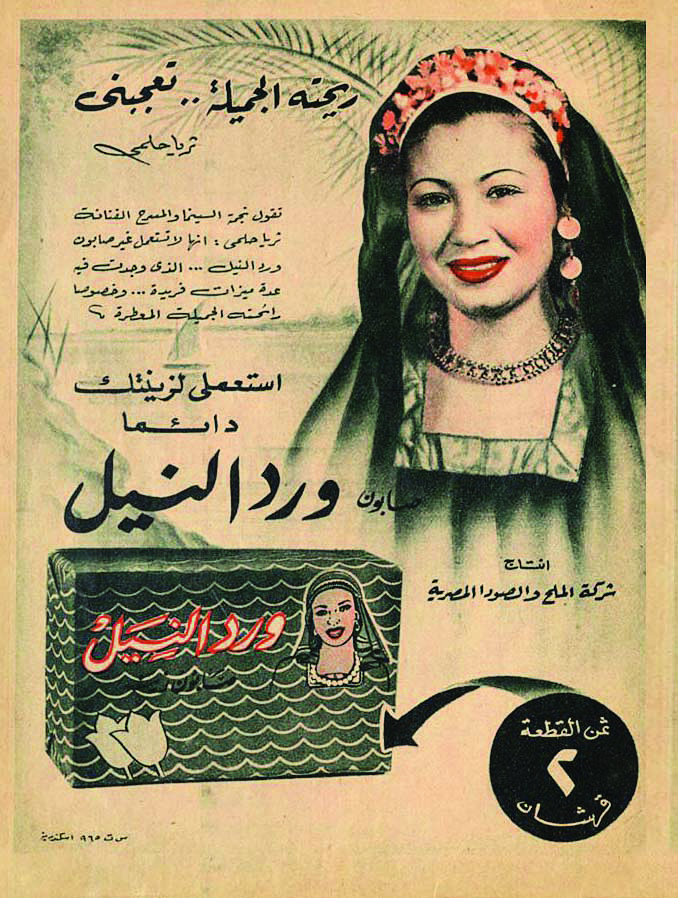
Toward the end of the Industrial Revolution, the world’s economy had been forever altered. Advertising became more than just a way to sell products—it was a tool that shaped consumer behavior about what to buy, why to buy it, and what it means to be modern. Drawing on over 350 images of magazine and newspaper ads, in A Trade in Dreams: A Century of Egyptian Print Advertising, Bahia Shehab reveals how consumer culture determined political, social and economic change during the century between 1880 and 1980 in Egypt. Shehab, professor and founder of the graphic design program at the American University in Cairo and co-author of A History of Arab Graphic Design, shows how the Egyptian market navigated the influx of European and American luxury goods, and how these items became symbols of aspiration and, at times, ignited a wave of national resistance. I asked her how modern ads did more than sell—how they mirrored dreams, ambitions and the realities of a nation in transition.
What inspired you to delve into the Egyptian advertising industry at this time?
I started my career in the advertising industry when I first graduated from design school in the early 2000s. I spent the next 15 years of my life working as an ad woman on and off with multinational ad agencies in the region. I learned a lot about marketing and advertising, but part of me was always disturbed by the fact that most of the time clients wanted us to simply adapt strategies that had been developed in the West. As a creative who worked in advertising regionally across the Arab world, I began to wonder about the origins of the industry and what led some of us to the situation of being translators rather than creators. That led to further questions: How was the ad industry formed? How was it influenced by the politics of the time? The questions snowballed until I found myself working on the book. So it all started with one reflection that emerged from my practice.
How and when did Western methods take hold in Egypt?
Egypt has one of the richest, most creative ecosystems in the advertising industry in the Arab world. Western methods of advertising took hold in Egypt from as early as the late 19th century. The earliest ads to contain visuals were actually Western ads for industrial agricultural machines, medicine and alcoholic beverages. When these ads were introduced in local newspapers and magazines, local manufacturers began noticing how effective some Western marketing strategies were, and they started imitating them to drive sales.
Among the homegrown products, you discuss ads for international products and manufacturers. Were there global agencies in Egypt that determined the look and feel of native adverts?
We cannot really speak of global agencies, but rather Western agencies, as most of the products advertised were by Western entities. In my research, I did not come across any evidence of early Western agencies within the timeframe I was examining. There were certainly agencies in Alexandria and Cairo staffed with European talent, as I found some names of illustrators who signed their work with Western and European names. This was a common practice whereby Egyptian calligraphers signed the headlines and illustrators signed the illustrations, especially if they were well-known talent. This served as a form of endorsement for the brand, implying that prominent talent had been hired to execute their ads. Many ads were produced inside publishing houses like Dar al-Hilal, but by the 1940s there were eventually independent entities developing ads in the market. I have yet to uncover their stories.
What is the profile of an “ad person” in Egypt? Was it a gender-integrated profession?
Unfortunately, I didn’t find many stories of ad people, as there are no archives that documented those who worked in the industry, especially in its early days. I did find some signatures by women illustrators—such as the name Soraya on certain soap ads from the 1950s and 1960s—which indicated that female talent was employed. In the 1930s and 1940s there was also a very strong feminist movement within the publishing scene, with many women serving as editors and founders of publications. Rose al-Youssif is one example of a magazine founded by a woman and named after her. Anis al-Jalis was a women’s journal founded by Alexandra Khoury-Avierino (1872–1926). She was a pioneer among early 20th-century Egyptian editors in her use of advertising to support her publication, with as much as a third of Anis al-Jalis dedicated to advertisements. Dorria Shaifk was another name in publishing who also featured many ads targeted at women in the publications she founded. I would not assume that these women only employed male talent to execute their ads. Thus I would not say that in the early days of the industry it was necessarily a gendered profession. However, this feminine energy shifted after the 1952 revolution and the overthrow of King Farouk. With the rise of military rule, Cairo became less cosmopolitan and more and more feminine voices disappeared—not just from journalism and publishing, but from many of the creative fields.
Were there strict or loose taboos about how certain brands and products were sold through ads to the public?
It was interesting to see a great deal of alcohol advertising from as early as the 1800s; up until the 1960s, alcohol ads still appeared in Egyptian newspapers and magazines, and that stopped after Sadat came to power. The representation of women’s bodies in print advertising also changed over time. Many Western ads used female Western beauty standards—portraying slim women in dresses with their hair uncovered—to represent beauty products, and some were quite scantily dressed. In a society that was still evolving in its attitudes toward modernity, these early images were perceived as embracing progress, and through these ads and fashion magazines, tastes in women’s fashion slowly changed over time. Gender roles were also being codified through advertising from as early as the 1940s, with women depicted as responsible for the cleanliness of the home and for feeding the children and husband. We see a few ads featuring a man washing dishes in the early 1940s, and then men essentially disappear from the kitchen entirely after that. Again, we see a strong shift after the 1952 coup—or revolution, depending on which side of the fence you stand—where the role of women in ads moved more toward utilitarian contexts and they were featured in less and less luxury brands.
What made 1940–1949 the “Golden Age” of Egyptian advertising?
Cairo was a large cosmopolitan city with a thriving cultural scene, a booming economy and an active Suez Canal, even while the rest of the world was struggling with the Second World War and its repercussions. Although some European products stopped being exported to Egypt because of the war, this gave local manufacturers the space to establish their own factories for goods that had previously been imported from the West, and to launch new businesses that flourished in the absence of Western alternatives. There was also a vibrant cultural scene, with talents arriving from different parts of the world and showcasing their work in Cairo. This created a rich environment of production and trade, and since advertising is always linked to the economy, a strong economy yields strong advertising.
Was there anything equivalent to America’s “Big Idea” advertising paradigm in Egypt during its Golden Age or afterward?
I wouldn’t compare the Egyptian advertising ecosystem to the American one, as both are shaped by very different political, social and economic dynamics, and so I cannot speak of an equivalent “Big Idea” advertising revolution. What I can speak to are the recurring shifts in how Egyptian advertising communicated—how national brands united to resist colonial rule, how they rallied around the vision of Nasser or struggled under his nationalization project, or how some were completely destroyed with Sadat’s open-door policy. Because of the political atmosphere, the advertising industry kept shifting in response to the politics of each era. Based on my research and the data I studied, it is clear that the 1940s represented the most productive, creative and compelling period for advertising in Egypt. The subsequent decades each heavily reflect the politics of their time, which makes them fascinating in their own right.
The post The Daily Heller: How Egypt Advertised Its Wares appeared first on PRINT Magazine.