
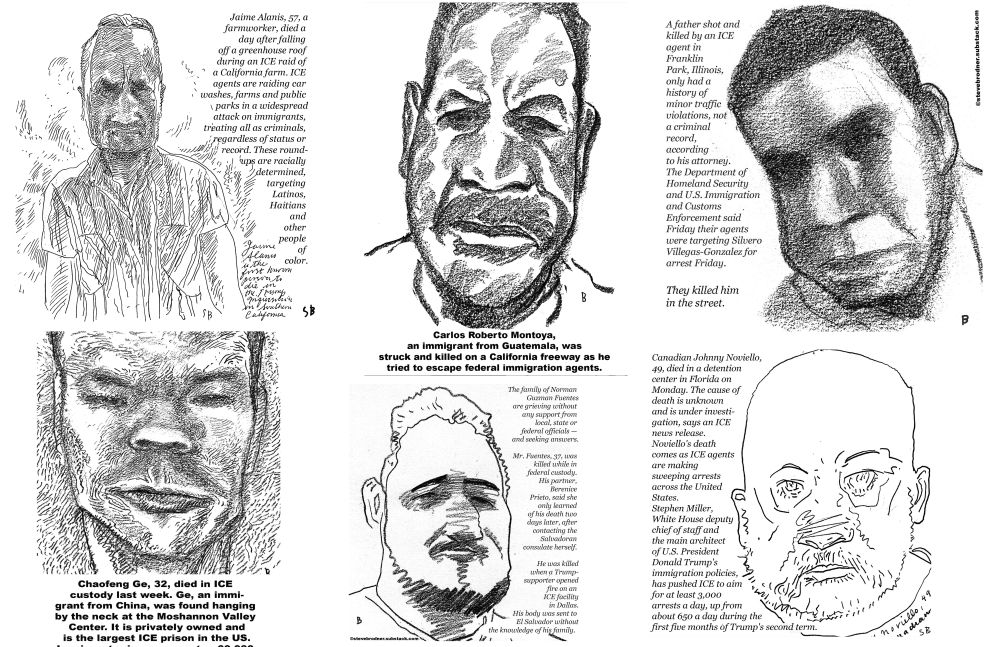
Steve Brodner is one of the most prolific and regularly published graphic storytellers and commentators today. He has long been at the nexus of a tradition of print parody—and to communicate his messages loud and clear, he uses as many platforms as possible. From 1979–1982 he published his own journal, The New York Illustrated News. In 1981 he became a regular contributor to Harper’s magazine with his monthly feature, “Ars Politica.” He’s also contributed to National Lampoon, Sports Illustrated, Playboy, Spy and Esquire (as an unofficial house artist). This all served to convince him that illustration is an important part of the mix of any journalistic enterprise. For the final month of 2025 he devoted a Substack column to those that Homeland Security has abducted. We talked about his struggles to keep the heat on ICE, and the methods to his mastery.
You’ve been drawing political cartoons and journalistic reportage for decades. But this recent batch on Substack has shown a different, decidedly expressive comic sketch style. What inspired the shift?
You can’t rely on fixed solutions for a variety of new problems. In this long career, I have been criticized and, perhaps, admonished for experimentation of different kinds. I look back on a lot of those old pieces and I feel that they are evidence of an artist in one kind of box or another struggling to get out. If we are permitted to match the medium to a message, then some images are going to be calling out for paint or crayon or pencil or marker. Some images are asking for a detailed treatment and others for a simpler finish. The world of illustration has long accommodated artists seeking a variety of solutions—from R. O. Blechman to Gary Panter to Anita Kunz to Yuko Shimizu to Ed Koren. If we viewed each solution used by them and all the artists who have ever lived as doorways to be able to address things differently, why not walk through those doors? I travel with a sketchpad and draw people and I’m always asking myself “is this face a blind contour person, or a disambiguated collection of features, or a collection of dots creating a sense of modeling?” If art can be totally free to be as expressive as possible, why would we give this a second thought?
Also, in the past, I would be needing five days to do an illustration, and now, sometimes, I will do five in one day. I find that this is more satisfying in that I can be more responsive to the news than I ever was. Sometimes, drawing faster and putting ideas together as they occur to me, I can have a comment out on the story when it is only an hour old. I’m not racing on a deadline, just going with the movement of the thing. (However, I’ll be damned if I could tell you what the “thing” is! Right now I am doing a book dedicated to why certain artists cannot be replaced by AI. Maybe I should call it “The Thing”!)
The outlets for political satire are few and becoming fewer. You do a weekly for The Nation. Are there any other current or foreseeable markets? Or has Substack and similar platforms become the main outlet for such expression?
The Nation is a great place to be. I am now in my sixth year of doing the column there, and in that time have had only a handful of edits. It is a very enviable position that I’m in. I am very free in terms of statement and form. It is a very lucky thing to be so very much in sync with a publication. The editors and designers and I have been friends for many years and have arrived at a place of close cooperation and mutual understanding. For however long that lasts, it is precious and something to be cherished. I cannot be more grateful to them.
Substack is a remarkable platform. Among the 10,000 or so subscribers and followers to [my newsletter] The Greater Quiet, there are enough paid subscribers to this daily newspaper to pay the equivalent of two or three decent assignments for publications per month. So it has largely replaced the search for work in other media that would probably not allow this freedom. In the last year, I have lost, thanks to the Trump regime, two big clients: the LA Times and Washington Post, both of which have radically changed their editorial policies to please the MAGAs. I have many colleagues in similar situations where they are tasked with finding new outlets and platforms. Substack has been a great place for writers and artists. Aside from Heather Cox Richardson, Robert Reich, Paul Krugman and Sy Hersh, one can follow Ann Telnaes, Rob Rogers, Jack Ohman and Liza Donnelly, etc. And many of us, I believe, are doing the best work of our lives.
Your series devoted to ICE abductees has been a driver for you. What is your hope for its impact on the public?
These faces are an attempt to slow down the news a bit, allow us to see these people and read the names of human beings who are exactly like us. It’s much easier to look away when the news renders a human story as a statistic and protects you from being affected emotionally. As with everything I do, I feel that this is a defiant act of occupying the space that ordinarily might be filled with something trivial or trivialized. If, out of the thousands who flip through it, there is one person whose heart is reached and was encouraged to pick up a pen or put on some marching shoes and make their voice heard, then my work is a fine drop in the bucket to combine with all the efforts to not let these inhumane policies pass, unrecognized or minimized.
You’ve always been committed to art as a means of dissent and advocacy. How has this changed in tenor or tone over the past decades? Do you believe drawing conceptually can still have influence?
Narrative art, like music and filmmaking, poetry and essays, can be powerful in the mix. We each have a role to play. My images are used in protest marches as well as shared online. You never know what impact you will have, or where. One thing is certain: Not creating anything will have zero impact.
Looking back, I feel now that the work I have done has been a part of a different era in which being a piece of the establishment press (The Washington Post, Esquire, The New Yorker, etc.) would contribute to the “gravity” or “importance” of the medium, so that the content of the work itself could be softer and more suggestive. Of course, this was a part of the ethos of mainstream media, in which commentary was allowed, within limits. But now there are no limits on how (radically) far the government is going, and those of us who are able to throw off those corporate media constraints can now actually meet that moment. As Mr. Lincoln said, “The dogmas of the quiet past are inadequate to the stormy present. The occasion is piled high with difficulty, and we must rise—with the occasion. As our case is new, so we must think anew, and act anew. We must disenthrall ourselves, and then we shall save our country.”
One of the things I’ve admired about your current style is the speed and looseness, while conveying emotional resonance. What is your method? Do you experiment everyday? Or have you found your own comfort zone?
The method, as I teach at SVA, is to sketch a lot. If you do that, anyone can be an illustrator. I sketch to figure out what I don’t want. I have a pen and pencil fetish. I have too many of everything. (But my wife still loves me!) The comfort zone comes when I fail enough to know [where] I want to go with a piece. I always want to be true to the subject. It is always done on paper (mostly Moleskine, but sometimes Strathmore or Arches. I love drawing with a hard pencil on Moleskine. It feels like I’m engraving graphite into the earth—which, maybe I am!) Also using woodless colored pencils, drawing slowly with three pencils and changing pencils after each line. Crazy but fun. I pick up things from my students sometimes, like making a picture entirely of straight lines or dashed lines. Did I mention I love teaching? Being around other artists of any age is very healthy! I have friends who are working artists in their 90s who inspire me as well. My advice is to be a gland!
What has been the response to your barrage of jabs at folly and inhumanity?
First, great support. The people who follow me on Substack are my peeps! They keep me going and also send me ideas that are very good and I draw them! On social media I face the usual mob of MAGAs who can’t stand the truth about their Orange Julius. I block and delete if they are rude, which they almost always are. But before I do I thank them. I tell them that they are the best thing that has ever happened to the left! And that I’m really happy I got under their skin! I say this with love, of course.
Have you put aside your more representational work? Or are you becoming more multilingual in a visual way?
I really don’t know where the work is going. I truly feel like I am floating on waves that are sending my little craft where they will. I would like to be done with Trump and do illustrated books. But, we know that if Trump dropped dead tonight—and of course we hope that doesn’t happen (and that whatever is bloating his poor, old ankles and foul-looking hands goes away soon), the disease of latent and blatant far-right politics and media perversion, etc., will continue to be with us for a very long time. It will be a greater test to see how well we can stay organized once the tide turns. Stay tuned.
The post The Daily Heller: Steve Brodner Doesn’t Know the Meaning of Complacency appeared first on PRINT Magazine.