
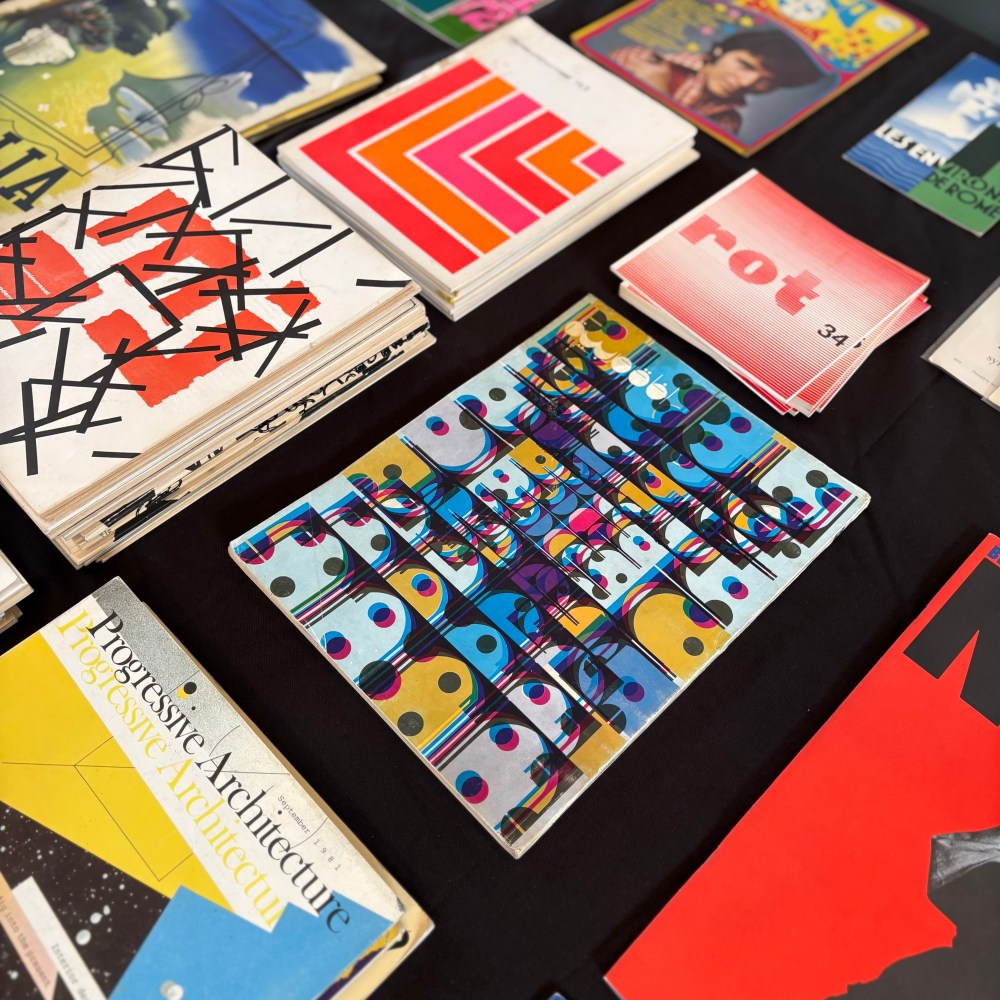
Matt Lamont is a collector with a mission. In addition to assembling a personal archive of designed printed matter for his own satisfaction, he presides over a digital presence of the materials — and now a substantive book is on the horizon. Last time we spoke in 2022, he was in the beginning stages of the quest, and just then showing his discoveries online. Four years later, I am interested in how his holdings have grown and what his plans are for the future.
I’ve witnessed the speedy growth of your collection. Are your aims still the same? Have you become more of an obsessive or scholar or documentarian or a bit of all three?
A huge amount has changed since we last spoke, particularly in the pace of acquisitions. The archive has grown significantly, especially the magazine collection, which now exceeds 5,000 titles documenting graphic design and related fields. I’ve completed a full run of Idea magazine, moved much closer to a complete run of Gebrauchsgraphik (1924–1990) and added substantial runs and individual issues of publications such as Typografia, Design (Council of Industrial Design), Architectural Design and Industrial Design.
My aims haven’t really changed, they’ve just become clearer. At its core, the project is about making the history of graphic design more accessible, while also correcting and expanding what we think we know. A lot of design history online is incomplete, misattributed or overly centred on a narrow canon. The archive allows me to challenge that by uncovering overlooked designers, connecting movements across regions, and building a more inclusive, global picture of design history.
Recent acquisitions have been much more intentional in that respect. I’ve been actively filling gaps, bringing in material from South Africa, Iraq, Japan and beyond, to ensure the archive doesn’t just reflect dominant Western design.
So yes, it’s probably a combination of all three. There’s definitely an obsessive element to the collecting, but it’s increasingly driven by documentary purpose.
How have you grown your collection? Is it systematic? Random? Large net?
It’s become much more strategic over time. The last two years have been heavily focused on magazines, as they offer a uniquely rich and specific view of design history. I’m very targeted, often collecting to complete runs, fill specific historical gaps, or support particular narratives I’m developing.
One major acquisition was a collection linked to Ken Briggs and Ian McLaren, which included over 300 items, around 250 posters produced in the 1960s and ’70s for institutions like the National Theatre, as well as original lettering proposals for the Barbican and presentation negatives. That significantly increased my holdings in British Modernism.
So while it might look expansive from the outside, there’s a kind of growing internal logic to it. Each addition is helping to build a more complete and interconnected picture.
Where do you house your materials?
Most of the archive is housed in my shared studio space in Bradford. It now contains well over 10,000 artefacts, magazines, posters, books and ephemera, etc.
In reality, I’m collecting faster than I can fully process, so the space is a mixture of organized storage and active working environment. There are systems such as boxes, categories, shelving, but also plenty of piles in progress (kind of productive piles).
When people visit, the structure tends to disappear quite quickly. I end up pulling things out constantly to show examples, which is part of the joy of it, but also part of the chaos. It’s a working archive in that sense.
How do you catalog your materials?
Each item begins with a high-resolution scan, typically 600dpi, sometimes 1200dpi depending on the detail required. I then clean, crop and standardize the images in Photoshop, usually placing them on a consistent black background for presentation.
From there, I catalogue key information: designer, title, date, size, format, series, and any contextual notes. Over the past few months, I’ve also been systematically assigning countries, movements and themes to build a more navigable and relational structure across the archive (quite a bit off).
The scale of this is significant; there are now over 8,000 artefacts publicly accessible online, alongside around 1,500 designer records that require biographies, contextual writing and cross-referencing. It’s an ongoing process that I work on daily (getting there).
The site itself has been five years in the making, and while the front-end design is due for an overhaul, the priority has been building a solid, deeply researched backend, ensuring the content is meaningful, not just visual.
Do you continue to make them available to the student and academic public?
Yes.
The entire online archive of artefacts is freely accessible. There’s no paywall for the core collection and anyone can explore it. The membership model supports the research side, such as in-depth articles, essays and curated content that are written directly from the physical archive. That revenue goes straight back into acquiring new material, so it becomes a kind of circular economy of research and collecting.
I’m also launching a series called Design Translated, where I’ll translate pre-1950s design texts from my magazine collection into English, many of which have never been accessible to an English-speaking audience before.
Alongside that, I’ve started a weekly newsletter series called Designer Friday, introducing a different designer each week, some well-known, others largely forgotten, all grounded in material from the archive.
A bit of a juggle amongst the agency and kids!
What do you feel you’re missing? And is there an endpoint to what you’re collecting?
Working on the book with Unit Editions, covering 1900–2000, has really exposed gaps in the archive, but also created a clear framework for filling them. It’s pushed me to seek out material that supports a more complete design history.
One area that still feels underrepresented is poster design, particularly at scale. Posters are more difficult in terms of cost and storage, so the focus in recent years has leaned more toward magazines.
As for an endpoint. I don’t think there is one. The more you uncover, the more you realize how much hasn’t been documented. It’s less about completing something and more about continuously expanding and refining it.
Do you have a model for collection or a specific collector that you are emulating?
Not really. I’ve ended up quite siloed in my own approach. That’s partly because the archive has grown organically from my own interests and questions. It’s not trying to replicate an existing model, it’s responding to gaps I’ve encountered and trying to build something that doesn’t quite exist elsewhere.
What’s on for 2026?
The main focus is the book with Unit Editions. A 400-page publication covering 100 years of graphic design, drawn directly from the archive. You can pledge to receive a copy here.
Beyond that, I’m looking at expanding the online platform, continuing the newsletter and translation projects, and beginning to think more seriously about how the archive can exist physically, whether through exhibitions, a study space or something closer to a public library.
2026 feels like a year where everything starts to consolidate, turning what’s been built over the last decade into something more visible and widely used. Lots to do in terms of writing and building the online archive. I would love the website to be the number one reference for design history online!
The post The Daily Heller: The Birth of a Collection appeared first on PRINT Magazine.