
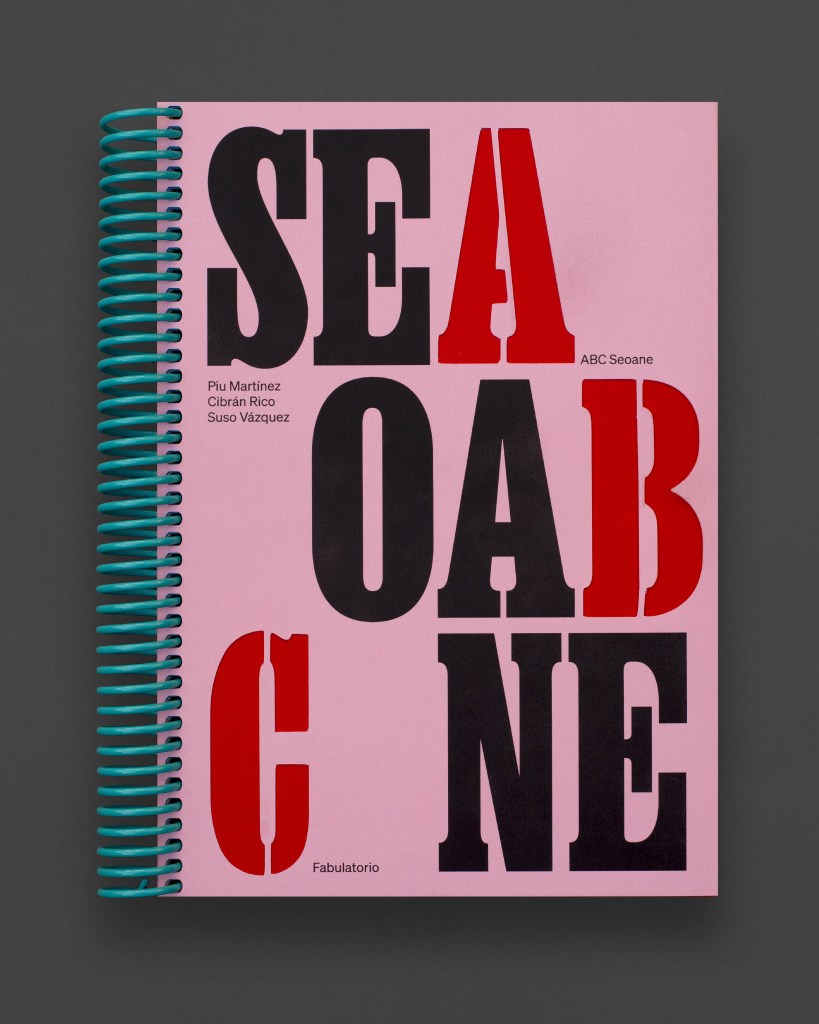
Fabuatorio, founded by Piu Martinez, Cibrán Rico and Suso Vázquez, is publishing a book about the Galician designer Luis Seoane. He was, states Martinez, “a polymath, an art theorist, designer, illustrator, painter, engraver, muralist, publisher, writer and journalist; he was also one of the key figures of the Spanish artistic avant-garde and a leading figure and driving force behind cultural and industrial heritage within the Galician diaspora in Latin America.” I asked Martinez to introduce us to the book, ABC Seoane, and this significant global designer who has yet to gain entry into the U.S. canon.
Can you tell me how you were introduced to Luis Seoane and his work?
Seoane’s influence is deeply embedded in the culture and folk traditions of Galicia. His book cover illustrations, his ceramic pieces for Sargadelos, the typefaces designed at the Laboratorio de Formas … all are part of everyday life in homes, schools and cultural institutions. Alongside Díaz Pardo, he is one of those responsible for giving our region, Galicia, its graphic and visual identity.
But I really got to grips with Seoane’s work during my time at university in Santiago de Compostela. There, I worked as a researcher, classifying and analyzing newspaper articles that mentioned Seoane’s work. I did this for a lecturer in the Library and Information Science department who was writing her doctoral thesis on Luis Seoane in exile.
Cibrán and Suso (Fabulatorio) also studied Seoane’s graphic legacy for the purposes of a thesis. They were also responsible for the catalogue of the TAPAS exhibition, a group show in which various artists created pieces that engaged with the covers designed by Luis Seoane for the publishing house Botella al mar.
Is ABC his design or an interpretation created by Fabulatorio?
ABC Seoane was designed entirely by Fabulatorio. This book, as such, has never existed. Creating an alphabet book seemed to us the most “functional” way to showcase Luis Seoane’s design and illustration work to new generations of Galicians, and also to introduce it to the rest of the world. What little is known about him relates to his work as a painter, and our aim was to highlight the brilliance, versatility and contemporary nature of his work as a designer.
We wanted to bring Seoane into schools, libraries and the homes of children in Galicia and around the world. His book cover illustrations were vibrant and bold, striking enough to spark readers’ curiosity and encourage them to discover him through something as simple as an alphabet book. ABC takes Seoane out of the museum to bring the museum to your home, school or playground. It is a book designed for shared, intergenerational reading. It is a little game through which to learn to enjoy the beauty of letters, the sound of words in a language such as Galician, and above all to enjoy the brightness and originality of the graphic work of an exceptional designer.
Is Luis still alive?
He died at his home in A Coruña (Galicia), where he had planned to return permanently, on April 5, 1979. In 1936, at the start of Franco’s dictatorship following the coup d’état against the Second Republic, Seoane went into exile in Argentina and did not begin to visit Spain regularly until the mid-1960s.
He does so to meet another of the most influential figures in Galician art and culture, Isaac Díaz Pardo (painter, ceramist, designer, publisher, etc.) and to develop, alongside him, one of the most brilliant ideas in 20th-century Galician culture: the creation of the Laboratorio de Formas, a sort of Bauhaus established to promote the cultural development of Galicia, from which emerged a revived Sargadelos Ceramics Factory and the Carlos Maside Museum in 1970. A true institution of contemporary art, it aspired to be a center for information on the aesthetic ideas of Galicia and the dissemination within the region of universal art movements.
His artistic legacy is currently in the care of the Luis Seoane Foundation, which is co-publishing the ABC Seoane.
The post The Daily Heller: The Brightness and Originality of Luis Seoane appeared first on PRINT Magazine.