
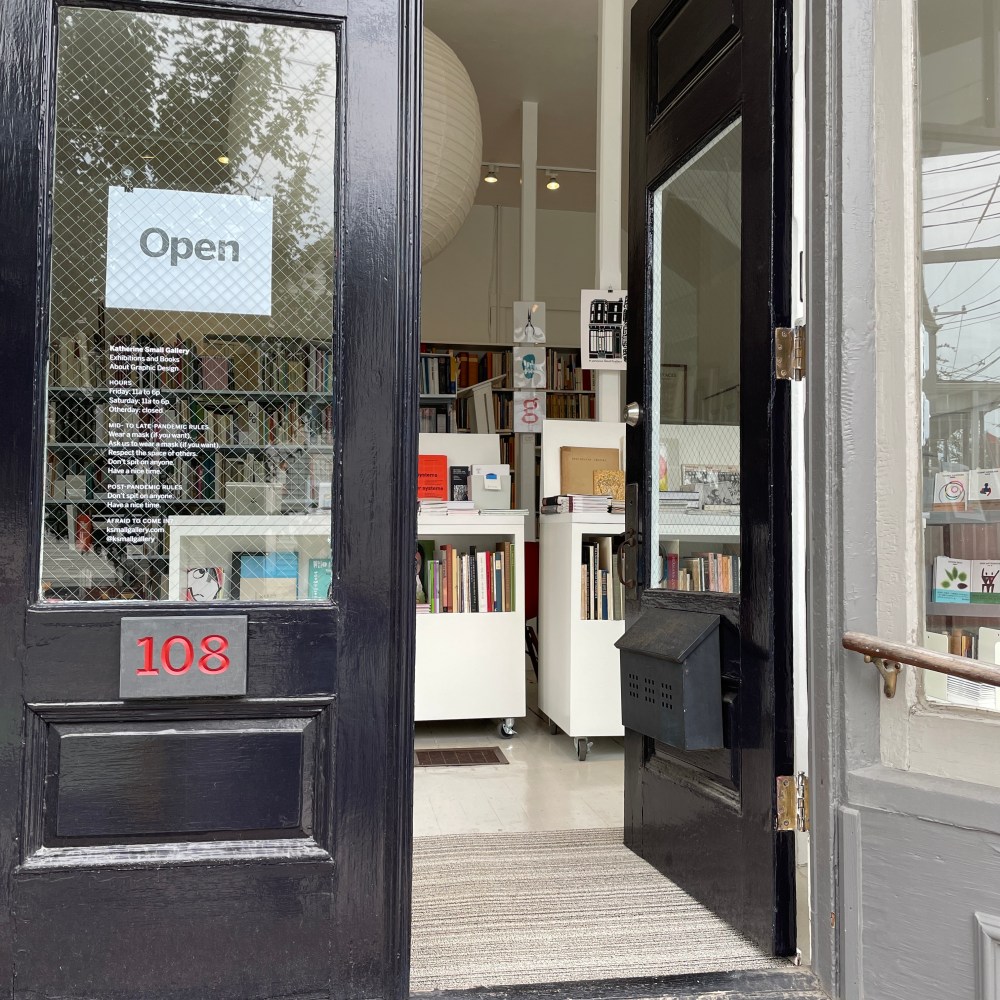
Katherine Small Gallery proprietor Michael Russem—bookmaker, designer and former owner/publisher of Kat Ran Press—has an unforgettable physical presence. An extremely long beard gives him the air of a 19th-century scholar-cum-bookseller. His establishment on Beacon St. in Somerville, Mass., goes well with his look. (Or is it the other way around?) Either way, I am a fan.
Every Sunday, rather than get into a funk reading the New York Times Opinion section, I crack open his weekly email newsletter replete with book signing and guest speaker announcements, exhibitions, and rare/limited-edition books for sale (at reasonable prices). His eye is acute to the best of the best. His brief texts describing the books for sale are preternaturally witty (see below), always enjoyable and often trigger a hearty laugh or chuckle. Russem is a calming presence in the type book biz, and I’m jealous … of his store, his beard, his books and his calm. I live out my dream of owning my own bookstore vicariously through him.
After receiving his most recent email blast, I decided it was important to help tell his story through a short Q&A. Only one thing is amiss … I forgot to ask: Who is Katherine Small?!
You’ve been running Katherine Small Gallery for a few years now. How’s it going?
It’s going OK. I mean, I love what I’m doing, and the shop is the best thing I’ve ever made. So in that sense, it couldn’t be better. But I often feel it’s a wildly reckless and irresponsible pursuit—and I’m wildly fortunate to be able to pursue it. There are demoralizing days and amazing days, and right now it’s all I want to work on.
Are you doing what you planned?
Every once in a while I read the business plan I wrote in 2017 and am embarrassed by how ridiculous it was. I’d imagined I’d offer a few new design books and mount lots of quickly curated, frequently changing exhibitions. Now I’m concentrating more on used and rare books, and the exhibitions require lots of research and writing and stay up for months rather than weeks.
I never wanted to sell books online—people were meant to come to the shop and see things in real life. The pandemic taught me that selling online was necessary. Fortunately—or unfortunately—it’s what keeps the shop open.
Most importantly, I knew I wanted this to be a place for the design community—and a place that regular people would appreciate, too. I think I’ve done that. I hope I have.
Wendingen by Hendrikus Th. Wijdeveld / From the collections of Ed Berlin
Wendingen by Hendrikus Th. Wijdeveld / From the collections of Ed Berlin
Is there a market for what you want to curate?
Leonard Baskin famously said, “People like me, who care about printing, constitute the tiniest lunatic fringe in the nation.” That, alas, is my market.
Piet Zwat from the collections of Ed Berlin
Gerd Arntz, Wendingen from the collections of Ed Berlin
What is the biggest lesson learned from going into “retail”?
This is going to sound dumb, but I was surprised to learn that there are all kinds of designers. Once I was introduced to printing and design, it was kinda all I thought about—and that was true of my mentors. I thought all designers were like that. But for lots of designers, design is just a job. And that’s totally fine. It was just a surprise. So I suppose the lesson in a retail setting is that I can’t make any assumptions about anyone who walks through the door—and that’s probably a good lesson outside of retail, too.
De Gemeenschap, from the collections of Ed Berlin
Is stock easier, harder or what you expected to get?
Getting the books isn’t the hard part. The real trick is finding enough people in the lunatic fringe to buy them.
Are young designers still collecting old design?
I think it might be more important that they look at old design than collect it. To that end, I’m always telling kids (and not-kids) they never need to buy anything—that they can just come and look and read books cover to cover. They don’t have to talk to me.
Metz En Co, from the collections of Ed Berlin
Have you found areas that you hadn’t considered?
How could I not?! There’s so much to see. I’m pretty sure I wasn’t so aware of lettering portfolios when I opened—loose sheets with wild approaches to letters meant as models for sign painters and “commercial artists.” They were essentially letterforms made to be ripped off. Now they’re perfect for type designers.
De Nieuwe Opgang-Serie, from the collections of Ed Berlin
Do you plan on expanding your niche, or staying right where you are?
I really only know about one thing, and am inclined to think I should stick with it. Art, architecture and photography books sometimes sneak in, but more by chance than by intention. I do sell jam, though. Design books and sticky fingers just make good sense.
What are you favorite items?
The things that I didn’t know existed—and the things nobody knew existed. I don’t want people to come in and see what they could see at another store. It’s a lot of work to leave the house. There have to be surprises. So: weird Dutch lettering portfolios. A sweet collection of bookplates. Record covers by a designer not known for record covers. People might leave with the greatest hits, but they should be able to see the B-sides.
You had a lovely Jan Tschichold exhibit, which makes me wonder what you will part with and what is not for sale?
In the back of the shop is my own library. There are some things back there that are magical but not really relevant to my work as a designer. I’d been saving them to share with students and designers. It recently occurred to me, however, that I’m supposed to be selling books, not just sharing them. So I’m starting to pull from the back some books I’ve had for ages. I’d rather they spark joy for others than just sit ignored by me.
The two things I won’t sell right now are Jan Tschichold’s engraved New Year’s card, made when he was just 17, and his letterhead from age 23. Someone recently offered me a nutty amount of money for the latter, but I like having it around. The letterhead, I mean—not the money.
But come, and I’ll show you all sorts of stuff even you have never seen. No purchase necessary.
Extracts From an Investigation into the Physical Properties of Books
A Society of Calligraphers Publication
“Here we have a pristine copy of one graphic design’s most revered critiques. In 1919, W.A. Dwiggins prepared this report on the state of books and their design and production. Things were not looking good. But this thing is. It belonged to Paul J. Sachs of Goldman and Harvard. It has been sewn into nondescript boards and has his bookplate on the pastedown. If you find the boards unsightly in spite of the fact that they’ve kept this safe for a zillion years, you can easily cut the book out without disturbing its integrity. An excellent copy of an uncommon item.”
The post The Daily Heller: The Design of Selling Design Books appeared first on PRINT Magazine.