
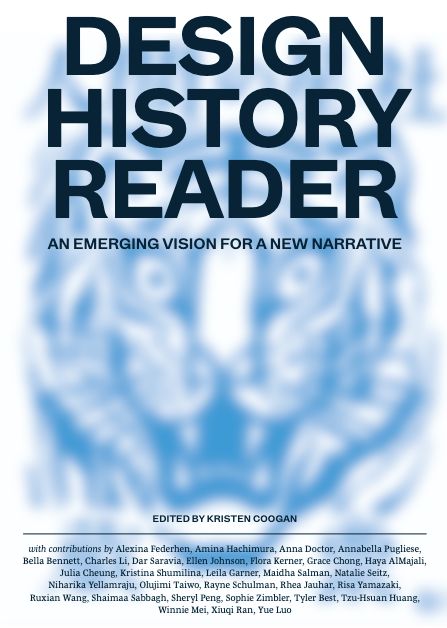
Design history is at the proverbial crossroads (and crowded intersections). As the editor of an important new collection of adaptive scholarship—Design History Reader: An Emerging Vision for a New Narrative—Kristen Coogan is helping to identify new on- and off-ramps and guide the traffic (her readers) on these largely untraveled roads. Her thought-provoking answers to my recent barrage of questions clearly explain her expressed goal of building a broadly diverse narrative—so rather than offer a conventional introduction, we will dive into Coogan’s editorial mission and process, which say it best.
You write in your introduction, “The central focus of this book is to promote a pluralistic approach to teaching and narrating graphic design history. Until now, traditional historical models have been monolithic and chronological.” How do you reconcile diversity in design history versus opportunity?
For me, reconciling diversity in design history with opportunity starts with acknowledging that the stories we teach are shaped by the systems that define and authorize them. Diversity isn’t just about adding more examples—it’s about rethinking how we decide what counts as design history. And the goal isn’t to swap one dominant narrative for another.
The Design History Reader argues for a pluralistic approach, not a new canon. Traditional models have been linear and Western-focused, offering opportunity to some histories while excluding others. Expanding opportunity means widening the framework itself.
In March 2020, that tension hit home. My Boston University students were suddenly sent back to Lima, Shanghai, Chennai … and beyond. There, they re-encountered their local visual cultures—Chicha posters, Chinese Big Character posters, Tamil graffiti—examples that didn’t appear in the Western narratives I was teaching. Experiencing this firsthand made it impossible to ignore how narrow design history had been, and how urgently we needed a more flexible, inclusive approach.
That moment really changed how I teach. I reworked my lectures and shifted the classroom dynamic so students could help build the knowledge with me, in the spirit of bell hooks and Paulo Freire. Over five years, through collaborative research and open conversation, our studio became a kind of design ethnography. Students brought perspectives shaped by their own cultures, languages and visual histories—and the history we studied grew naturally from there.
Since it was introduced in the 1960s, the study of design history has been something of a monolith. Is disrupting that a key part of your intention?
I’ve always grappled with the idea of the monolith. The goal wasn’t to replace the Western canon with another fixed story, but to build an ecosystem of histories that can grow and adapt. Plurality resists closure—it keeps the door open to more voices and more ways of seeing.
That’s what the Design History Reader models. It challenges singular narratives, puts cultural specificity at the center, and shows how plurality can reshape what counts as design history. Its thematic chapters offer a new grammar for understanding design—one built on breadth, not hierarchy.
In this sense, diversity and opportunity aren’t in conflict. When we commit to plurality, they reinforce each other: diversity expands what we see, and opportunity expands who gets to define design history.
If we look at the key triggers for graphic design production, arguably it is central to industrial nations. Within that niche, can you allow for global under-representation in the writing of history? How does your Design History Reader propose alternative narratives?
It’s true that a lot of graphic design’s historical “origin points” come from industrial nations and capitalist systems, but that doesn’t mean the rest of the world has to be left out. The Design History Reader pushes back on that idea by offering alternative narratives built on a broader set of values—values that expand what we think of as historically significant.
The stories in the Reader spotlight qualities that traditional accounts often overlook—immediacy, craft, subversion, resistance, theatricality, even camp. For me, it’s more than a history book: It doesn’t just add new material to the archive, it rethinks how we define the canon in the first place. It shows that design history becomes richer, more inclusive and more meaningful when we open up our sense of what—and who—counts.
I am fascinated by the ways you circumvent Eurocentric dominance, but is that ultimately the best narrative route? Do minority cultures conform to the established definitions of design or do they transform the definition?
This ties back to the ‘grammar’ I mentioned earlier. Minority cultures don’t simply conform to Eurocentric definitions—they transform them, operating through entirely different frameworks of meaning, production and value. They aren’t responding to Western definitions—and they shouldn’t have to—because their logics of function, symbolism and community are distinct. Minority cultures expand and reshape what design can be, how we define value, and what professionalism means, and this book makes the case for a history that can hold all those different stories at once.
Historians have had a (bad) habit of classifying “non-Western” or “non-capitalist” design languages as “indigenous,” colloquial, alternative, and other modifiers. Should vernacular (or, if you like, untutored) design be looked at as a building block of visual language, as a style or manner ripe for borrowing or usurping, or is it all part of one large melting pot?
For me, the question isn’t whether vernacular or “untutored” design counts as raw material, style, or part of a melting pot. Again, the bigger issue is how we’ve historically defined what counts as “good” or “professional” design. When I look at the work of the Gee’s Bend Quilters, Ndebele house painters, or Buddy Esquire, it’s clear that the craft, discipline and cultural intelligence in these practices is extraordinary, sometimes surpassing formally trained or institutionally sanctioned design.
Western design history has long treated this work as peripheral because it doesn’t fit Eurocentric ideals of universality, clarity or Modernist order. It was never “less professional”—it just operated by a different logic.
When we evaluate vernacular design on its own terms—voice, authenticity, locality, pride, resistance, community—it opens up what design can be. These works aren’t lesser or just waiting to be borrowed. They’re essential, showing alternative ways of making, meaning and belonging that push back against dominant narratives and enrich the field in ways we can’t afford to ignore.
When I started researching and writing about graphic design (and illustration) history, it was a thrill to discover something that was passe or forgotten, and then see how it related and was reintroduced to contemporary life. What do you think the value of your history is for current designers? Is it about uncovering little-known facts or mining artifacts that form a continuum?
The value of history for contemporary designers starts with exactly what you described—the thrill of discovering hidden treasures, forgotten stories and overlooked practices. The Design History Reader adds another layer: Many of these stories are told not from the outside but through voices rooted within the cultural groups that produced the work. That perspective changes how we interpret the work and deepens the connections we can make with it.
We also talk a lot about Lorraine Wild’s Great Wheel of Style in our studio, which gives us a useful model: styles cycle, ideas resurface, and visual strategies once considered passé gain new relevance. Knowing history provides inspiration, context and a vocabulary for anticipating where design might go next. For designers who feel “everything has been done,” history offers reassurance: It has been done, but never in exactly the same way. Digging into these histories fuels originality and inspires fresh thinking.
The value is twofold: discovering little-known works and seeing how they connect. That continuum becomes richer, more complex and more inspiring when it embraces the full breadth of global design histories—not just the familiar Eurocentric arc.
Do you expect your readers to embrace this as a textbook of a new methodology or as a sampler of what is possible to further explore?
I hope the Design History Reader works as both a methodology and a sampler. At its heart, it’s saying this: History isn’t just what gets recorded—it’s who’s doing the recording. When only a few voices hold that authority, the field shrinks. The Reader pushes back.
It offers a way to study, uncover and engage with design history that is fluid, dialogic and culturally specific, rather than fixed by a single universal narrative. The examples it presents aren’t meant to establish a new canon, but to spark curiosity, spotlight overlooked practices and inspire others to keep redefining the field.
Ultimately, the Reader is a starting point: a model for inclusive, critically engaged design history and an invitation to imagine, explore and expand the narrative long after the book is closed.
There is a predominance of Asian design themes in the book.
The strong presence of Asian design themes in the Design History Reader reflects several overlapping realities. Many Asian students in Boston University’s graphic design program—and across Western higher education over the past two decades—bring with them rich artistic and design traditions, each with its own canon, values and histories of innovation. Their perspectives naturally shape the scope of the research behind the Reader.
At the same time, countries like Japan, China and South Korea are not only culturally rich but also globally influential design centers. Their visual cultures circulate widely and interact dynamically with Western traditions, and contemporary design discourse increasingly reflects this two-way exchange.
The Asian design examples in the Reader generally fall into two groups. The first includes students who grew up in Asian countries and encounter Western appropriations or reinterpretations of their visual culture—often with surprise or even disorientation. They notice nuances, inaccuracies and gaps that outsiders might miss. Their “insider” perspective gives their analyses a clarity and depth that is hard to replicate, making their contributions invaluable. Essays like Beyond the Brush: Exploring the Evolution of Korean Typography and Japonisme and Cultural Appropriation highlight this reality.
The second group includes Asian American students who approach research as a form of cultural recovery—an opportunity to reconnect with their own aesthetic heritage. Their work often blends historical inquiry with personal identity, as in essays like Gidra: The Rise of Asian American Student Activism or Taiwan: A Hybridization of Style. These contributions show how design history can also be a space for belonging and self-definition.
While demographic shifts play a role, the prominence of Asian themes isn’t just about enrollment patterns. It reflects the richness, innovation and global influence of Asian design cultures—and highlights how essential their inclusion is for any contemporary design history.
There is also a breaking down of the distinction between art and design. Is this still a contentious topic? Or have design historians reconciled themselves to the truth and fallacy of this barrier?
The line between art and design has always been blurry. So much contemporary and historical art relies on graphic communication—using text, image and hierarchy to convey a message—while design increasingly embraces expressive, conceptual or performative qualities traditionally associated with art. Some work resists easy categorization: It may be self-initiated, ephemeral or “unreproducible” in the conventional sense, yet still operates as visual communication with clear intent and audience.
For me, the question isn’t whether something is “art” or “design,” but how it works, who it speaks to, and the strategies it uses. Embracing this messiness gives us a fuller, more honest view of visual culture.
Yours is one of many books to come out within the past year that addresses new paradigms of teaching design history and/or decolonizing it. Why do you think this is happening now? And do you foresee canon-redefinitions in scholarship of the near future?
Several factors made this moment ripe for rethinking design history, and the pandemic played a central role. COVID lockdowns forced both isolation and hyper-connection, creating unprecedented space to observe, reflect on, and critique the systems around us—including education and how history, and by extension design history, is taught. It quickly became impossible to ignore the gap between the established canon and the perspectives and experiences of students in the classroom.
The Design History Reader was never meant as critique alone—that doesn’t help anyone. Instead, it offers a concrete alternative: a methodology for teaching, researching and engaging with design history in an inclusive, pluralistic way. Born from a moment of global disruption, it’s both a product of its time and a model for how design history can evolve.
Who do you want as an ideal audience for the Reader?
The Design History Reader is for everyone—educators, students, design enthusiasts, and anyone curious about the stories behind what we see. I hope readers from all backgrounds can see themselves reflected in its pages. One of the goals of this project was connection: Students light up when they encounter material that resonates with their experiences or identities. My hope is that the Reader sparks that same excitement, inviting everyone not just to learn design history, but to feel part of it.
The post The Daily Heller: The Growth of New Design History Ecosystems appeared first on PRINT Magazine.