
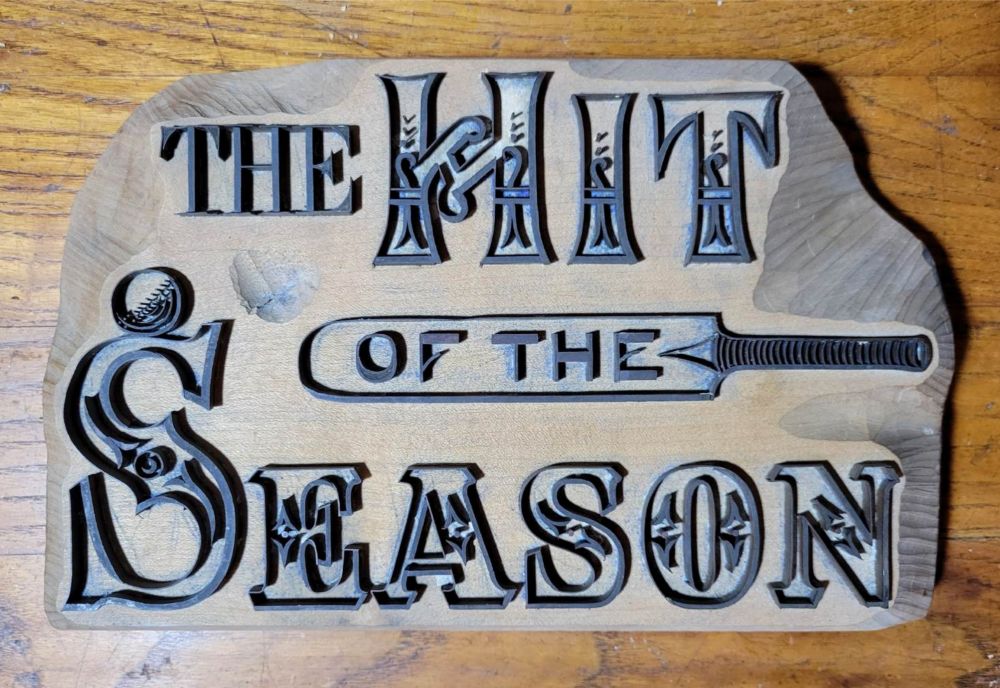
It’s almost Christmas. But for Adrian Wilson, whose vintage textile label collection is among the most comprehensive in the world, Christmas came early. After selling his collection, I thought he would move on to another passion. But while spending time in Manchester, UK, this past fall, he was made an offer he couldn’t (and wouldn’t) refuse: to buy out a large collection of original handmade metal relief “stamps” designed for textile imports and exports. For me, the vicarious thrill of hearing Wilson talking about his newfound treasure and absorbing the history of this early branding strategy was an early Christmas present. So my gift to you, dear reader, is today’s interview with Wilson and tomorrow’s selection of more such beauties of anonymous trademark artistry from the 1870s–1930s.
Photos courtesy Adrian Wilson
Give me some more background on this collection.
To attract buyers to buy their fabric in markets, merchants would stamp trademark images and descriptions of the type and length of fabric on the front of each folded piece. It was a huge marketing exercise, with images, phrases and graphics tailored to each specific market based on ideas from the textile importer or the exporter’s agent in each location. The biggest of the 800 or so merchants in Manchester could have up to 10,000 different ethno-specific trademarks, which were fiercely protected as brands. Because of the industrial revolution, factories around Manchester could make cotton fabrics cheaper than anywhere in the world, so it was the Amazon Prime of the 19th century, exporting everything from a delicate handkerchief to a ship’s sail across the world. Over 80% of all fabric in the world came from Manchester in the 1880s, and in 1913, the city exported 4 billion yards of cloth in one year. All of which had to be folded into 250 million pieces, hand-stamped, compressed into bales for shipping.
Original condition of a stamp.
The stamp after cleaning.
Were they also used for imported textiles and fabrics?
Textiles and fabrics were only exported from Manchester at this time, apart from the small trade in unsold fabric from foreign mills.
What is the approximate date of their use?
The first-ever civil court case in England (Southern vs. How) was over a textile stamp: “In 1618, an action upon the case was brought in the Common Pleas by a clothier, that whereas he had gained great reputation for his making of his cloth, by reason whereof he had great utterance to his great benefit and profit, and that he used to set his mark to his cloth, whereby it should be known to be his cloth: and another clothier perceiving it, used the same mark to his ill-made cloth on purpose to deceive him, and it was resolved that the action did well lie.” Most of my stamps date from the 1870s to the 1930s.
After cleaning the stamp, Wilson make printed copies.
Who or what was responsible for their design and manufacture?
The designs came from importers, or from the merchant’s agents who traveled to promote the cloth. Customers may be illiterate, so a large, recognizable image was always used at the top of the piece. An image of a giraffe would mean nothing to someone in South America, and a Llama would mean nothing to someone in Africa, but with so much competition between merchants, the specificity of images used was mindboggling in an age before the telephone, nevermind the internet. There are images of obscure tribal festivals, local fables and many, many deities of all sorts. Of course, there were also images of British Royalty because the monarch of the richest nation was the ultimate celebrity influencer back then. The merchant would go to great lengths to make sure none of the images deterred customers by offending them. Things like steamships, telephones, steam trains or early cars were depicted, to imply the fabric (and its chemical dyes or complex machine printing) was comparable with the advanced technology of the time. The period after 1850, when royal monopolies such as the Royal Africa Company, East India Company and the Levant had all expired, led to a huge immigrant influx to Manchester of foreign merchants who sought to make their fortune in the textile trade. The export business was eroded as other countries built their own factories, notably Japan, which took the trade with China and then India, who bought unwanted textile machinery after the 1929 crash decimated the dwindling trade. Two world wars led to the deaths of many mill workers, and the continual bombing of factories in the Blitz hastened the end.
Stamps were all handmade, with some of the most complex taking a month to complete. A stampmaker learned over his five-year apprenticeship how to cut sheets of different thickness of copper into strips, sharpen one edge and then carefully bend, crimp and hammer each piece into a block of wood.
I had a studio in one of the old Manchester textile warehouses in the 1980s when the trade had all but died out but was given a bag of stamps and had no clue what they were. I spent as much time as I could rescuing as many as I could before they were dumped or burned, and have a couple of thousand, but that really is just a tiny fraction of what there was.
Selections from The Adrian Wilson Textile Stamp Collection.
What will you do with them?
The first thing was to increase the awareness of this hugely important but forgotten history of branding/advertising/art. I was a special guest with them on the Antiques Roadshow when it visited Manchester, provided the Museum of Science & Industry in Manchester with a complete Victorian textile merchant’s office, which was on display for 20 years, gave a talk on the unique typography of the stamps at the Type Director’s Club and TypeCon in 2008, opened an award-winning free store with them for a year in New York, and people come to my studio to print with them at least once a month. I was delighted that this year, the National Library of Singapore understood the historic and cultural value of the collection and acquired my large printed archive, so they will now be safely preserved and researched. I kept the stamps, as I feel they are alive when being used, and as you love typography, I made a selection from my sample books that your readers may enjoy. I am always free to give talks, exhibitions, printing sessions, and I have a website with lots more background. After getting requests to do prints at events, I am considering the idea of creating a mobile stamp truck, which could be a unique and fun way to let people experience the joy of printing with these 100+ year-old works of art.
The post The Daily Heller: When Stamping Was Brand Strategy, Part 1 appeared first on PRINT Magazine.