
Brion Gysin and Ian Sommerville’s dreamachine
Dreams don’t start when we fall asleep. They’re already forming, just below the level of attention, as patterns rather than images. More like rhythms than narratives. Under certain conditions, they become visible. They don’t need to be invented, only activated. Light can do that. Not constant light, but flicker. The kind you don’t focus on directly. It passes through closed eyelids and shifts perception from seeing outward to noticing what’s already happening inside, revealing that the capacity to produce images is already there.
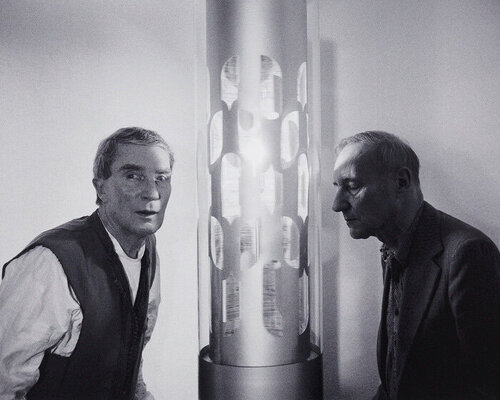
In the early 1960s, the painter and writer Brion Gysin and the mathematician Ian Sommerville begin working with this idea without really framing it as representation. At the time, both are moving within the same loose network as William S. Burroughs, between Paris and London, where language, authorship, and perception are already being dismantled through experiments like the cut-up. They are not trying to produce images, but to set up the conditions for them to happen. The Dreamachine comes out of this, often described as the first artwork meant to be experienced with the eyes closed. A simple setup, a cylinder with cut-outs rotating on a phonographic turntable and around a light source, breaking it into pulses. Sit in front of it, close your eyes, and something shifts. The light doesn’t disappear, but is reorganized in a way that it becomes rhythm first, then something closer to a signal, and then patterns start to take shape. The machine does not create images, it exposes the fact that we already do.
Around eight to thirteen pulses per second, the frequency lines up with the brain’s alpha state, that in-between zone where you’re not fully focused but not drifting either. The body stays still, but perception starts to move. What comes up isn’t memory, and not exactly hallucination. More like geometry that keeps forming and dissolving at the same time. Grids, spirals, waves, repeating structures that feel familiar without pointing to anything specific.
Brion Gysin, William S. Burroughs, & the Dreamachine by Charles Gatewood, London, 1972 | image via Von Bartha
CUTTING LIGHT, TIMING THE BRAIN
A few years earlier, neuroscientist W. Grey Walter had already demonstrated that rhythmic light stimulation can synchronize brain activity, a phenomenon later described as photic driving. Electrical patterns in the brain begin to align with external pulses, not only in the visual cortex but across wider neural networks. The Dreamachine operates directly within this space.
There is a parallel here with the cut-up technique developed by Gysin and Burroughs. Text is fragmented, rearranged, and reassembled into sequences that interrupt linear meaning. The Dreamachine applies a similar logic to perception itself. Light is cut into intervals, continuity is broken, and in that gap a different order appears. Something that feels less constructed than discovered.
Flicker, in this sense, is not new. Firelight already carried this property. Repetitive, unstable, never identical. People sitting around a flame, entering states that move between attention and drift. Ritual, trance, pre-cinematic perception. Devices like the zoetrope formalize this interruption into motion, while early film relies on the same alternation between light and darkness to construct continuity.
Brion Gysin (1916, Royaume-Uni – 1986, France) Dreamachine | © Ville de Paris | image credit : Centre Pompidou, MNAM-CCI/Georges Meguerditchian/Dist. GrandPalaisRmn | Réf. image : 4N05062 | Diffusion image : GrandPalaisRmnPhoto
image-making shifts in the body
Brion Gysin and Ian Sommerville’s invention feels almost like a return disguised as a device based on a pre-digital technology that behaves like a prototype for something much later. By the mid-20th century, flicker reappears in experimental film. Artists like Tony Conrad and Paul Sharits strip cinema down to pulses of light and color, pushing perception to its limits. The screen stops functioning as a window and becomes an active field. In the case of the Dreamachine, the flicker dissolves the illusion of the external world instead of building it, pushing attention inward.
The body is not receiving images but actively generating them. The retina, the optic nerve, the cortex all participate in a feedback loop where stimulus and perception blur into each other. Close your eyes, and the image relocates. The Dreamachine simply amplifies this condition, making visible what is usually too subtle to notice. It suggests that vision is never passive but always an active construction, continuously assembled from fragments, rhythms, gaps.
William Burroughs & Brion Gysin, The Dreamachine Installation view von Bartha, Basel, 2019 | image via Von Bartha
signals in, perception out: from showing to generating
This logic extends to immersive installations, light-based chambers and sound fields that aim to surround rather than represent. The emphasis shifts from showing an image to setting conditions for one to appear. In parallel, artificial intelligence generates visuals not from direct observation but from patterns in data, assembling images through relationships between fragments. Signals in, images out. Structurally, this is not entirely different from how the brain responds to flicker. In both cases, there is no fixed image waiting to be revealed, only a process that produces one when activated. At the same time, the mechanism here remains simple. A rotating form, a light source, a specific frequency. No interface, no stored content. What it suggests is less about the object itself and more about a way of thinking that images may not belong to surfaces, but to conditions and that perception can be shaped by timing and rhythm as much as by content, acting as an early model for how images continue to emerge today.
Brion Gysin (1916, Royaume-Uni – 1986, France) Dreamachine | © Ville de Paris | image credit : Centre Pompidou, MNAM-CCI/Georges Meguerditchian/Dist. GrandPalaisRmn | Réf. image : 4N05060 | Diffusion image : GrandPalaisRmnPhoto
Brion Gysin & William S. Burroughs, Dreamachine-gazing, 1979 | © VG Bild-Kunst, Bonn ; photo © ZKM | Center for Art and Media Karlsruhe, photo: ONUK
William Burroughs & Brion Gysin, The Dreamachine Installation view von Bartha, Basel, 2019 | image via Von Bartha
William Burroughs & Brion Gysin, The Dreamachine Installation view von Bartha, Basel, 2019 | image via Von Bartha
Brion Gysin (1916, Royaume-Uni – 1986, France) Dreamachine | © Ville de Paris | image credit : Centre Pompidou, MNAM-CCI/Georges Meguerditchian/Dist. GrandPalaisRmn | Réf. image : 4N05061 | Diffusion image : GrandPalaisRmnPhoto
Untitled, 1961 Untitled (Dreammachine Interior), 1979 Untitled, 1962 Vue de l’exposition Brion Gysin : Dream Machine, 16 octobre – 28 novembre 2010, Institut d’art contemporain, Villeurbanne/Rhône-Alpes. © Blaise Adilon
This article is part of designboom’s Dreams in Motion chapter, exploring what happens when we treat our dreams and reveries as an active, radical rehearsal for impending material realities. Explore more related stories here.
The post the dreamachine discovered the most powerful image-making device was already inside us appeared first on designboom | architecture & design magazine.