
‘Design 1900 – Now’ at the V&A
The V&A in London has opened its newly revamped Design 1900 – Now galleries, expanding its view of contemporary design to include pop cultural artifacts, like the first ever youtube video upload, that have shaped the past three decades.
Installed within the museum’s existing architecture, the refreshed galleries trace design from the late 20th century into the present, presenting over 250 works across fashion, product design, graphics, and technology. The framing is broad, with industrial design displayed alongside social media, collectible toys, and politically-charged garments.
Boombox radio and cassette deck; ‘Rising 20/20’; manufactured in Japan; ca.1984 | image © Victoria and Albert Museum, London
a youtube video becomes a museum artifact
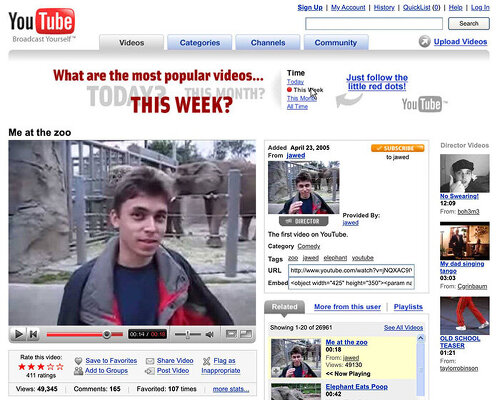
Among the new works in the galleries is a reconstruction of YouTube’s original watch page showing Me at the zoo, the first video ever uploaded to the platform. The museum acquired both the 19-second clip, posted by one of YouTube’s co-founders in 2005, and the underlying early web page that hosted it. The reconstruction includes the interface elements and front-end code that shaped how users encountered online video at the start of web 2.0.
Seen today as a physical display within the Design 1900 – Now galleries, the watch page becomes a designed object in its own right. The layout is simple, with a small video player suspended above grey navigation bars, rudimentary icons, and text links that once directed early users to related content. The clarity of this interface and its constraints speak to a moment when streaming was new and networked media were still defining familiar patterns of interaction.
YouTube watch page, 8 December 2006 (reconstructed 2026). Museum nos. CD.13:2-2026, CD.14-2026, CD.15:2, 4, 5 and 9-2026 | image © Victoria and Albert Museum, London
contemporary design shaped by pop-culture
Beyond the significance of the first YouTube upload, the Design 1900 – Now display brings together objects that chart how design has intersected with everyday life and cultural shifts. In one corner a first-generation Apple iPhone sits alongside a pair of plush Labubu Dolls.
A pair of sneakers made from recycled ocean plastic gestures toward sustainability’s material challenges, while the familiar Tactile Paving Slab designed in 1965 by Seiichi Miyake emphasizes how design can alter how we navigate public space. A radical 1991-made chest of drawers by Tejo Remy of the Dutch collective Droog Design reminds visitors that playfulness and conceptual thinking have endured as impulses within design culture across generations.
These works speak through contemporary usage and virality. Together they portray a sweep of design that is everyday and global, ranging from objects that have reshaped personal habits to those that address subcultures and pop-cultural phenomena.
Tactile Paving Slab, Tile, ca. 1965 (designed), 2016 (manufactured) | image © Victoria & Albert Museum, London
Expanding the Definition of Design
The museum’s curatorial approach widens the field beyond traditional categories. Design here includes interface layouts, viral videos, fashion silhouettes, and everyday consumer goods. The emphasis rests on how these works influence behavior, communication, and self-presentation.
Design 1900 – Now therefore reads as an institutional statement about the present. By placing early YouTube alongside fashion, product design, and pop-cultural artifacts, the V&A frames the past three decades as a period in which platforms became as influential as physical objects. The galleries trace a shift toward systems that structure how images circulate and how identities are expressed.
Electronic cigarette, BM600 disposable vape by Lost Mary. Manufactured by Shenzhen iMiracle Technology, 2024 | image © Victoria & Albert Museum, London
You Can’t Lay Down Your Memory, Chest of Drawers, 1991 (designed), after 1993 (manufactured) | image © Victoria & Albert Museum, London
Doll, The Monsters ‘Labubu’ vinyl plush pendant, Exciting Macaron series, created by Kasing Lung, manufactured by Pop Mart, 2025 | image © Victoria & Albert Museum, London
‘Selfish’ by Kim Kardashian, 2015, First Edition book, published by Rizzoli | image © Victoria & Albert Museum, London
Leg splint, designed by Charles and Ray Eames, manufactured by Evans Products Company, moulded plywood, 1941-1942 (designed) | image © Victoria & Albert Museum, London
project info:
name: Design 1900 – Now
museum: Victoria & Albert Museum
location: London, UK
The post the first-ever youtube video and an 80s boombox become vintage artifacts at V&A museum appeared first on designboom | architecture & design magazine.